
15 unreal rock formations in Lanzarote, Spain
This post may contain affiliate links. If you use these links to make a purchase or booking, I may earn a small commission at no extra cost to you! Thank you for your support!
Did you know that between 1730 and 1736, volcanic eruptions buried nearly a quarter of Lanzarote under lava? That six-year fury is exactly why many rock formations in Lanzarote look like they belong on another planet.
From narrow lava cracks you can walk into to a giant volcanic bomb vomited out by a volcano, black-lava coastlines, and craters you can hike, Lanzarote’s volcanic rock comes in just about every strange shape you can imagine! Trust me on this!
The catch? A lot of these spots have no signs, no trails, and barely any crowds – you kind of have to know they’re there. We spent four weeks driving to every corner of Lanzarote hunting them down.
In this guide, I’ll share my favorite volcanic rock formations across Lanzarote, starting with the ones that wowed us most. Let’s get into it!
1. Las Grietas volcanic cracks
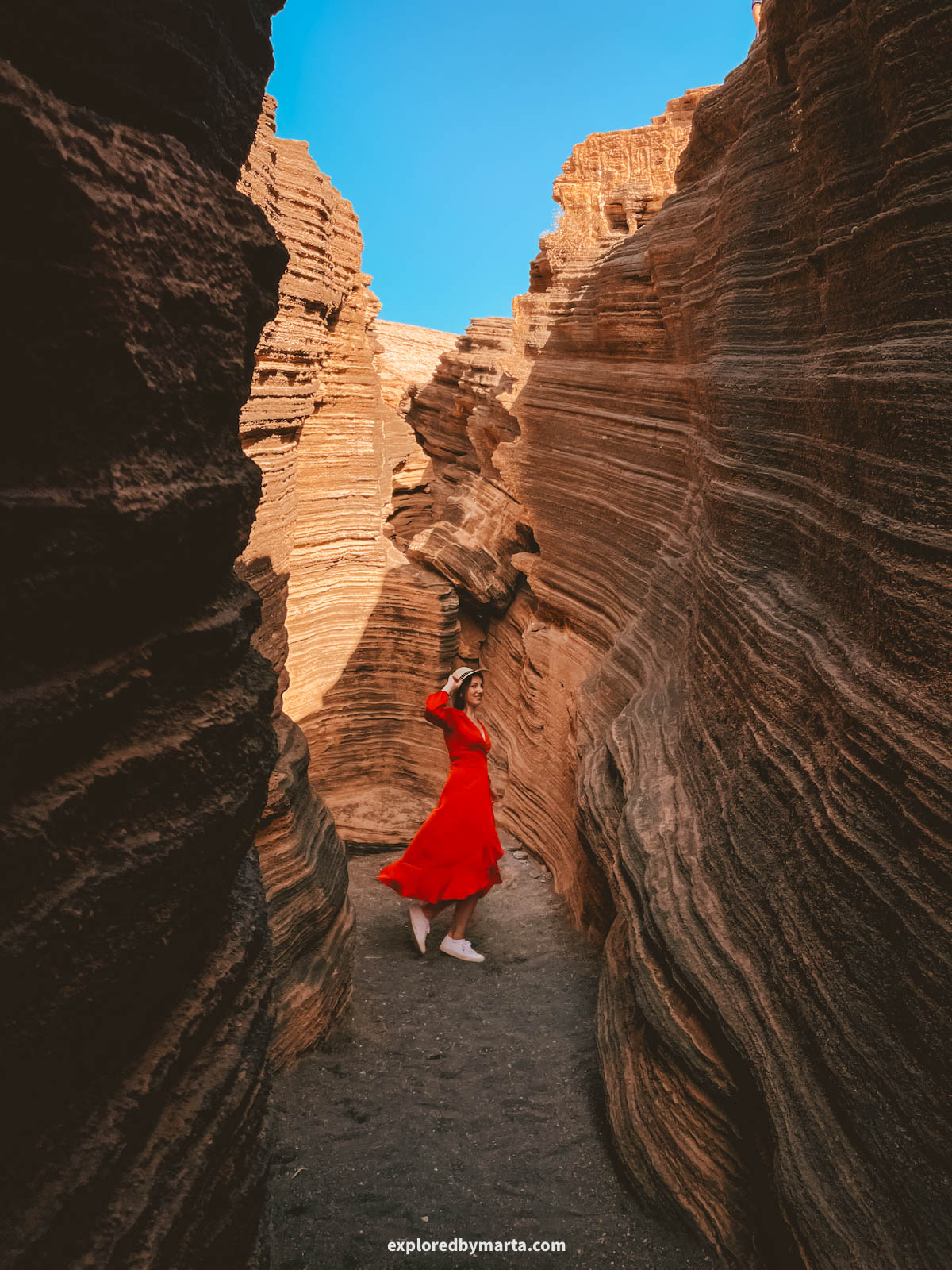
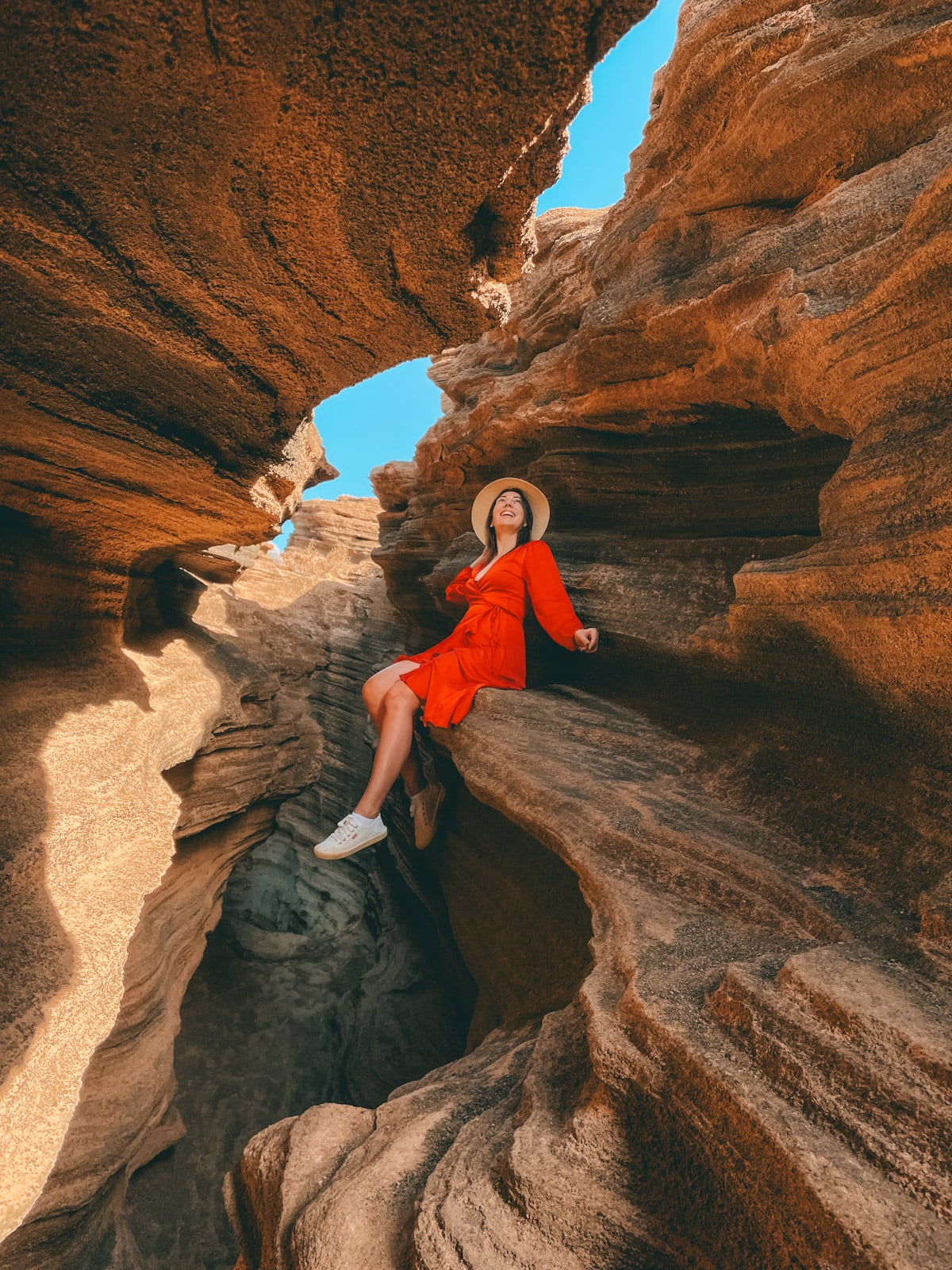
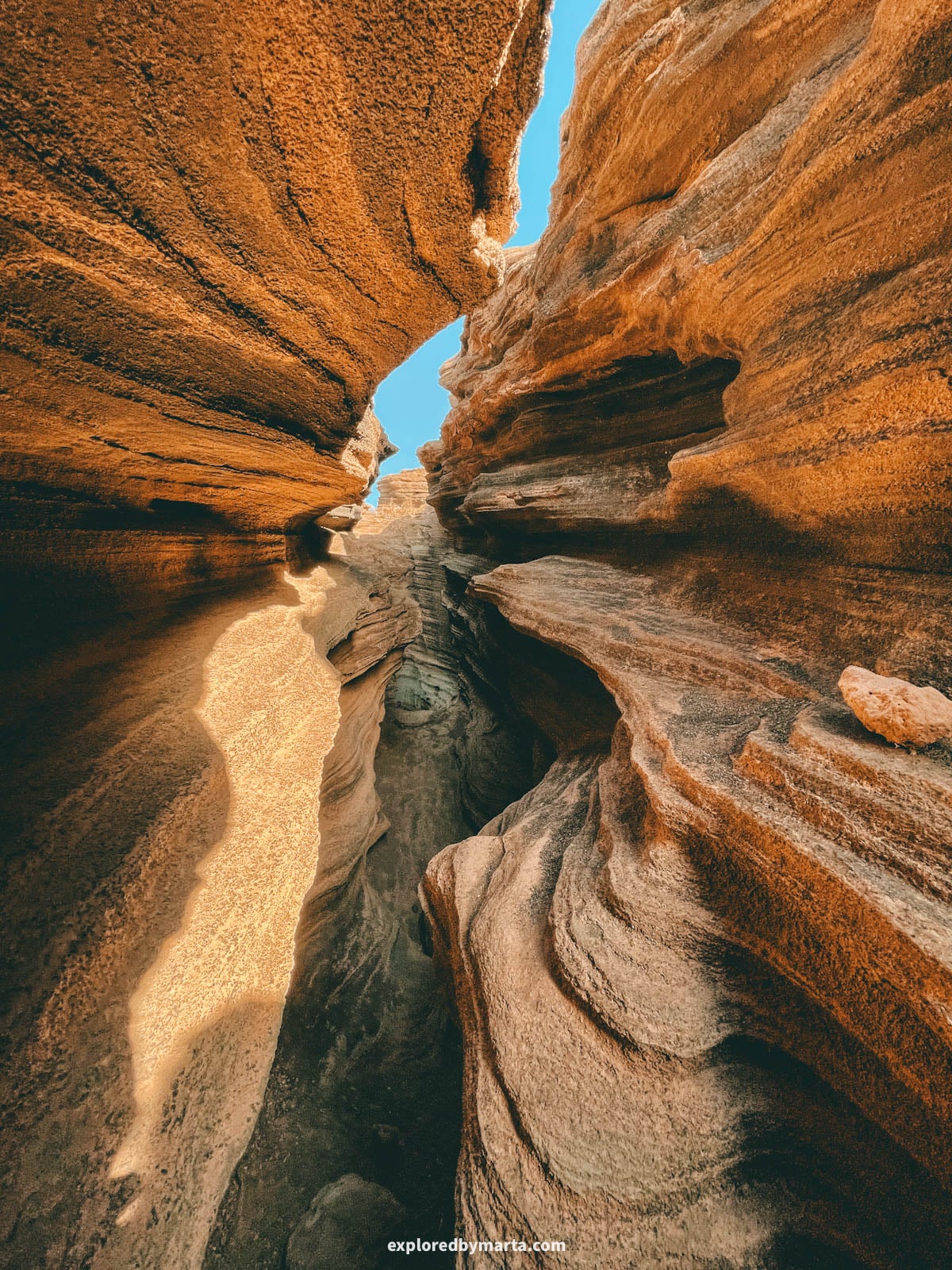
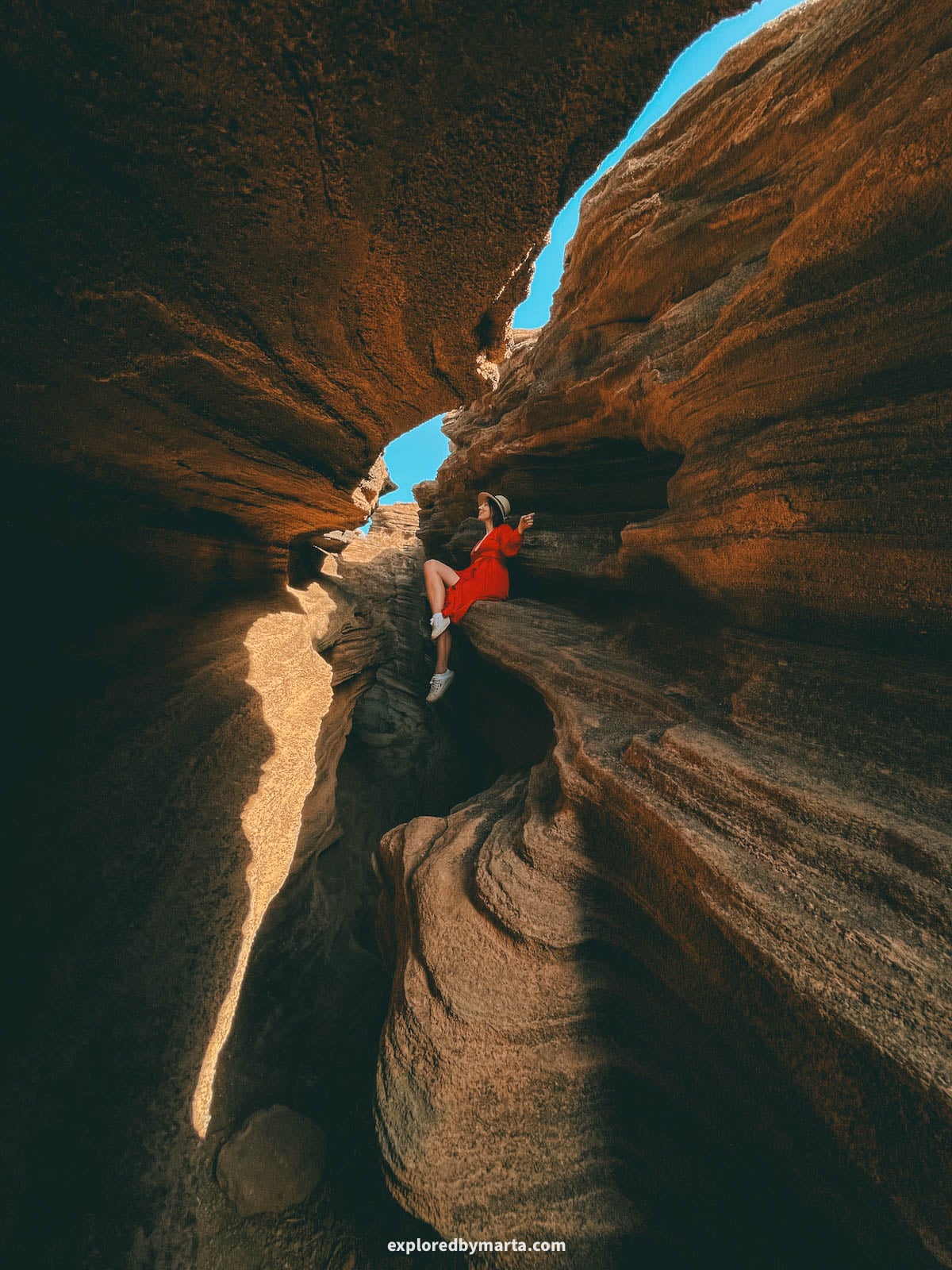
Las Grietas is the perfect place to start, and the name gives it away – Las Grietas means “the cracks” in Spanish. And that’s exactly what you get: deep, narrow slots you can walk right into.
These cracks opened up in the volcanic rock on the side of Montaña Blanca volcano, and erosion has been slowly widening them ever since. The result is a maze of twisting corridors just tall enough to swallow you up.
You can squeeze maybe 30 to 50 meters (100 to 165 feet) in before they pinch shut. The first crack you reach when you approach from the parking area is the widest and most popular, so it’s usually where everyone stops (exact coordinates below).
And I completely understand – if you want a cool photo as a keepsake from Lanzarote, this is the perfect photo spot for that!
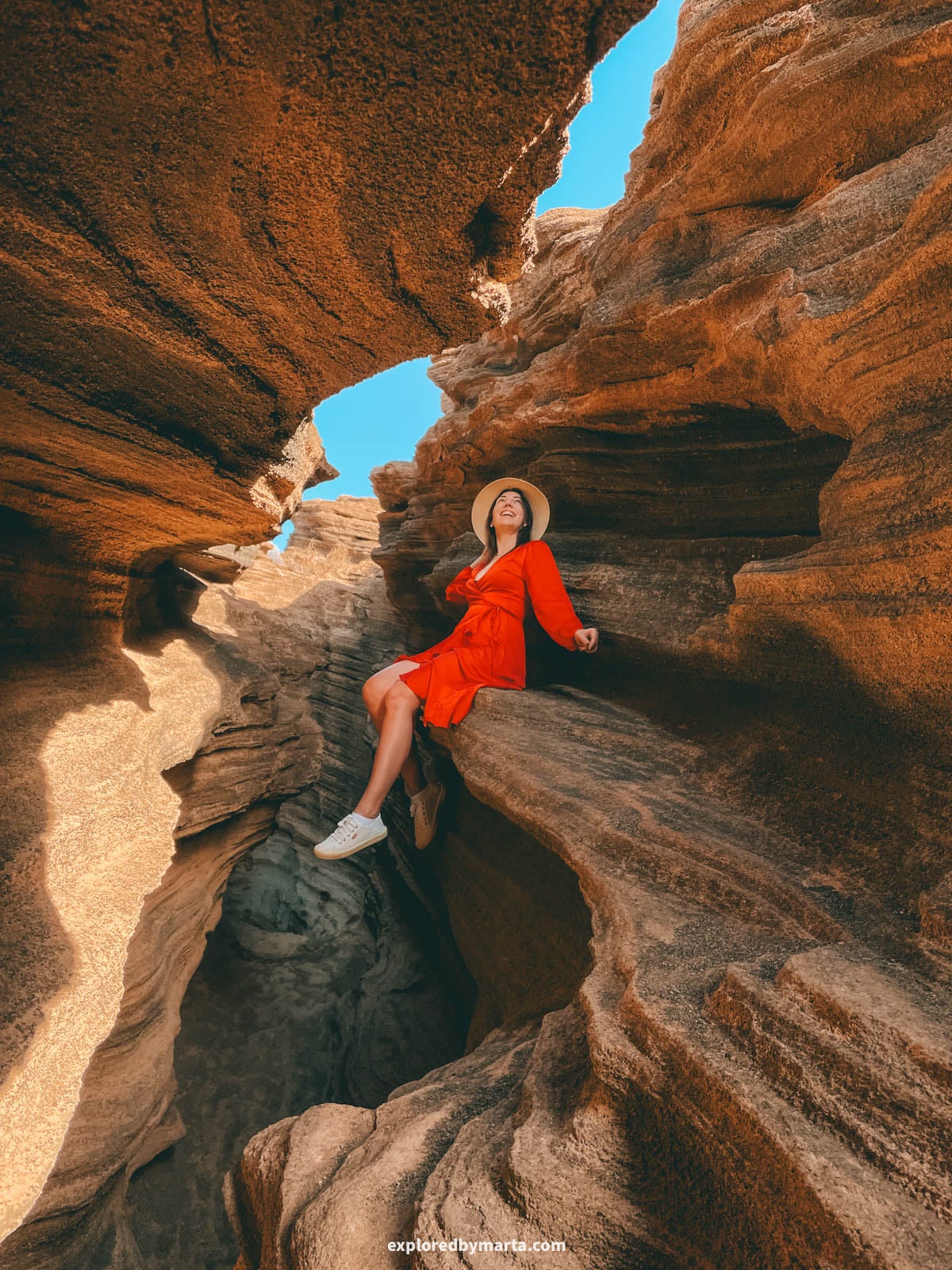
But don’t stop there! Follow the dirt path, and you’ll find more of them – some narrower, some wider, and much quieter. Just check how tiny I am in the photos compared to those beautiful rocks!
Las Grietas is not an official tourist attraction, but because of its unique and beautiful features, it has become quite a popular place to visit in Lanzarote.
Getting there is rather easy if you have a car – there are two larger parking areas right next to the roadside, so leave your car there and then simply walk a couple of hundred meters over to the rocks (see the exact location for the biggest crevice below).
We came here in the morning hours when the sun had climbed just high enough to shine inside the cracks. It was beautiful! It was also a less busy time, and we were almost the only ones there.
Obviously, midday is usually busier, but, honestly, you can visit them at any time during the day. For me, walking straight into a crack in a volcano was pretty memorable. This place truly feels unreal!
Location: Las Grietas – Parking area
2. Giant volcanic bomb at Montaña Colorada
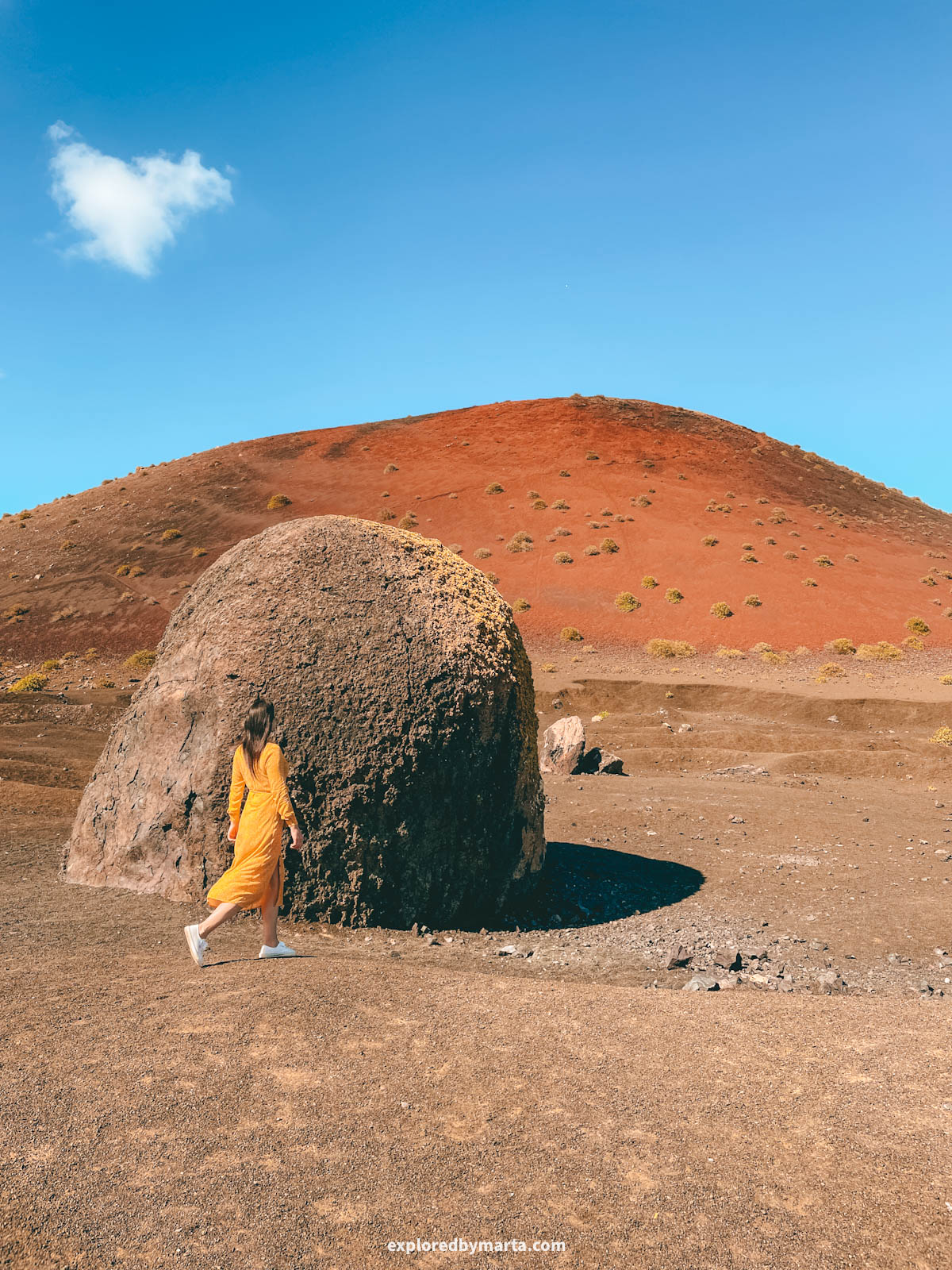
Next up is one of the coolest single rocks on the island – a giant volcanic bomb sitting right beside the red-black cone of Montaña Colorada.
A volcanic bomb is a blob of molten rock flung out of a volcano mid-eruption, cooling into a solid lump as it flies. How crazy does that sound? Most are rather small, but this is truly a gigantic piece of rock – well over head height, which is what makes it famous.
It is said to be one of the largest volcanic bombs in the world!
You reach it on the flat trail that loops around the red volcano, Montaña Colorada. It’s about 800 meters (half a mile) from the parking lot if you head straight there (the full loop around the volcano is around 3 to 4 kilometers or 2 to 2.5 miles).
One thing – please don’t touch the bomb. It’s a fragile piece of natural history, and it only stays impressive if everyone leaves it be. And remember that it is illegal to take volcanic rocks back home with you (unless it’s an official souvenir).
Location: Giant volcanic bomb
3. Los Charcones volcanic pools
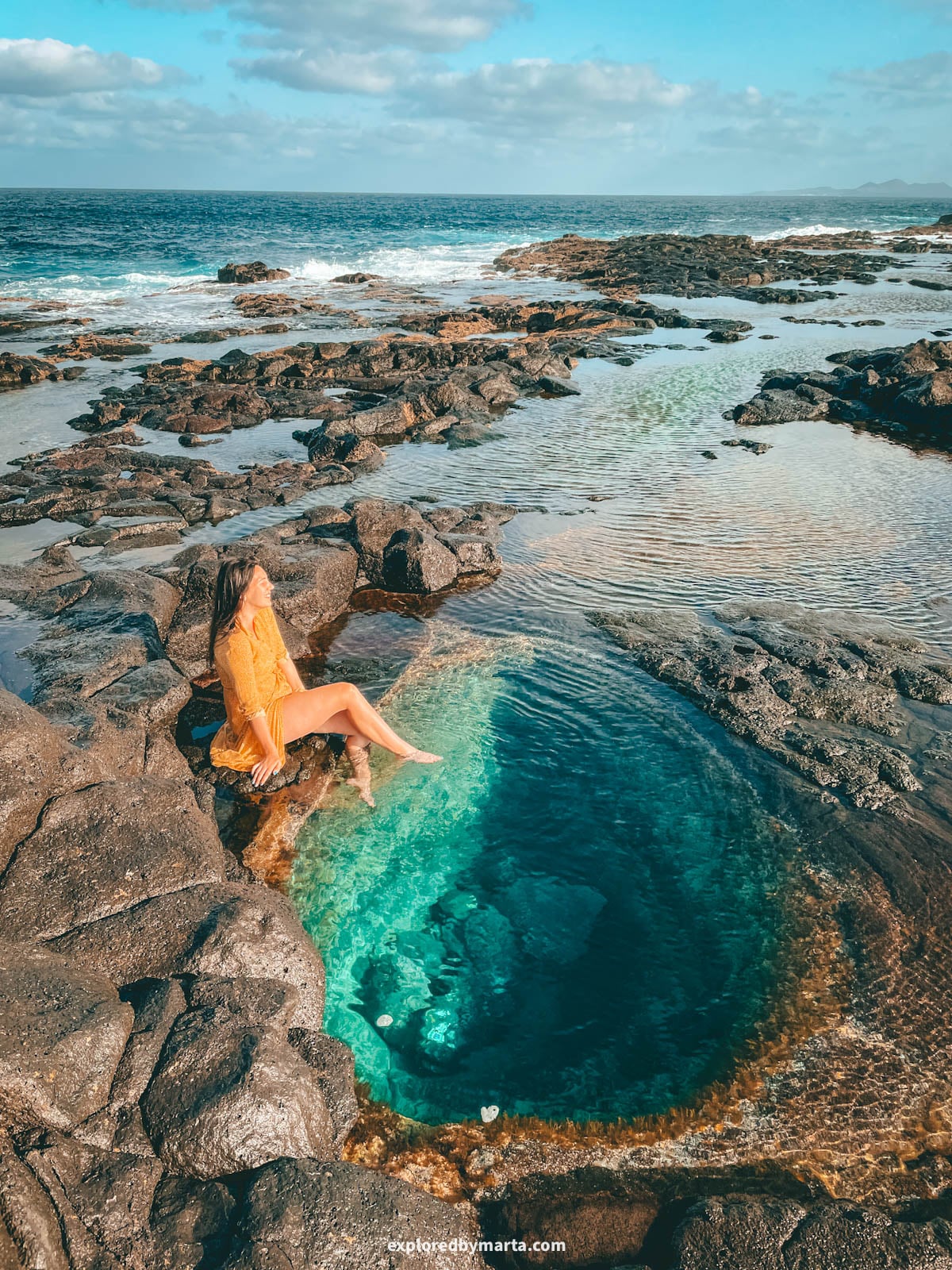
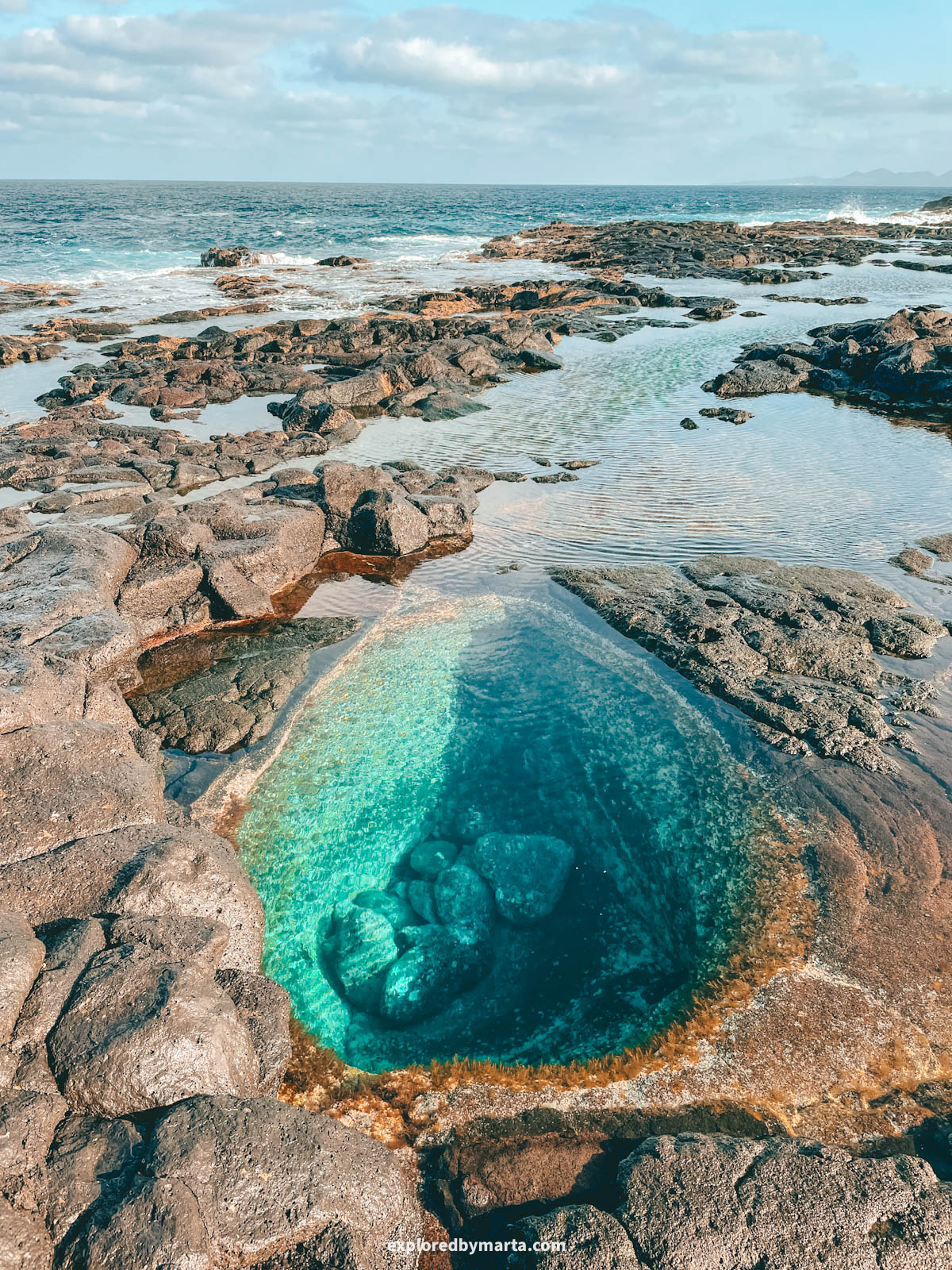
Down in the southwest corner, Los Charcones is a stretch of coastline dotted with natural volcanic pools – little turquoise bathing spots carved right into the black lava rock.
The pools formed where lava met the ocean and hardened into unique shapes, and the sea now fills the hollow pits with crystal clear waters. It does kind of look like a jacuzzi, right?
You could spend a whole day just working your way along the coast, hopping between them.
Getting here is the tricky part. The roads down to the coast are very rough gravel that a lot of people won’t risk, especially with a rental car.
With a 4×4, it’s quite easy to manage all the rough bumps and sharp rocks, but most visitors just park at the beginning of the gravel road and walk the last 2 to 3 kilometers (1 to 2 miles) on foot.
We somehow nursed our little Fiat 500 almost all the way to the abandoned Hotel Atlante del Sol, then walked the rest. Not our most comfortable driving, but it saved our legs and time, haha (it was our final day in Lanzarote).
Because this is a coastal area, you need to come here at low tide, and I’m being serious with this. At high tide, the waves crash over the rocks and the pools are neither safe nor pretty.
For me, this is Lanzarote at its wildest – practically empty, raw, and a little bit of a mission. Exactly the kind of place I love!
Location: Los Charcones – Parking area
4. Floating rock at Risco de Famara
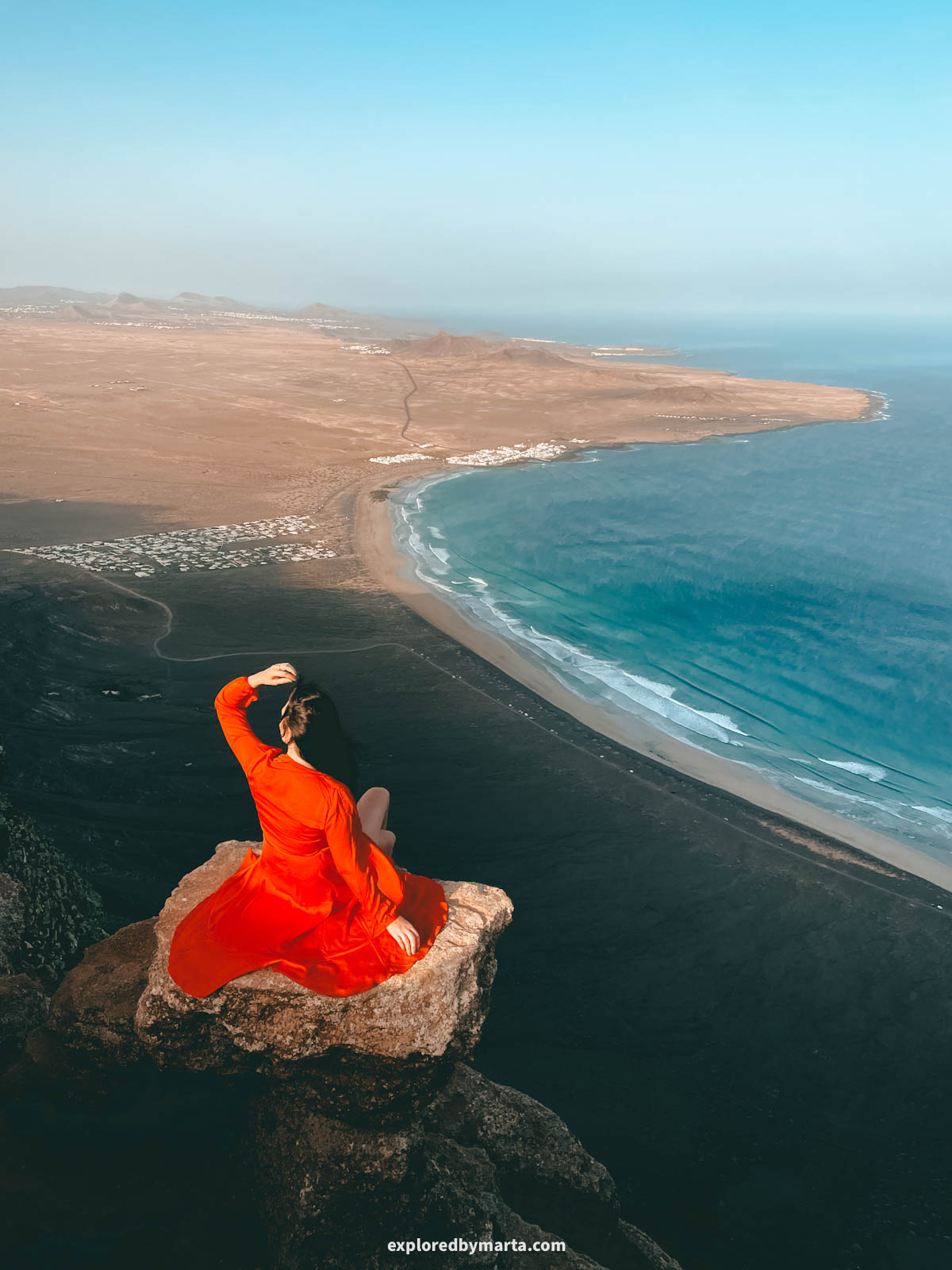
High up on the Famara cliffs – the highest point on the island – hides one of the most jaw-dropping rock formations in Lanzarote: the floating rock.
It’s a flat slab of rock that juts out from the cliff edge, separated just enough that when you sit on it, you look like you’re floating in thin air over the ocean far below. Isn’t it just spectacular?
Yes, I admit that I am a bit of an adventurer and wanted a quick photo there.
It’s wider and sturdier than it looks, so I felt safe out there – but if heights make you uneasy, maybe better skip this spot!
If you are visiting Famara Cliffs (which you should!), this rock is just a short walk from the Aparcamiento El Bosquecillo parking lot. The drive up there is pretty bumpy and narrow in places, but the views are definitely worth it.
Famara Cliffs and Mirador de El Risco de Famara viewpoint is actually a popular place to visit at sunset, as you can see the whole island below glowing in golden hues (magical!).
However, sunset time also gets pretty busy, so we came here in the morning for some photos and then again in the evening to watch the sunset. So worth it!
But the whole area is beautiful at any time during the day. The view alone, out over Famara and the island of La Graciosa, would be worth the trip. The floating rock is just the wild bonus on top.
Location: Floating rock at Risco de Famara
5. Cueva de las Cabras cliff cave
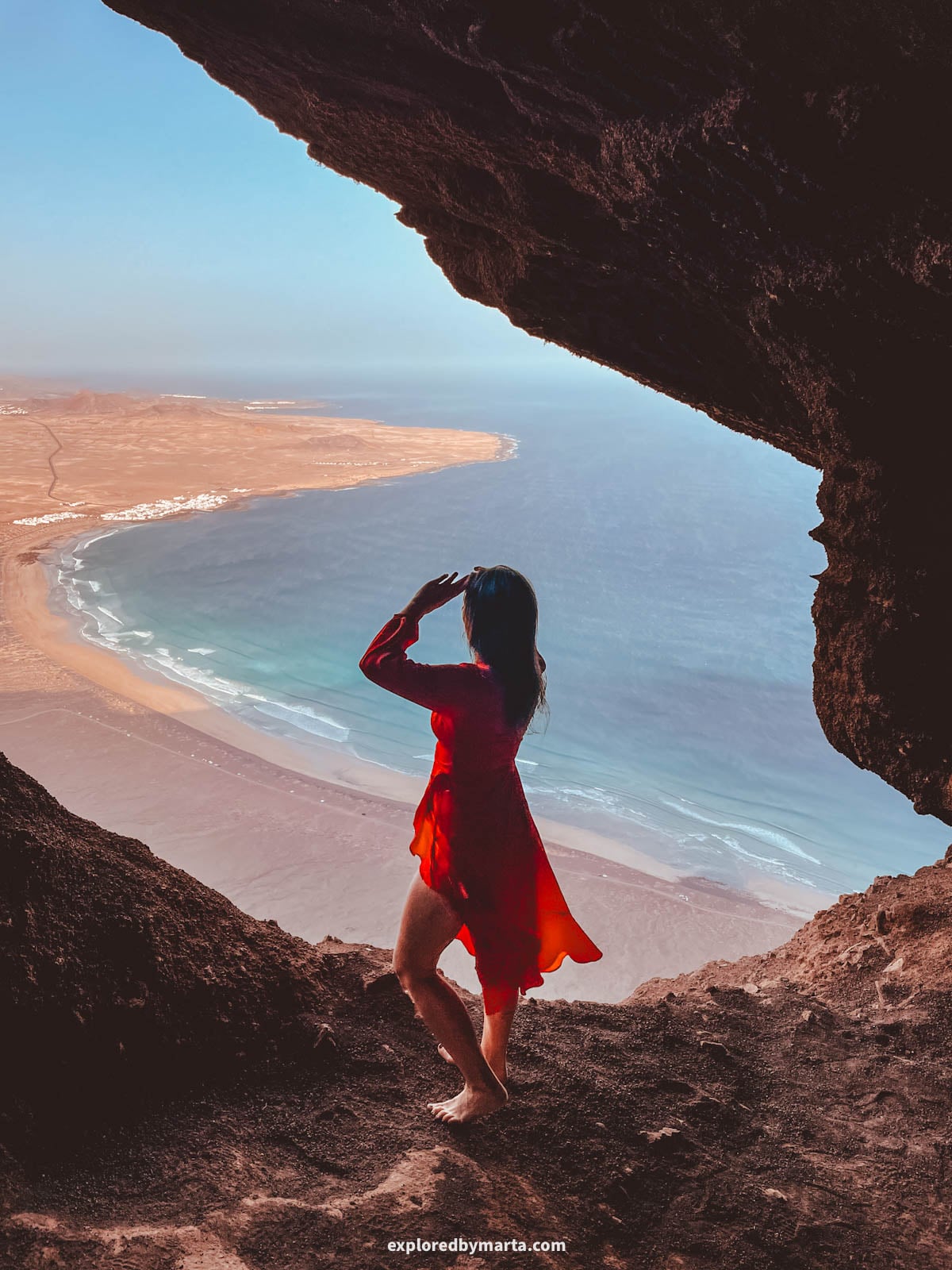
Right beside the floating rock, carved into the same Famara cliff face, is Cueva de las Cabras – also known as Cueva de los Suecos.
It’s a hollow in the cliff wall with an opening that frames Famara beach far below, like a window cut into the rock. In my opinion, that framing is the whole appeal of this spot.
However, getting to it means a few careful steps down the cliff, with a big drop below, so this one isn’t for everyone. One wrong footing here is serious, so please take it slow and know your limits.
If it feels too risky, don’t sweat it – the view from the clifftop is essentially the same, so you lose nothing by staying up top. Check out my guide to the best caves in Lanzarote to explore other beautiful caves (including ones that are much safer to visit!).
For me, this whole clifftop – the floating rock, the cave, the view – is one of the best stops in Lanzarote!
Location: Cueva de las Cabras
6. La Rofera (Stratified City)
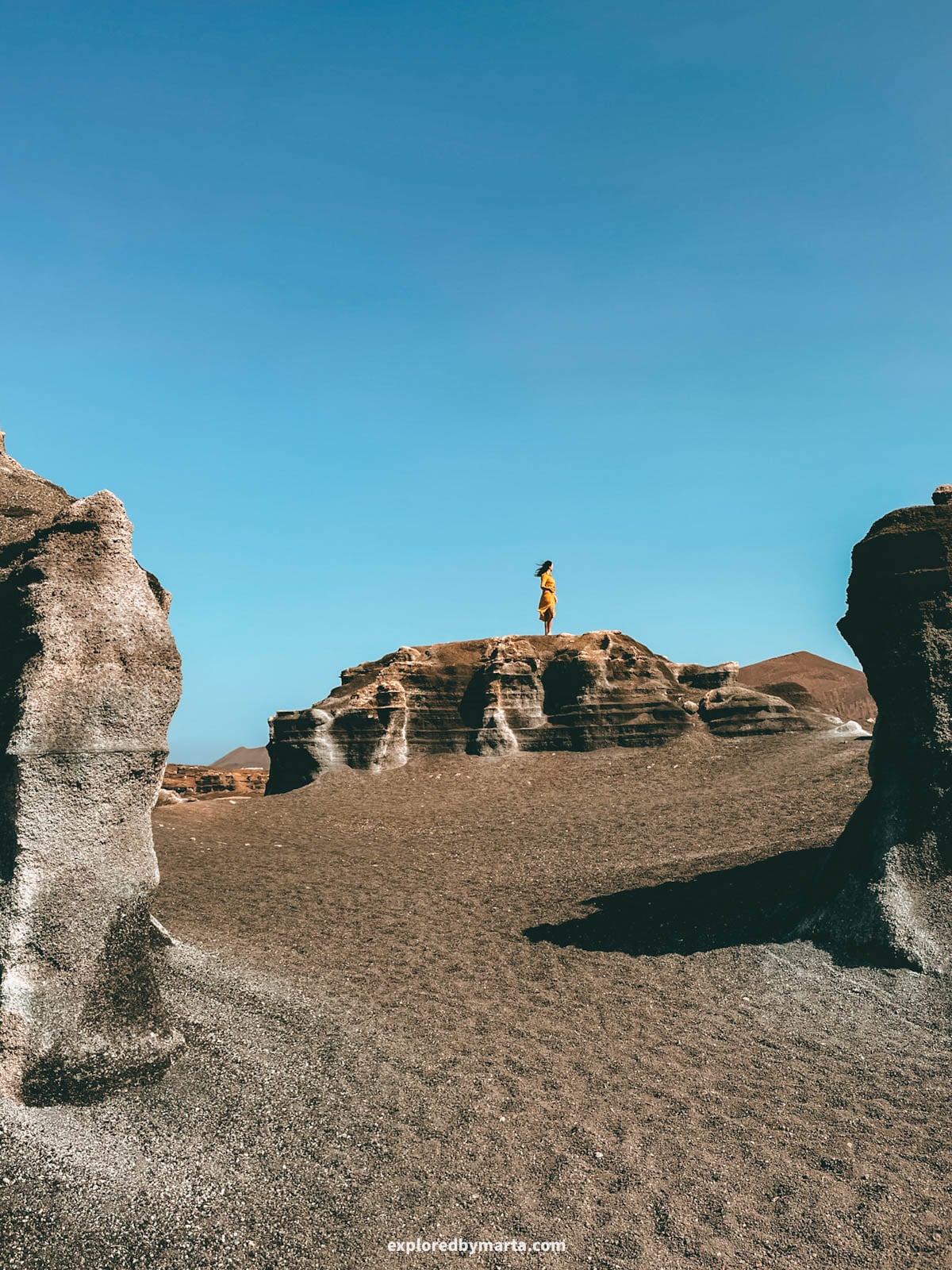
This was one of my favorite stops on the whole island. La Rofera, better known as the Stratified City or Los Roferos, is a large area of dark grey and black rock formations that looks like it belongs on another planet.
What makes it special is that it’s part nature, part human hands. This is an old, abandoned quarry where locals once dug out “rofe,” a coarse volcanic sand farmers spread on their fields to trap moisture and shield crops from the sun.
Between the digging and thousands of years of wind, sun, and rain, the ground has been carved into these layered mounds – rounded, ridged, and full of little caves. That stacked, stratified look is exactly where the nickname comes from.
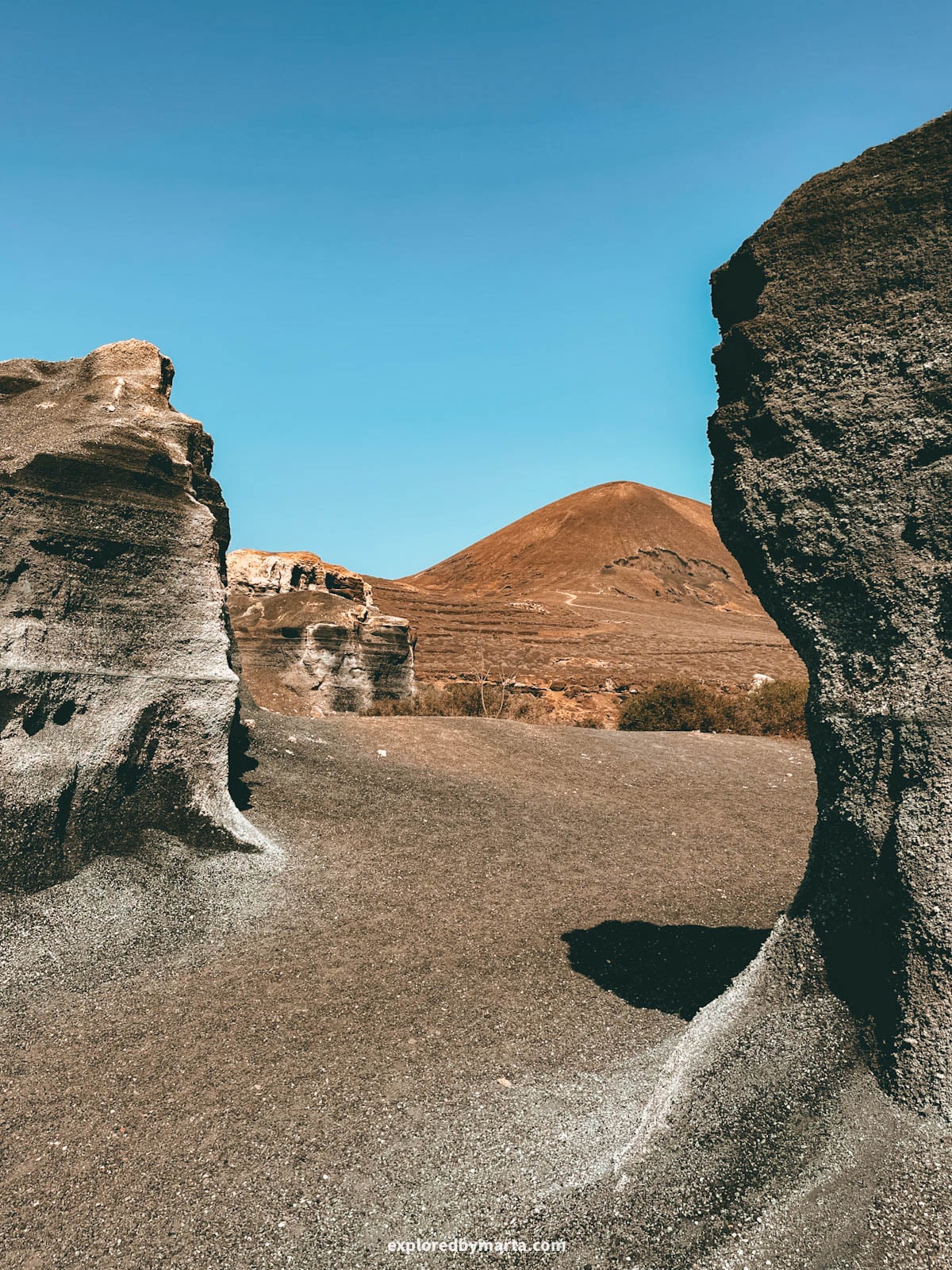
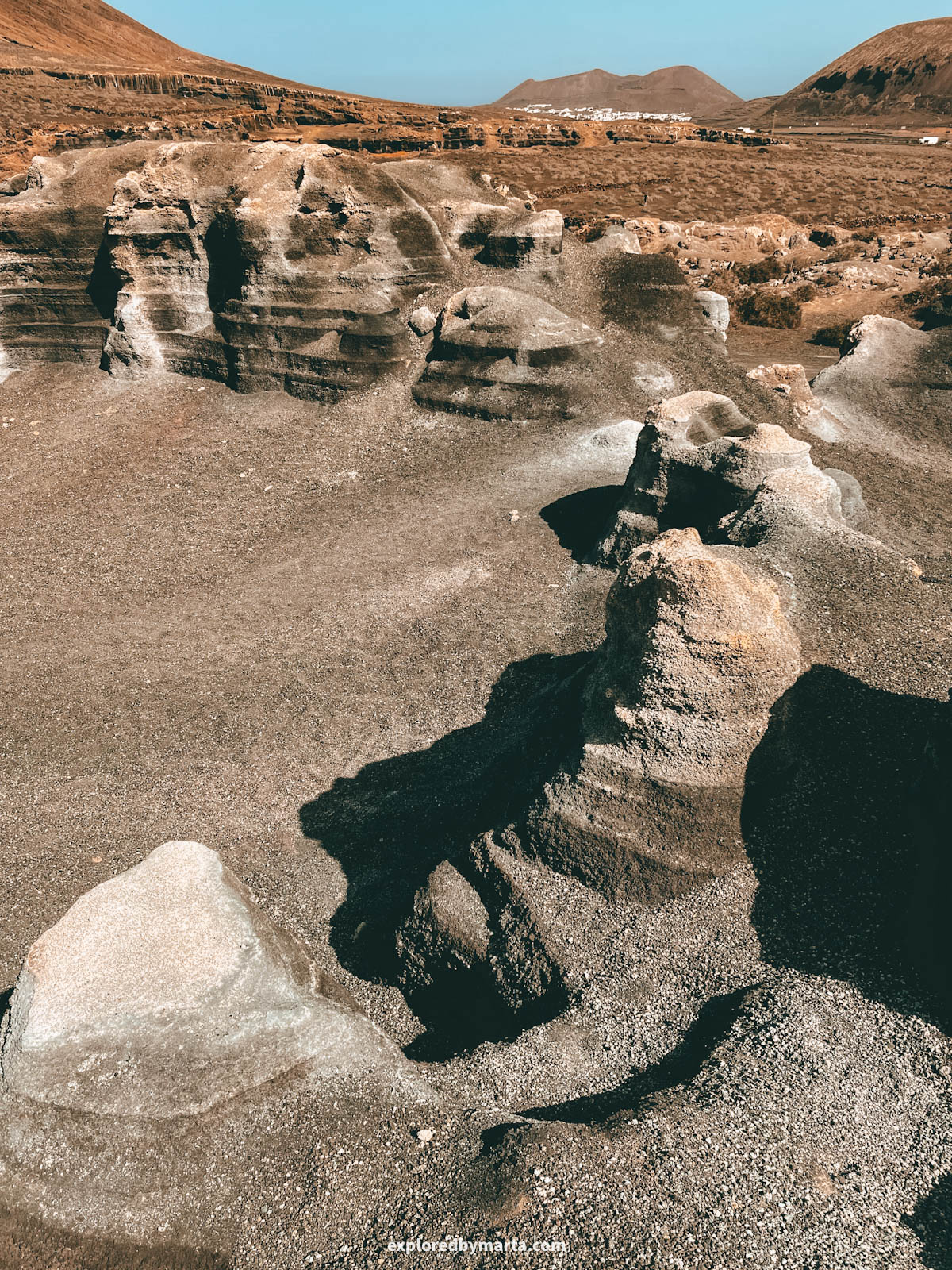
And here’s the wild part: the erosion isn’t finished. The rocks are still slowly wearing down, so the place literally keeps changing shape over the years. What you see won’t be quite the same a decade from now, as it happens with nature, obviously.
Best of all, it’s completely free and out in the open – no gates, no tickets, no set hours. Don’t you just love such places? You just park at the side of the road, walk in, and explore at your own pace, any time of day you like.
If you want to walk around and check out more of this unique place, it is best that you wear closed shoes, though – the ground is loose volcanic gravel that’s rough underfoot. And those small and sharp stones just find their way into sandals all the time, haha.
Location: La Rofera (Stratified City)
7. La Geria volcanic vine pits
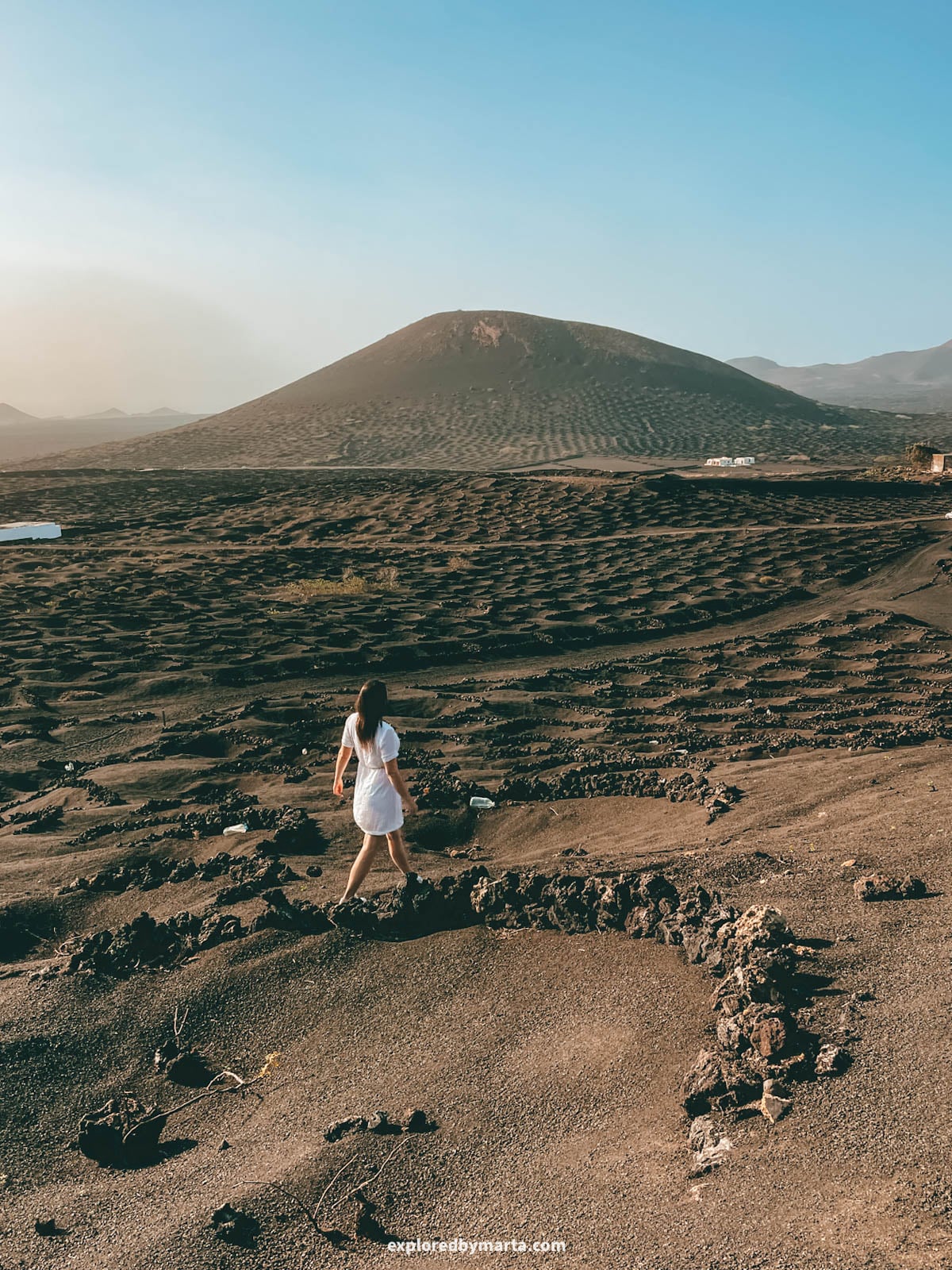
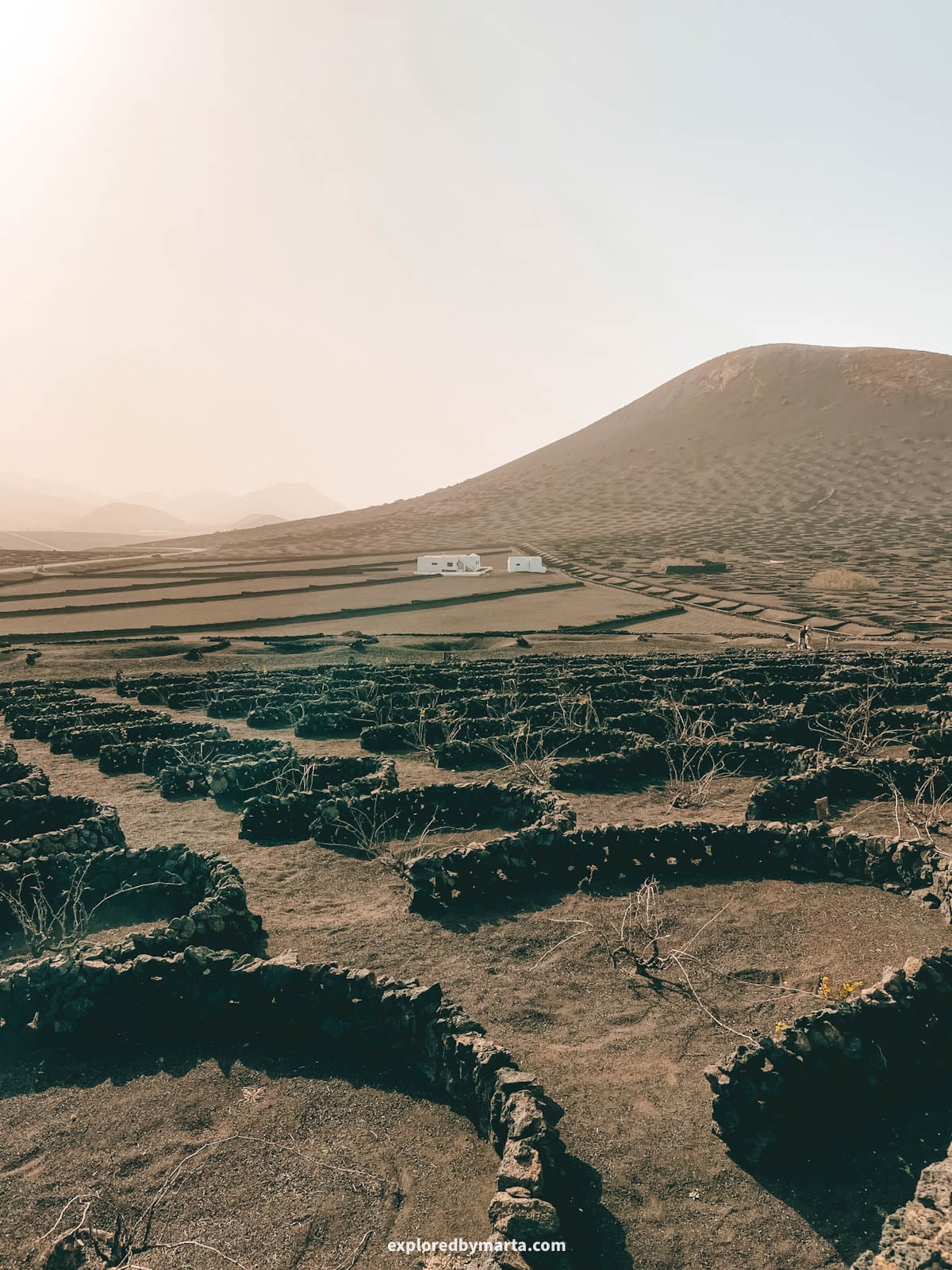
La Geria isn’t a rock formation in the usual sense, but the landscape here is so uniquely volcanic that it earns its place – a whole valley of black lava pits, each cradling a single vine.
So what are these weird circular rock formations that cover a large part of Lanzarote?
After the 1730s eruptions buried a quarter of Lanzarote in ash, farmers dug thousands of hollows down through the black lapilli to reach the soil below, then ringed each one with a low stone wall to block the wind.
The result is dark, crescent-shaped pits as far as you can see – a landscape you won’t find anywhere else on Earth. And that black volcanic ash actually traps moisture, which is how vines grow here with almost no rain! How crazy is that?
It’s genuinely striking in person, especially with the low sun throwing shadows across the pits. You can pull over along the road to take it in, or stop at one of the bodegas for wine tasting and a closer look at these unique fields.
At least, that’s what we did. Turns out those black pits produce some seriously good wine!
Location: La Geria
8. Cueva de los Verdes lava tube
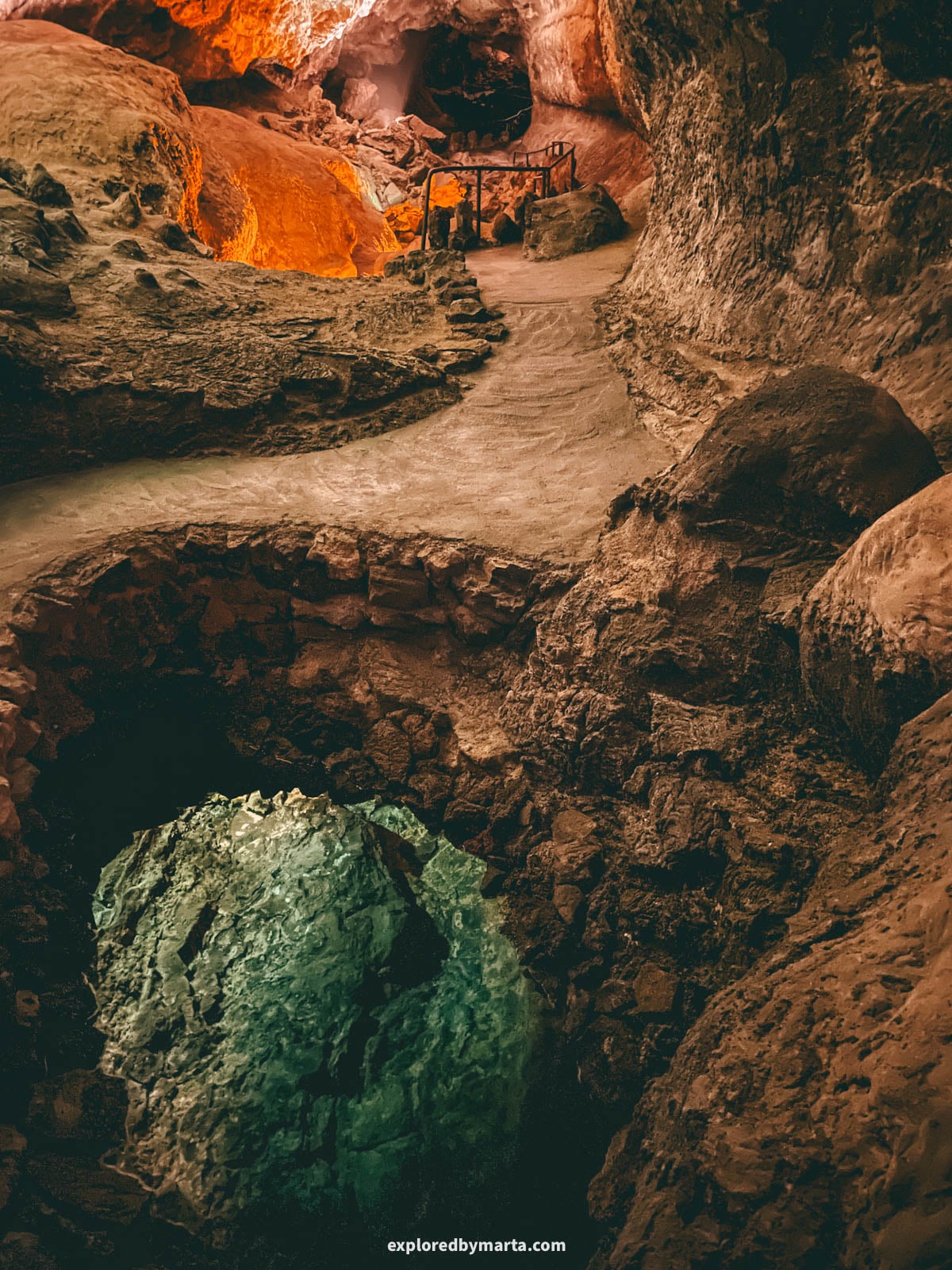
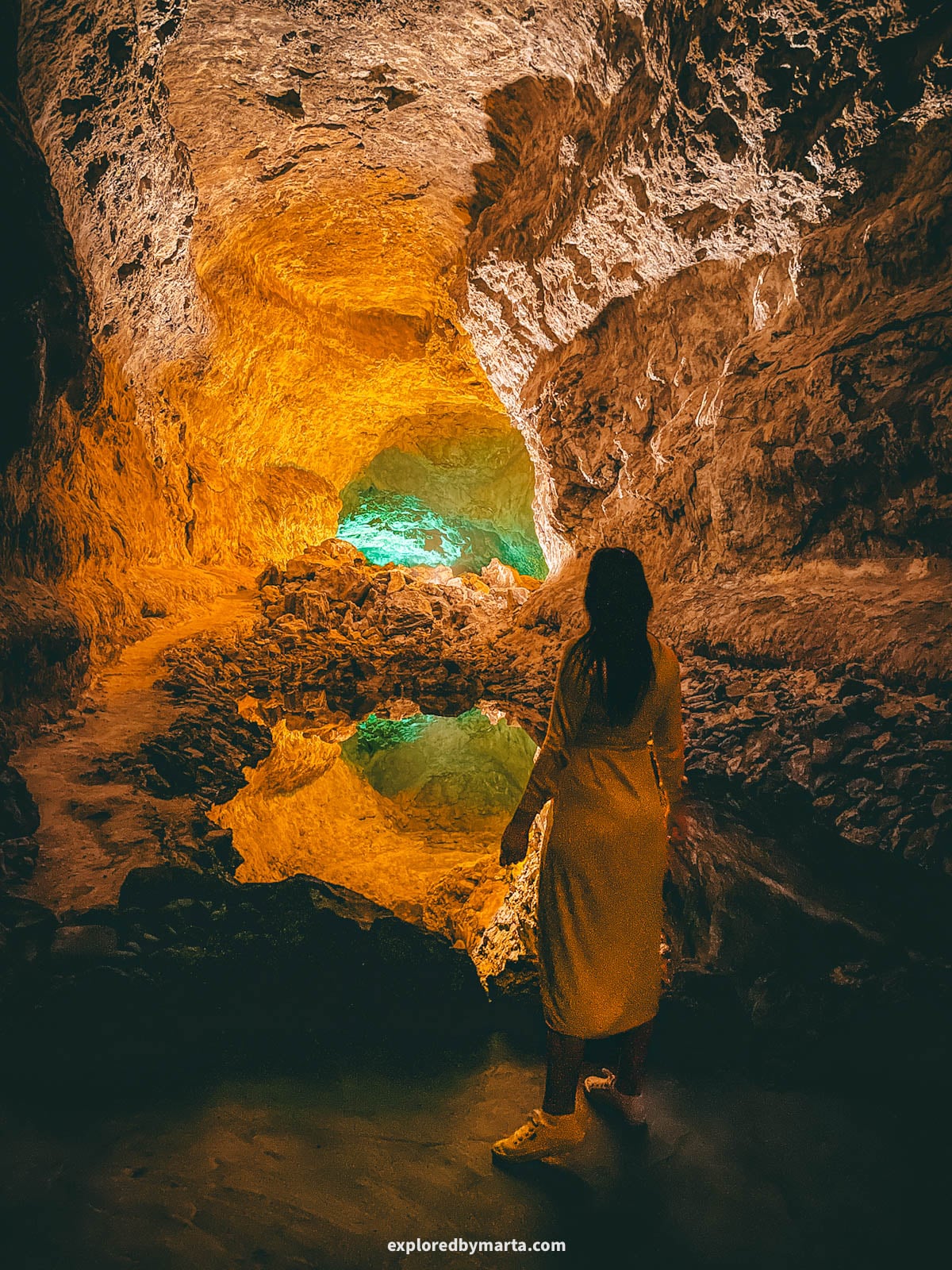
As a rock formation, Cueva de los Verdes is hard to beat – a tunnel carved through the earth by a river of molten lava. The best part? You can actually visit this lava tunnel!
It formed when the Monte Corona volcano erupted and sent lava racing to the ocean, leaving behind a tube more than six kilometers (about four miles) long.
Part of it even runs out under the Atlantic and is known as the Túnel de la Atlántida (The Tunnel of Atlantis), a 1.5-kilometer (0.9-mile) underwater section that’s the longest known volcanic submarine lava tube on Earth.
You can visit Cueva de los Verdes on a guided tour, walking through chambers of layered volcanic rock lit to show off every ripple and texture the lava left behind. Geologically, this is probably the most impressive thing on this list!
Because it’s a ticketed show cave with a lot more to know before you go, I’ve given it the full treatment in my guide to the best caves to visit in Lanzarote – tickets, timing, and what to expect inside. It’s a must-visit place!
Location: Cueva de los Verdes
9. El Cuervo volcano crater
Did you know that Lanzarote is often called “the island of 1,000 volcanoes”?
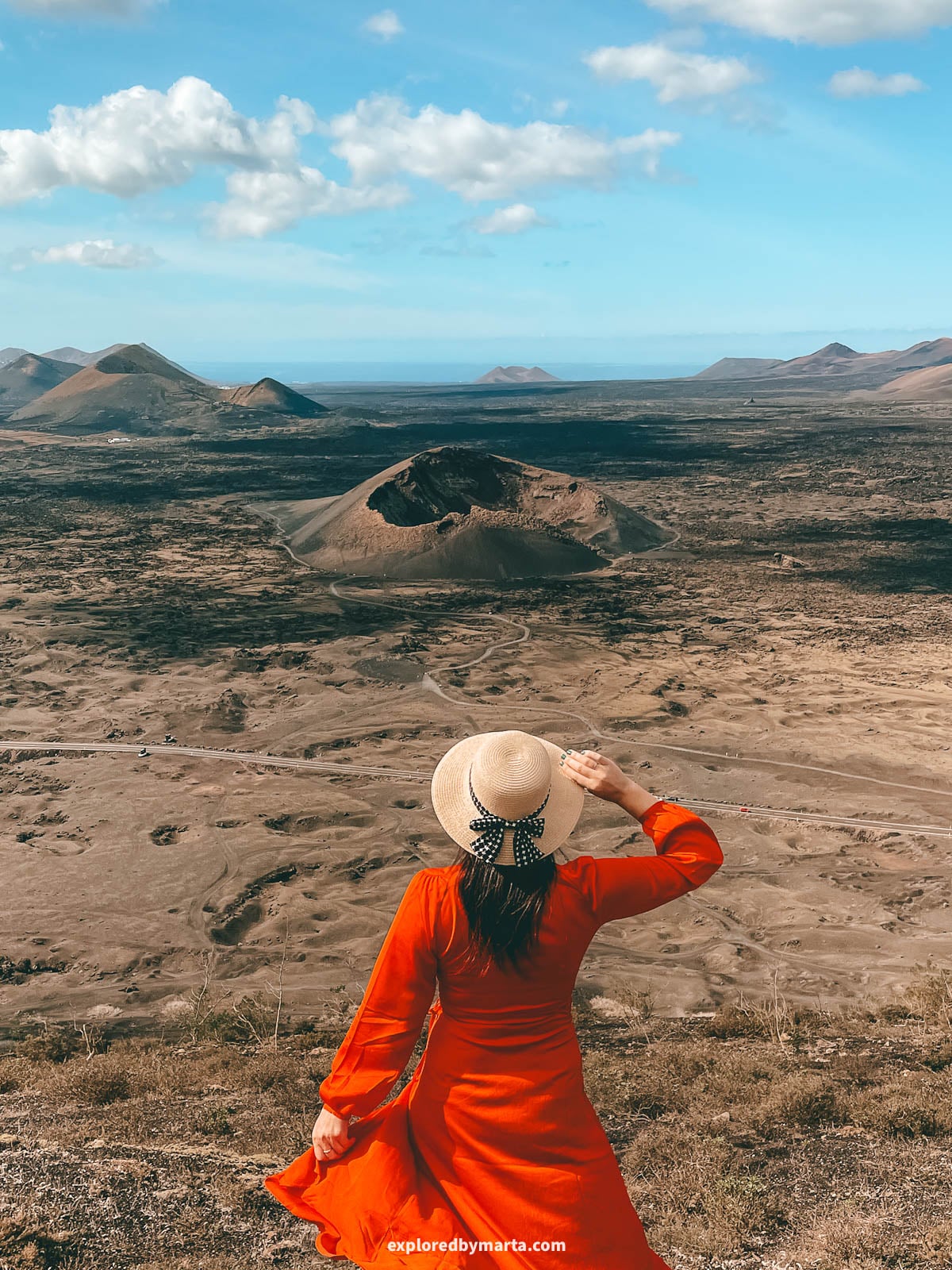
Yes, but actually there are approximately 200 volcanoes in Lanzarote, and, based on everything I’ve learned about Lanzarote, El Cuervo is, without a doubt, the most famous volcano on the whole island.
Why? Well, here’s what happened.
On the night of September 1, 1730, eruptions started in Lanzarote, and El Cuervo was the very first volcano to erupt in the great event that reshaped the island, so in a way you’re looking at the place where Lanzarote’s most dramatic (so far!) chapter began.
The actual date is known so precisely because the priest of nearby Yaiza town wrote the whole thing down as it happened – his diary is still one of the most famous first-hand accounts of the massive eruption.
Here’s a wild detail: while El Cuervo itself only erupted for a few weeks, other eruptions kept jumping across the island and continued for six years, burying a quarter of Lanzarote in lava and creating around 33 new volcanoes.
Most of this area is now part of Timanfaya National Park, another must-visit place in Lanzarote.
But back to El Cuervo. It is known for its distinct shape and the fact that so much lava piled up around it in the years after that the crater floor now sits lower than the ground outside – the volcano was half-swallowed by the eruptions that followed it.
The best part? You can actually hike inside this crater!
A flat trail of about 4 kilometers (2.5 miles) loops around the volcano and leads into the crater through a gap in the wall. Inside, you’re ringed by black rock walls – it genuinely feels like stepping onto another planet!
It’s an easy, mostly flat walk with info boards along the way, so it works even with kids. One thing though – please don’t take any lava rocks home, as it’s a protected natural area.
This was one of my favorite easy hikes on the island – low effort, huge payoff, and that apocalyptic-movie landscape everyone comes here for. Amazing!
Location: El Cuervo volcano – Parking lot
10. Cueva de Montaña Cabrera
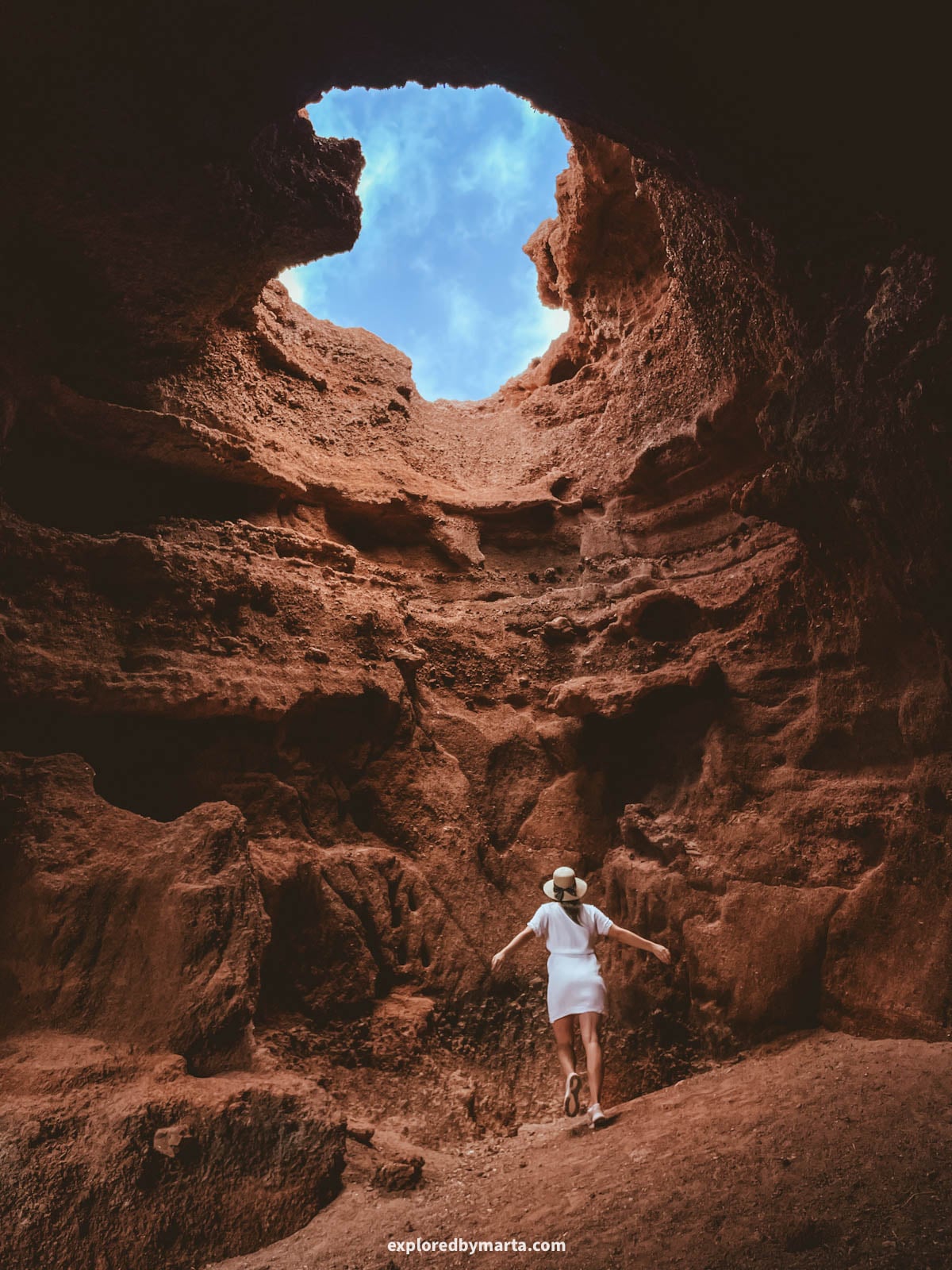
Montaña Cabrera is a volcano with a secret – a cave hollowed right inside it, with an open hole in the ceiling and a side entrance you can walk into.
If you are a bit of an adventurer, this is a cool place to add to your Lanzarote itinerary!
This is one of the wild caves in Lanzarote. There are no signs or trails – just park near the houses at the base and hike up the loose slope (check exact location coordinates below!).
If you switch your map to satellite view, then you’ll see that the whole west side of the volcano is pocked with these pits and holes, left behind as the lava drained and collapsed.
Aim for the hole furthest to the right, and you’ll get there in no time. And no flip-flops, please! There are loose stones everywhere, and you’ll need at least some grip to comfortably get up and down the mountain!
It’s a real off-the-radar spot, so don’t expect crowds or facilities – just a cool cave inside a volcano.
Location: Cueva de Montaña Cabrera
11. Caldera Blanca white crater
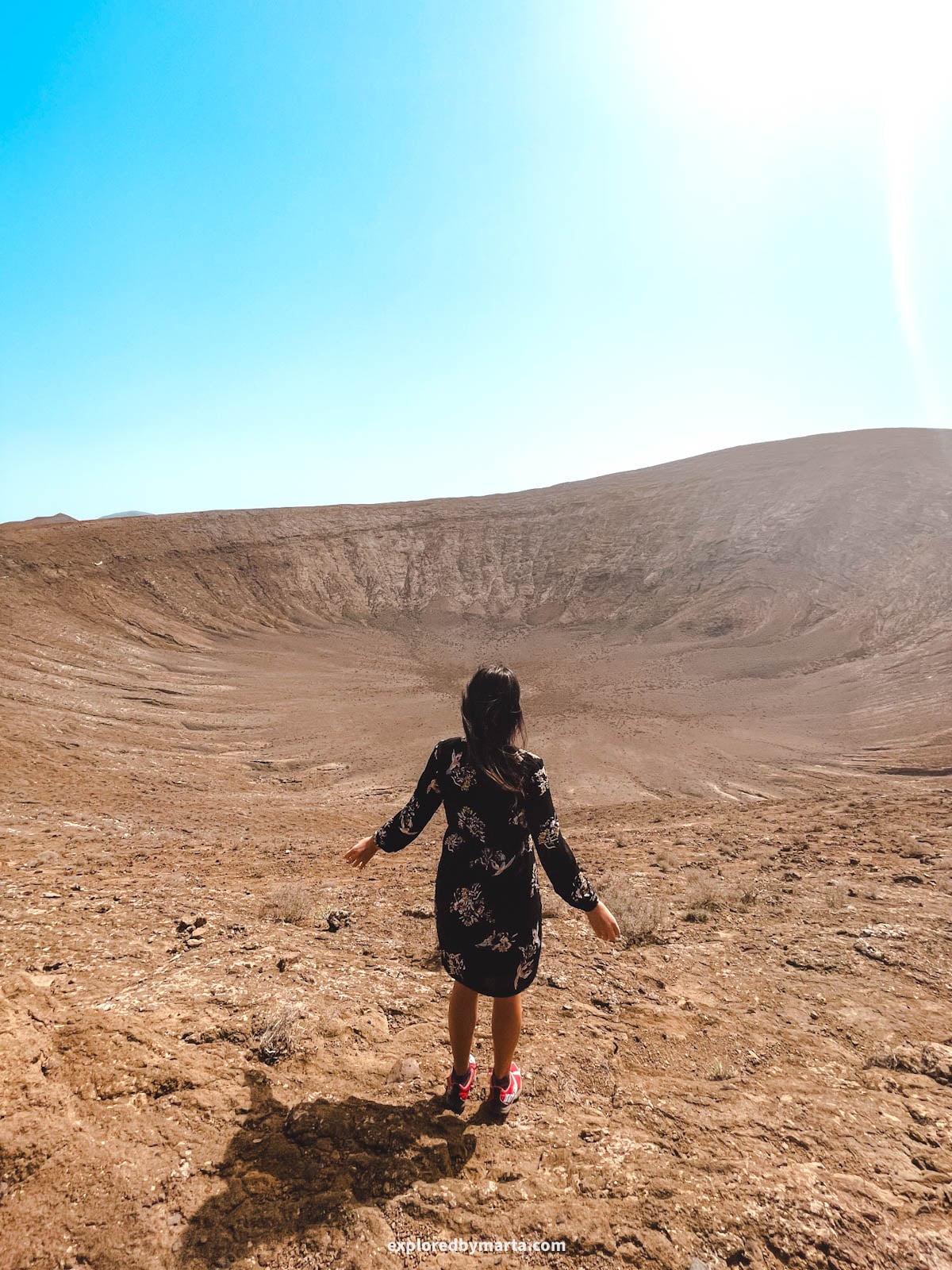
Caldera Blanca, the “white cauldron,” is the most impressive volcanic crater on the island!
Unlike the ‘young’ volcanoes from the 1730s, Caldera Blanca is ancient – its rocks have bleached pale with age, which is exactly where the “white” in its name comes from.
What’s interesting is that when the 1730s eruptions flooded this area, Caldera Blanca and its little neighbor Montaña Caldereta rose above the black lava fields like two white tropical islands – locals even call these untouched patches “islotes,” little islands in a sea of lava.
You can clearly see this unique sight if you switch your map to satellite view and zoom in.
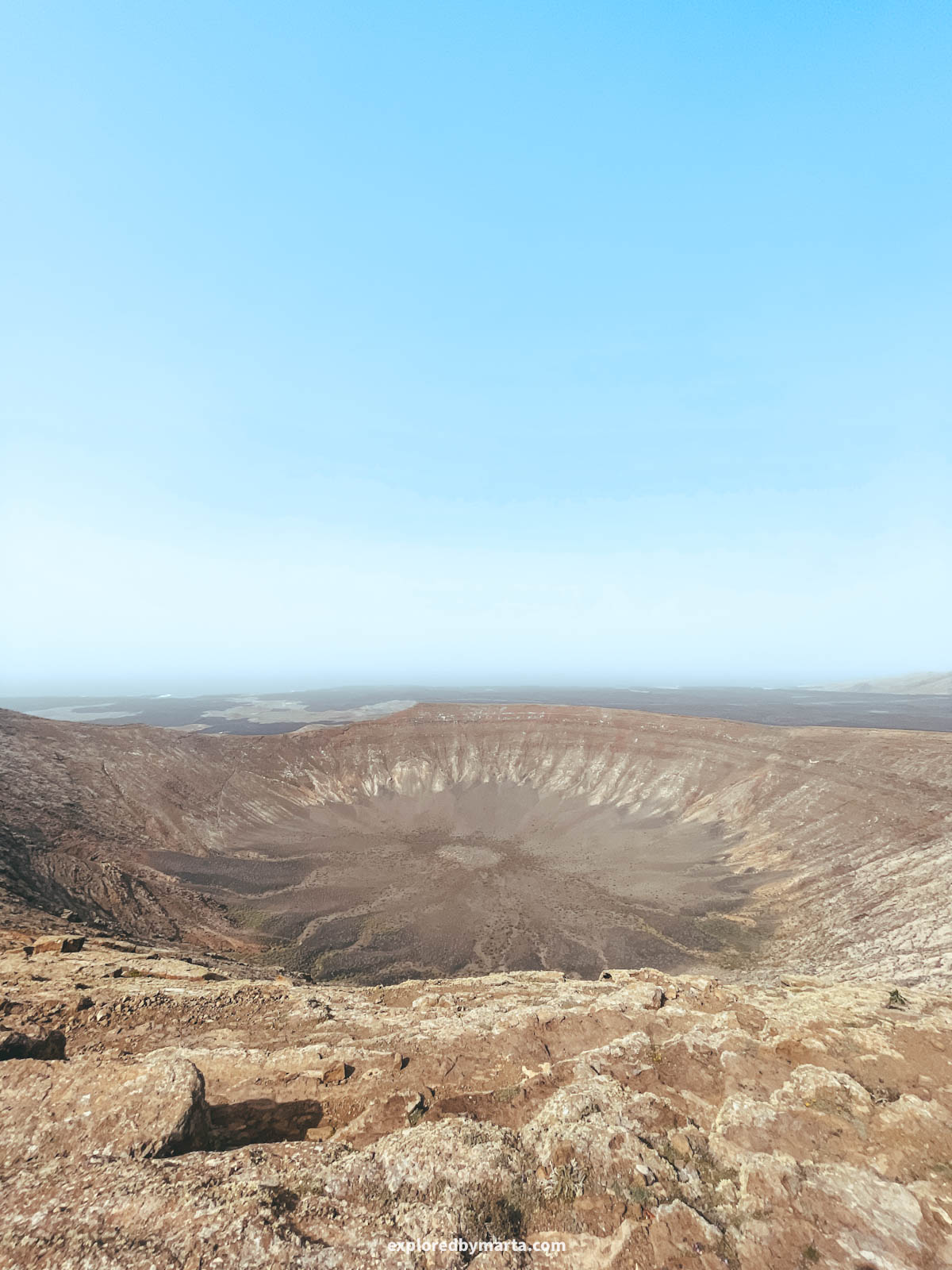
The crater itself is enormous – roughly 1.2 kilometers (0.75 miles) in diameter – and almost perfectly circular with high walls all the way around, which is genuinely rare for a crater this size and age. Standing on the rim looking down into that giant bowl was pretty humbling.
Caldera Blanca is also a popular hiking route.
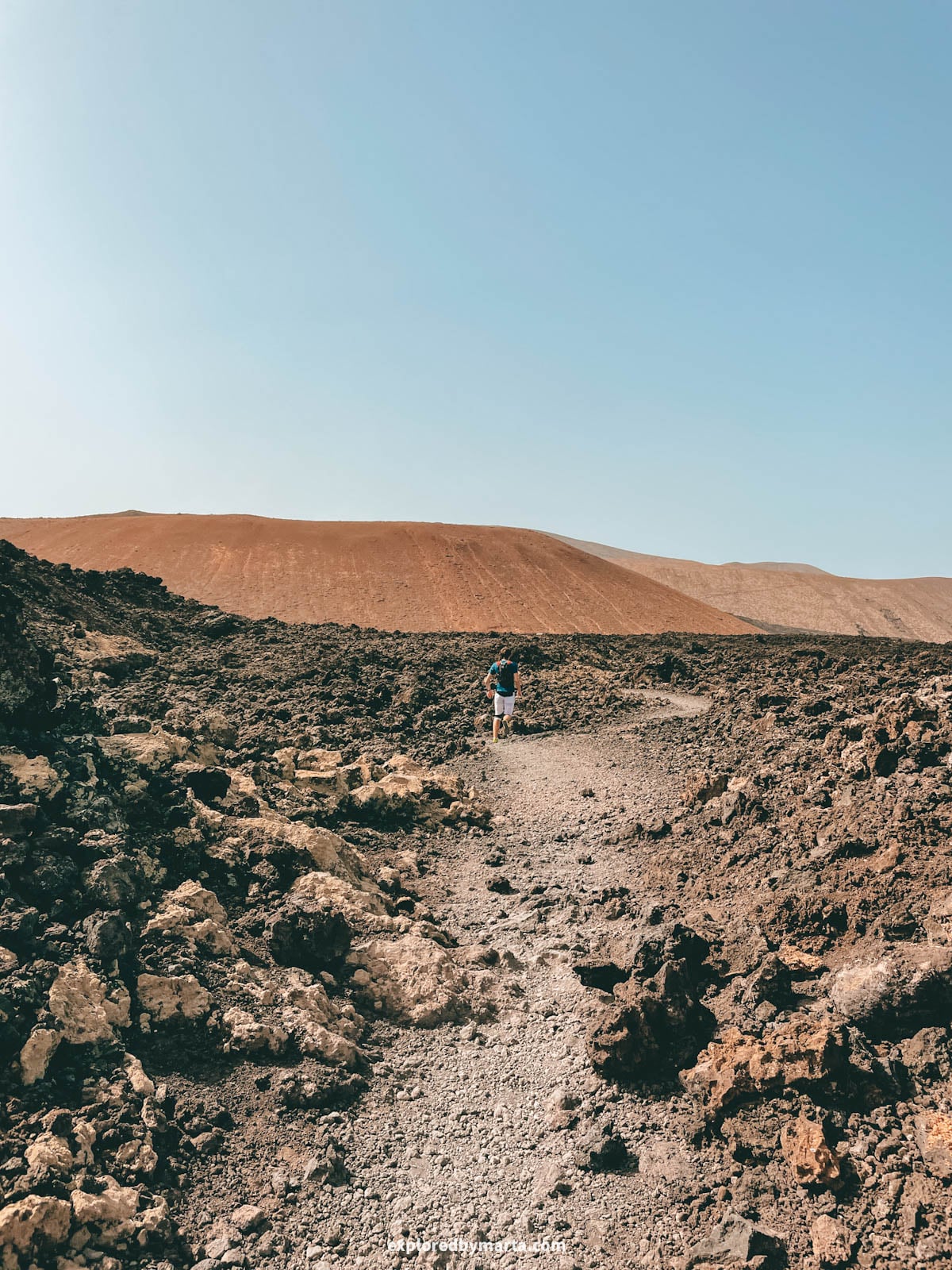
For a shorter adventure, you can climb to the top of the rim to see the area and the crater from above and then simply walk back, or you can also climb up and hike all the way around the rim of the crater.
The crater hike is around 10 kilometers (6 miles) round trip, and we decided we wanted to do the whole route.
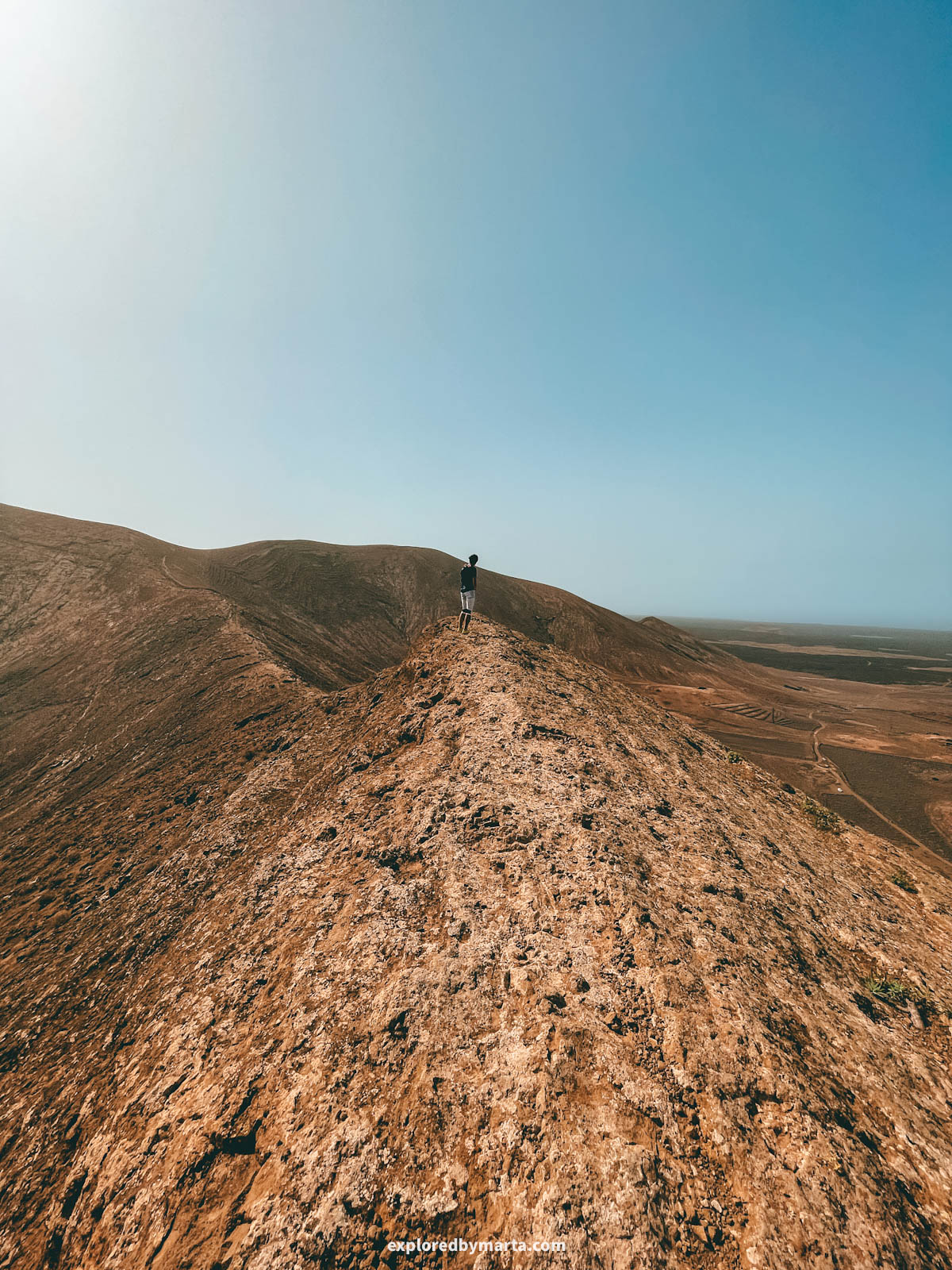
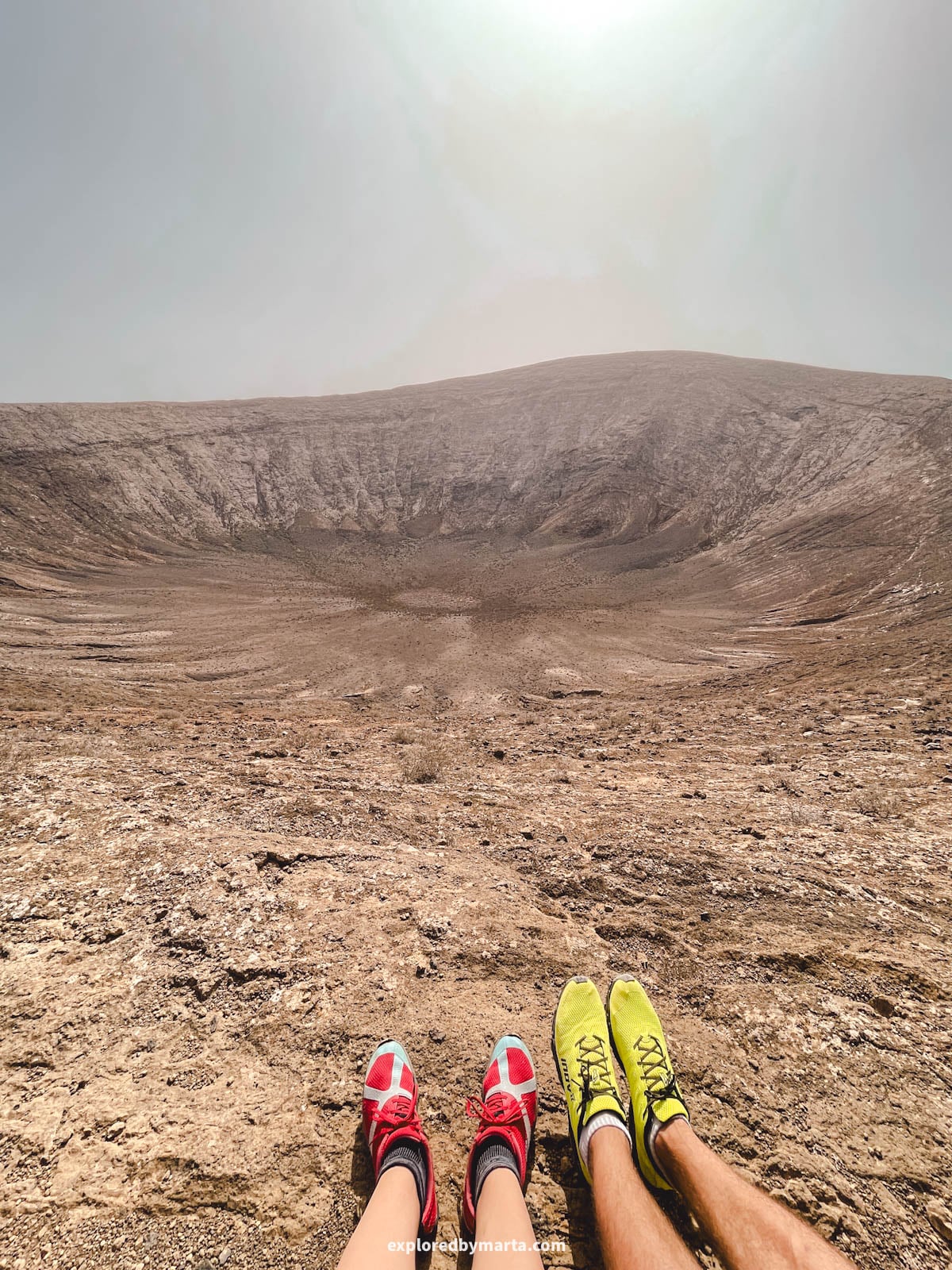
We actually did it like a run in about 1 hour 30 minutes, but if you walk like normal people, it will take about 3 hours for the whole route.
The most difficult part was the climb up to the rim. Besides, it was seriously windy up on the top of the rim, and there’s zero shade the whole route, so bring plenty of water and sun cover, wear proper shoes, and don’t underestimate it.
The best part? The views! From the top, you get one of the best views on the island: the black Timanfaya volcanoes lined up along the horizon, and the whole surreal, Mars-like landscape spread out below. The 18th-century eruptions really did a thing here.
Walking the rim of a giant volcano was a proper Lanzarote bucket-list moment. Tough, but worth it!
Location: Caldera Blanca – Parking lot
12. Cueva de Órzola sea cave
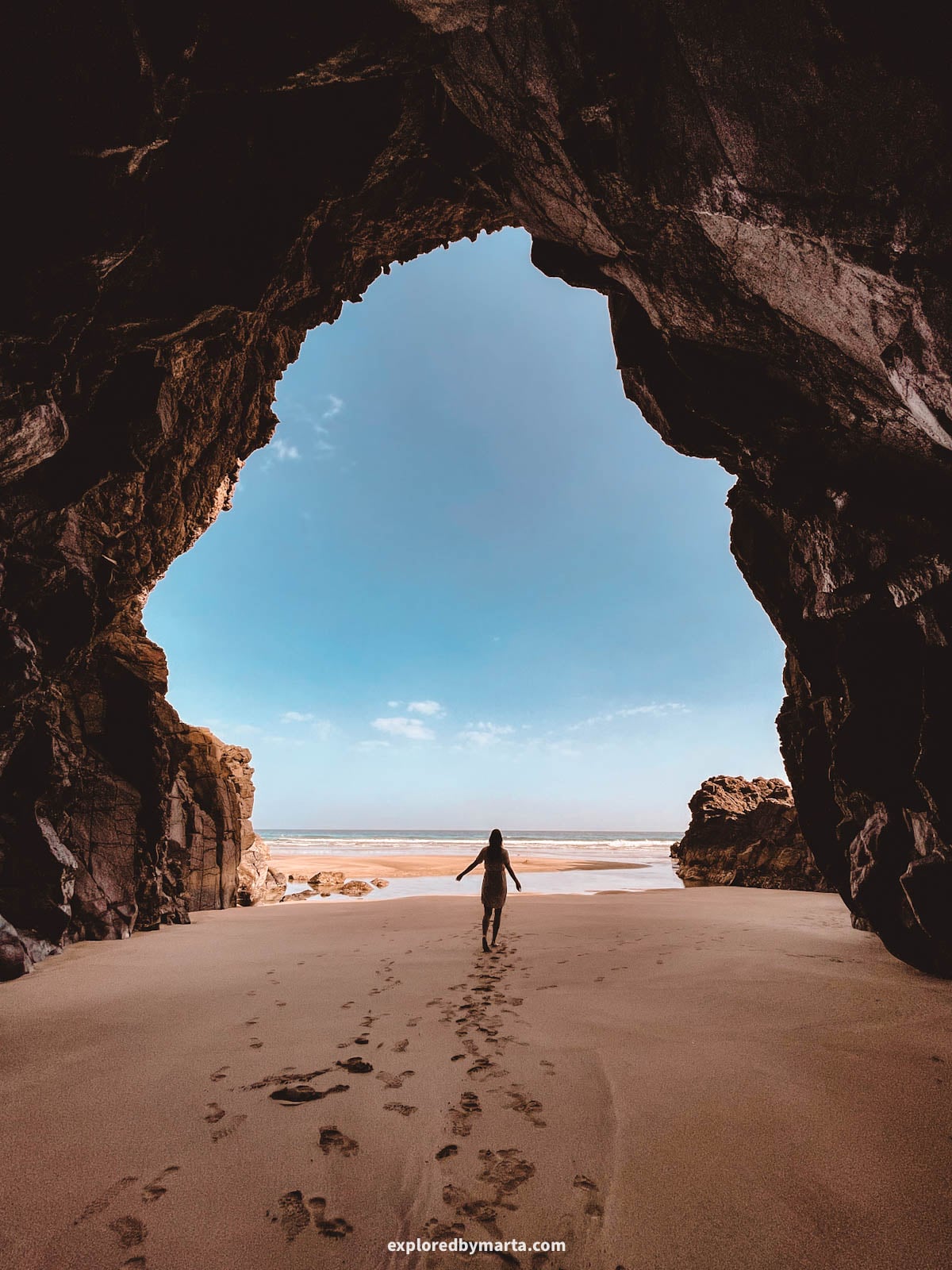
Up in the far north of Lanzarote near Órzola town, the Atlantic has carved a small, scenic sea cave into the black coastal rock – a different kind of formation from all the lava and craters inland.
Sea caves like this one form slowly, as waves pound the same weak point in the rock over centuries until they hollow it right out. So while the island’s tubes and craters were built by fire, this one was carved by water.
To get there, walk along Playa de Órzola until you spot the dark rocks reaching into the sea. The cave sits just behind them. The catch is that you can only reach the cave at low tide. If the tide is low, you’ll get there without any problems.
At high tide it’s a different story – the water floods right in and the waves crash against the rocks, so it’s genuinely not an option. So don’t forget to check a tide table before you go!
Location: Cueva de Órzola
13. Los Hervideros lava coastline
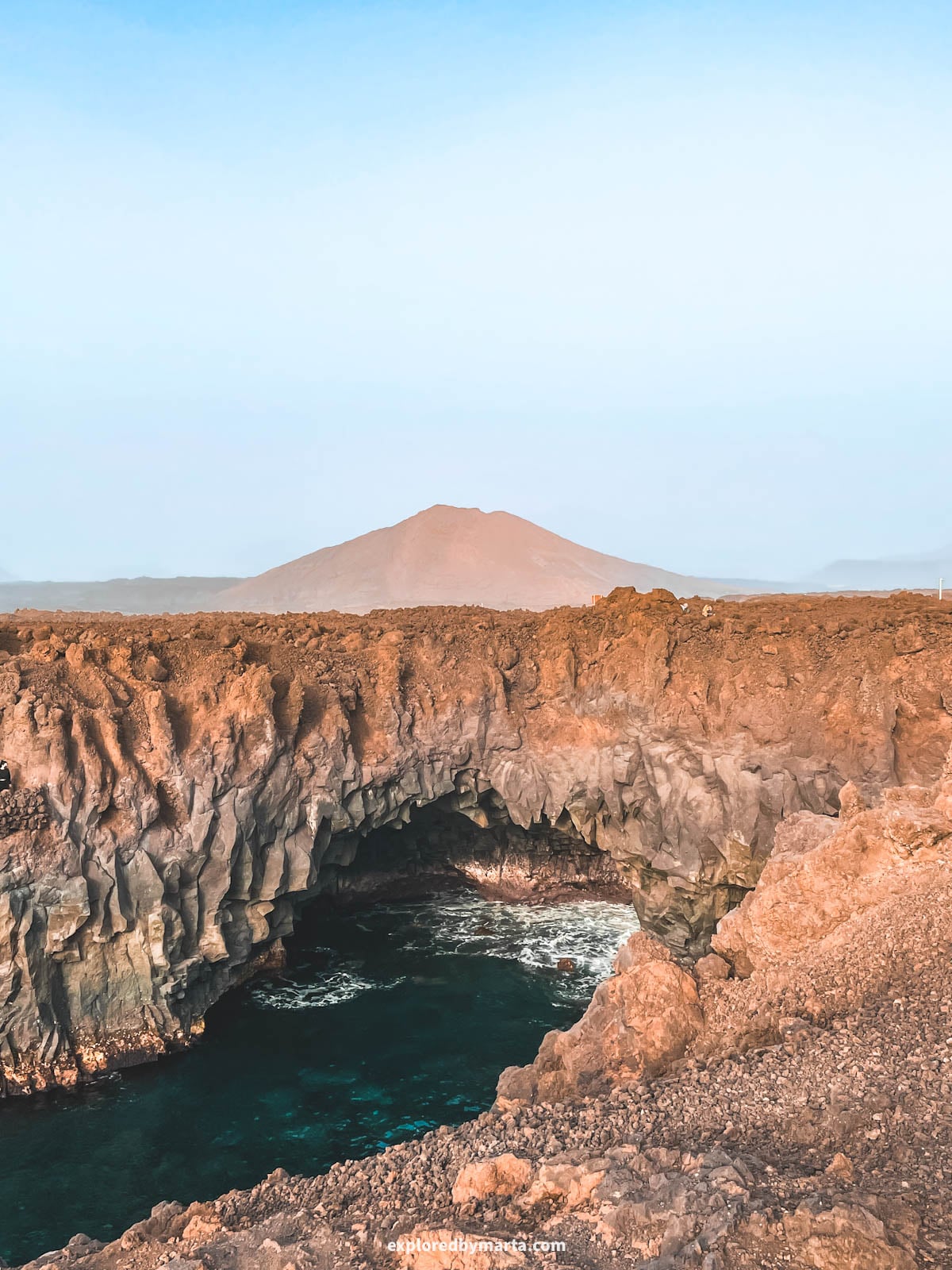
On the west coast, Los Hervideros is where lava and ocean collided head-on, leaving one of the most dramatic coastline spots on the island.
The name Los Hervideros means “the boiling waters,” after the way the sea churns and erupts through the twisted lava rock. As the lava hit the water and hardened, it left caves, holes, and channels all through the cliffs.
There’s a little network of walking paths and viewpoints built into the rock, so you can wander right along the edge and peer down into the blowholes.
And, finally, we have a place in Lanzarote where coming at high tide is actually the best scenario! And if you get the waves – even better! You’ll see the waves crash up through the holes and the whole coast seems to boil.
For me, this was one of the most mesmerizing spots on the island. Even though we didn’t catch the biggest waves, I still could have watched this spectacle for hours, haha.
Location: Los Hervideros
14. Red quarry at Montaña Tinamala
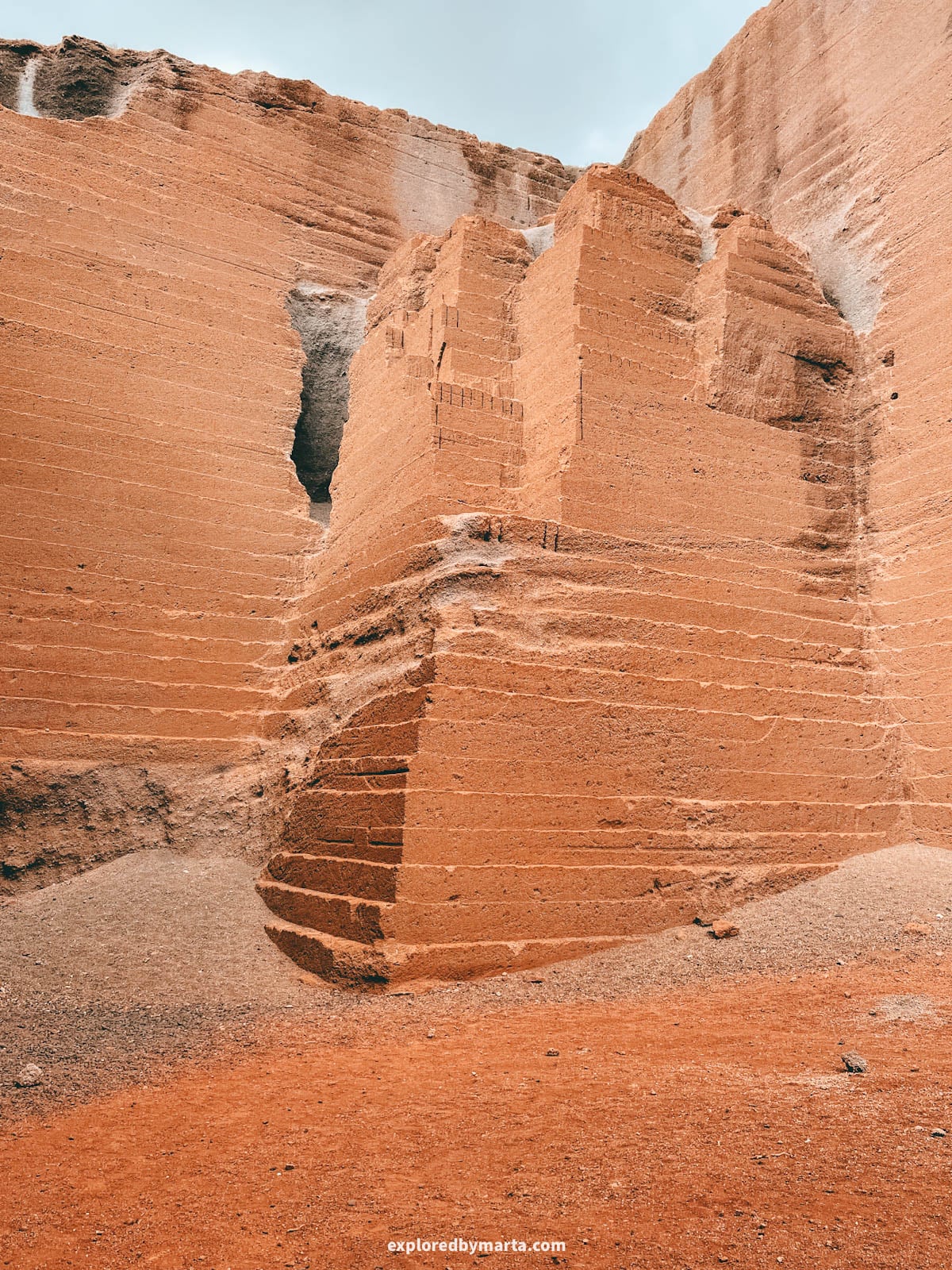
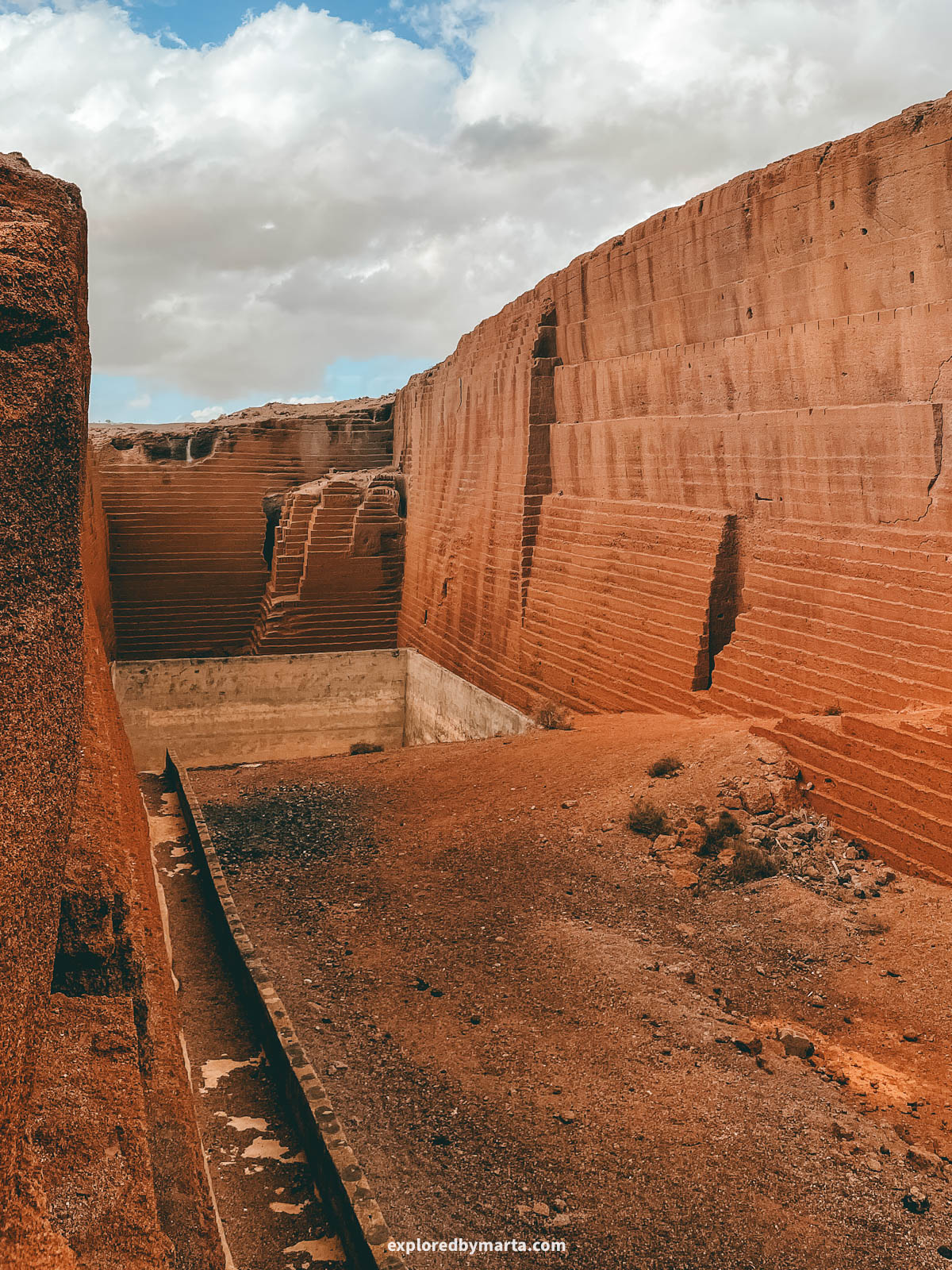
The red quarry at Montaña Tinamala is a proper hidden gem in Lanzarote – a spot only the curious ever find, and one of the more surprising rock landscapes on the island.
It’s not fully natural – it was once mined for “rofe,” the red volcanic gravel used in construction, and today left behind are two big rust-red hollows carved into the Montaña Tinamala mountain.
The color is the draw. The whole quarry glows a deep red-orange, unlike anywhere else on the island, and it feels a bit like stepping onto Mars.
We left our car at the base of the mountain and hiked up on foot. The quarry is private property, but it has long been abandoned. When we visited, there were no fences or signs, but I’ve seen some comments that there may be signs now.
However, you can see the quarries even without entering them if you approach them from above. Really looks like an Egyptian temple or something.
Location: Red quarry at Montaña Tinamala
15. Cueva Paloma sea cave
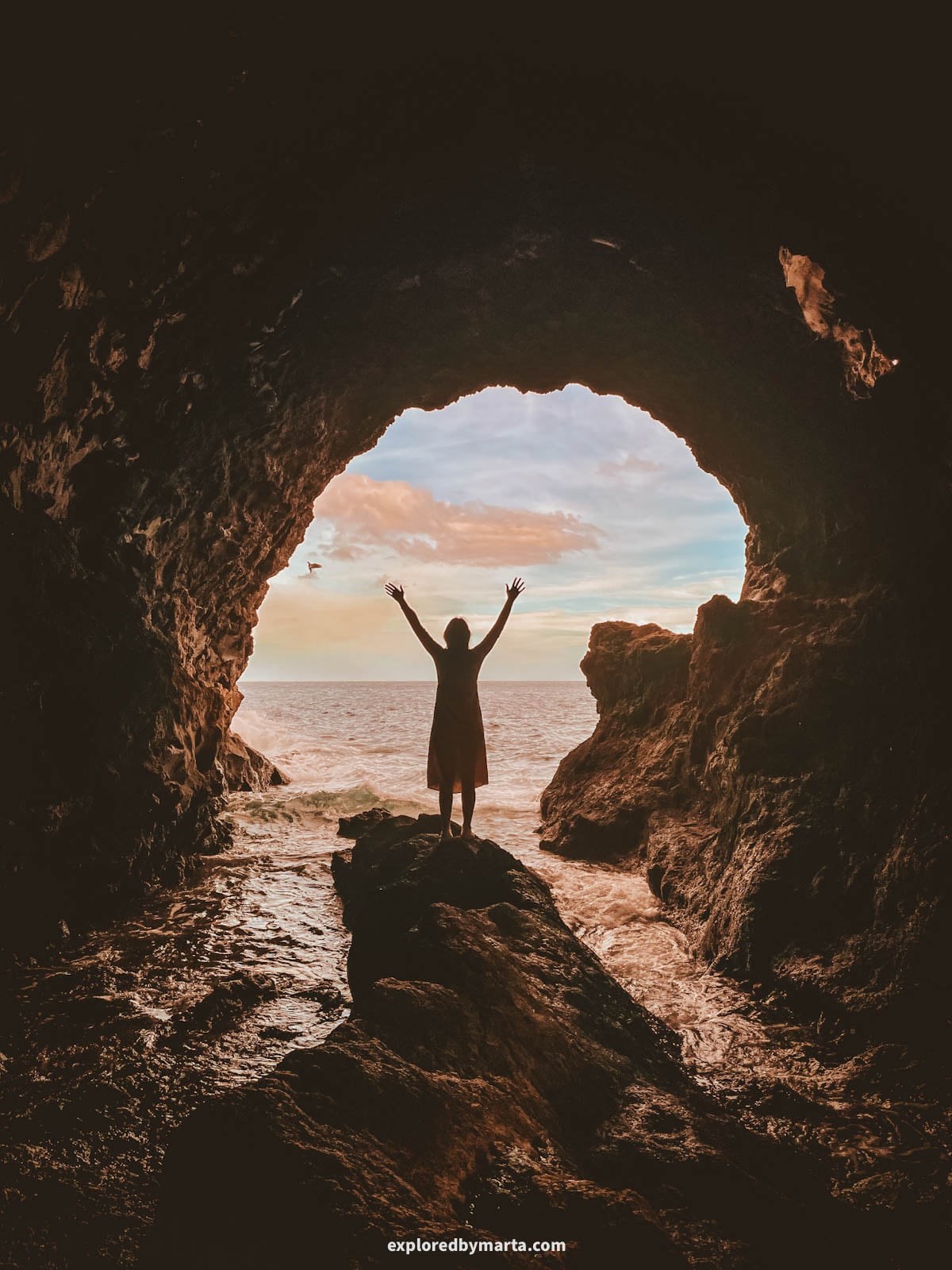
Cueva Paloma is a sea cave shaped like a big lava tube opening straight onto the ocean.
Located over on the east coast, its name means “Dove Cave” (see how I caught one in the photo?), and it’s one of the easiest formations here to reach – a side entrance from the shore lets you walk right in with dry feet. No scrambling, no hiking.
You’ll find it right next to the little village of Charco del Palo, on the island’s east coast. Park at the roadside (we parked on Calle Seifio), and it’s just a couple of steps down to the shore. You’ll see an opening where the location is marked on Google Maps (see below).
As with any sea cave, timing is everything. You need to come closer to low tide and pick a calm day, or the waves will push right inside and splash through the whole opening. The ocean is no joke!
Location: Cueva Paloma
FAQs about rock formations in Lanzarote
How does Lanzarote have so many unique rock formations?
Lanzarote is entirely volcanic, and the eruptions of 1730 to 1736 buried a quarter of the island in lava. That, plus millions of years of older activity and ocean erosion, left the strange lava cracks, craters, and coastal rocks you see today.
Can you take volcanic rock from Lanzarote?
No. Taking volcanic rock, lava, or lapilli from Lanzarote is not allowed, and it’s taken seriously in protected areas like Timanfaya. Leave the rocks where they are so the landscape stays intact for everyone.
What is the most unique rock formation in Lanzarote?
Las Grietas is a favorite for its narrow volcanic cracks you can walk into, and the giant volcanic bomb at Montana Colorada is unmissable. For sheer scale, hiking the Caldera Blanca crater is hard to beat.
Do you need a car to see the rock formations in Lanzarote?
Pretty much, yes. Most of these spots have no public transport and sit at the end of gravel roads or quiet turnoffs, so a rental car gives you the freedom to reach them at your own pace.
Are the rock formations in Lanzarote free to visit?
Most are completely free, like Las Grietas, La Rofera, and Los Hervideros. A few ticketed sites, such as Cueva de los Verdes, charge entry, but the wild formations cost nothing beyond getting there.
Read more about traveling in the Canary Islands
Of all the things that surprised me in the four weeks we spent on the island, it was how alien the ground itself felt – cracked, twisted, and glowing red in places. Lanzarote wears its volcanic history right on the surface.
The best part is how many of these volcanic formations are free, wild, and yours to explore at your own pace. Jump in a car, pack good shoes, and go see the ones that call to you!
If you’re planning a trip to Lanzarote or the Canary Islands and want to learn more about these volcanic lands in the Atlantic Ocean, check out my other guides below.
Read more about Lanzarote:
- 23 best things to do in Lanzarote, Spain (bucket list spots)
- 20 best photo spots in Lanzarote, Spain (with locations!)
- 7 best caves in Lanzarote, Spain (lava tubes and sea caves)
- Ultimate places to see on nearby La Graciosa island
Read more about the Canary Islands:
- Amazing rock formations in Fuerteventura
- The best caves to visit in Fuerteventura
- The best photo spots in Tenerife
- Things to do and places to see in La Palma
- Hidden gems and secret spots in Gran Canaria
PIN FOR LATER!


Paldies! ļoti noderīgi ieraksti.
Lai izdevies ceļojums! 🙂