
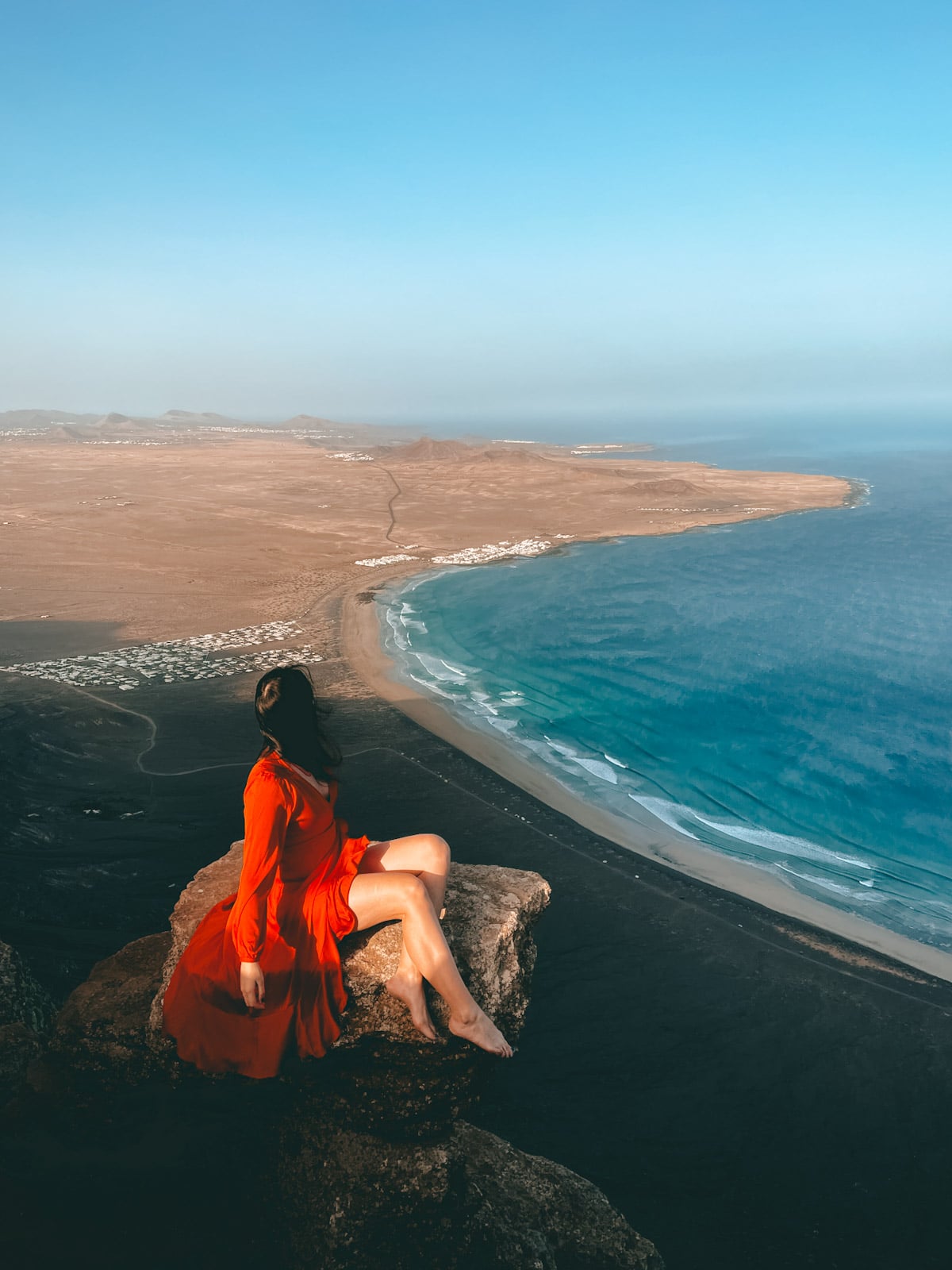
20 best photo spots in Lanzarote, Spain (& locations!)
This post may contain affiliate links. If you use these links to make a purchase or booking, I may earn a small commission at no extra cost to you! Thank you for your support!
It’s no accident that filmmakers use Lanzarote to stand in for alien planets. Black lava fields, underground lava tubes, red craters, and vineyards growing in volcanic ash are just some of the most iconic photo spots in Lanzarote.
And it’s not all volcanic drama, either. There are clifftop miradors looking over a tiny neighboring island, green lakes, golden beaches, and quiet coves – so whether you shoot on a camera or a phone, this island delivers.
The catch is that a lot of the best Instagram spots in Lanzarote are unmarked and easy to drive straight past. We spent four weeks exploring every corner of Lanzarote, so I’ve mapped out my favorite photo spots below, with exact locations for each.
Let’s get into it!
1. Road LZ-67 through Timanfaya National Park
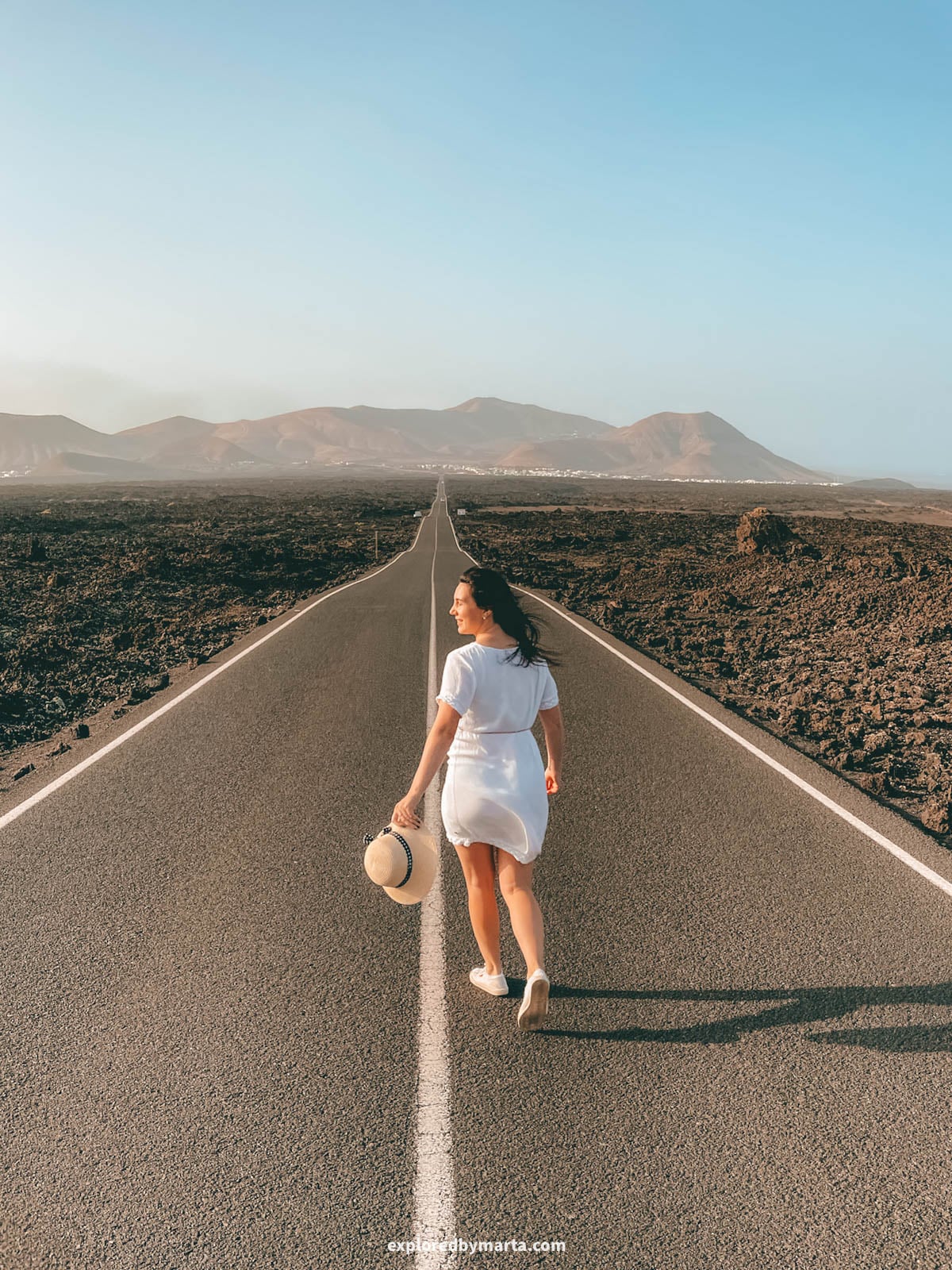
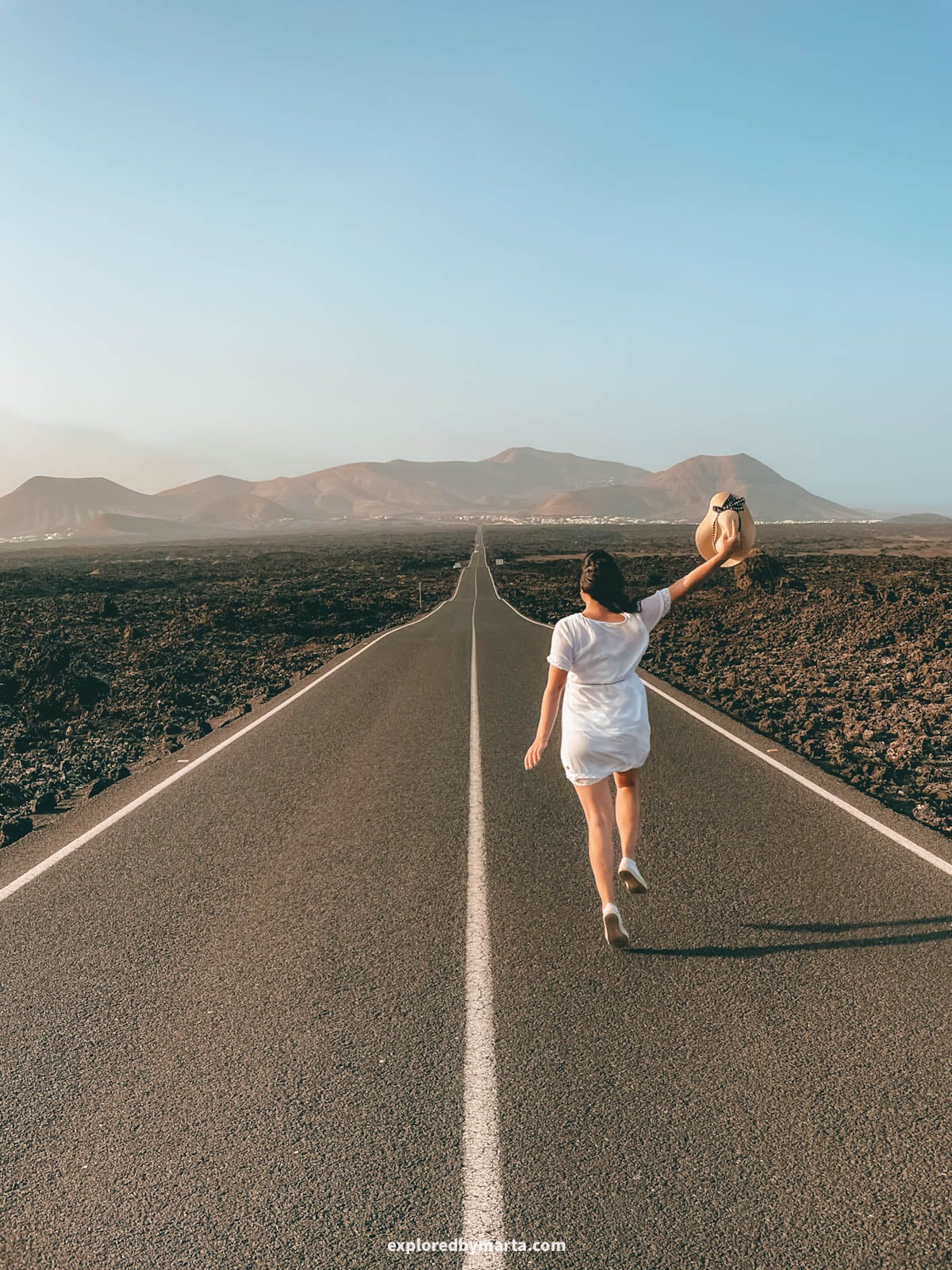
You’ve probably seen those shots of a long, empty road cutting straight through a field of volcanoes. That’s the LZ-67, running between Yaiza and Mancha Blanca right through Timanfaya National Park.
Timanfaya is a protected park you can’t wander into on foot – only on official guided tours. But the road itself is free to drive, and it has two long straight stretches that are perfect for the photo.
Volcanoes rise on both sides the whole way, and it genuinely feels like you’re driving across another planet. It’s the classic Lanzarote road shot.
A safety word, because people don’t think about it: this is a live road with traffic, so be mindful where you park your car! We came very early in the morning so that we don’t disturb anyone.
Even if you skip the photo, driving the iconic LZ-67 road is one of the must-do things in Lanzarote!
Location: Timanfaya National Park – Photo location
2. Mirador del Río
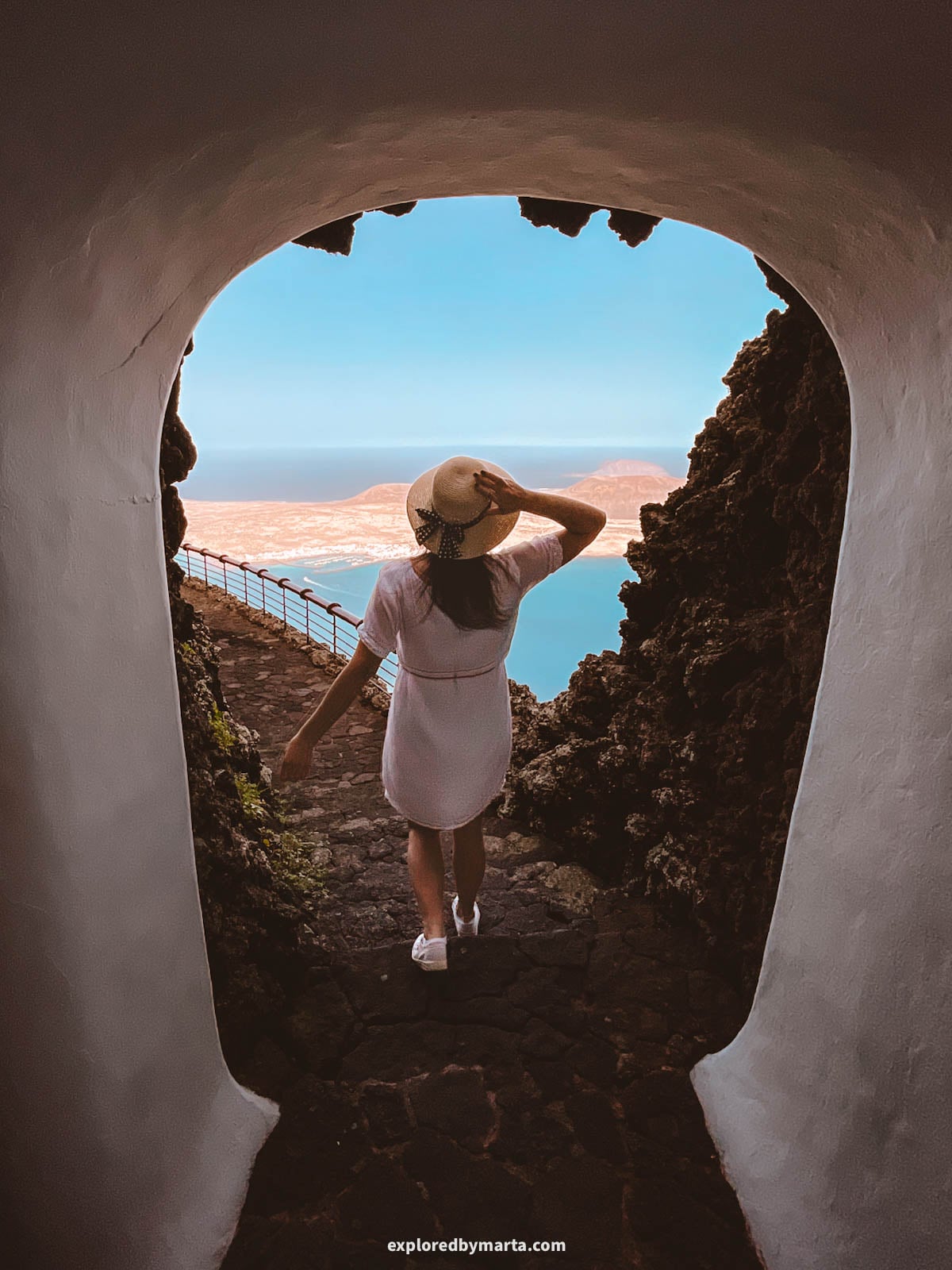
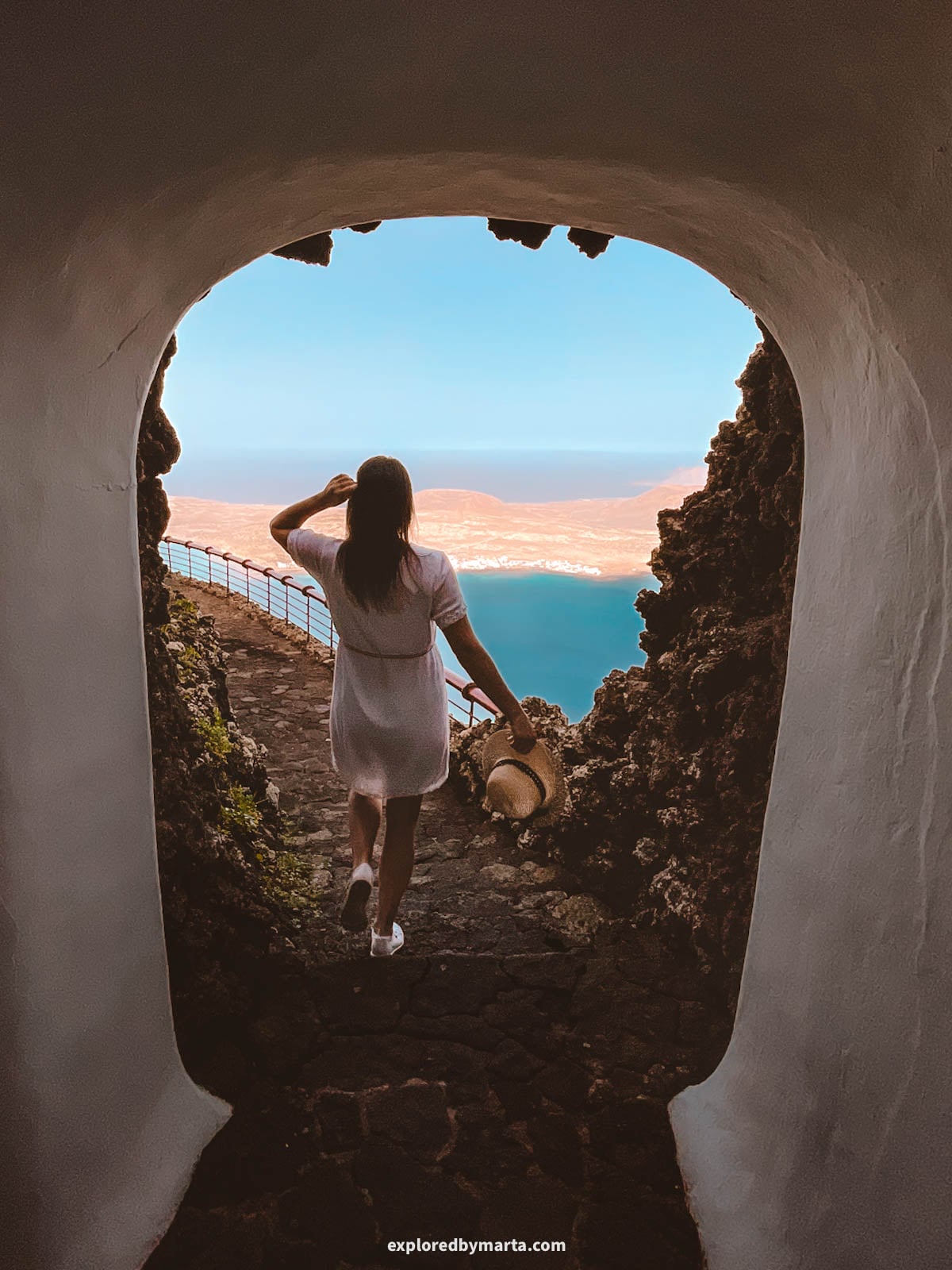
Mirador del Río is the most famous viewpoint on the island, and the draw is as much the building as the view. It’s the work of César Manrique, who carved it into the clifftop so cleverly that it’s almost invisible from outside.
Who’s César Manrique? He was a local artist who shaped how the whole island looks – he fought to ban high-rise resorts and roadside billboards, and turned the island’s volcanic landscape into art. Several of the spots on this list are his work, including Mirador del Río.
Once you step inside Mirador del Río, it opens right up – sweeping curved windows, smooth white arches, and organic stone shapes framing the ocean. The arched stone window and the café’s almost-floor-to-ceiling glass are the signature spots here!
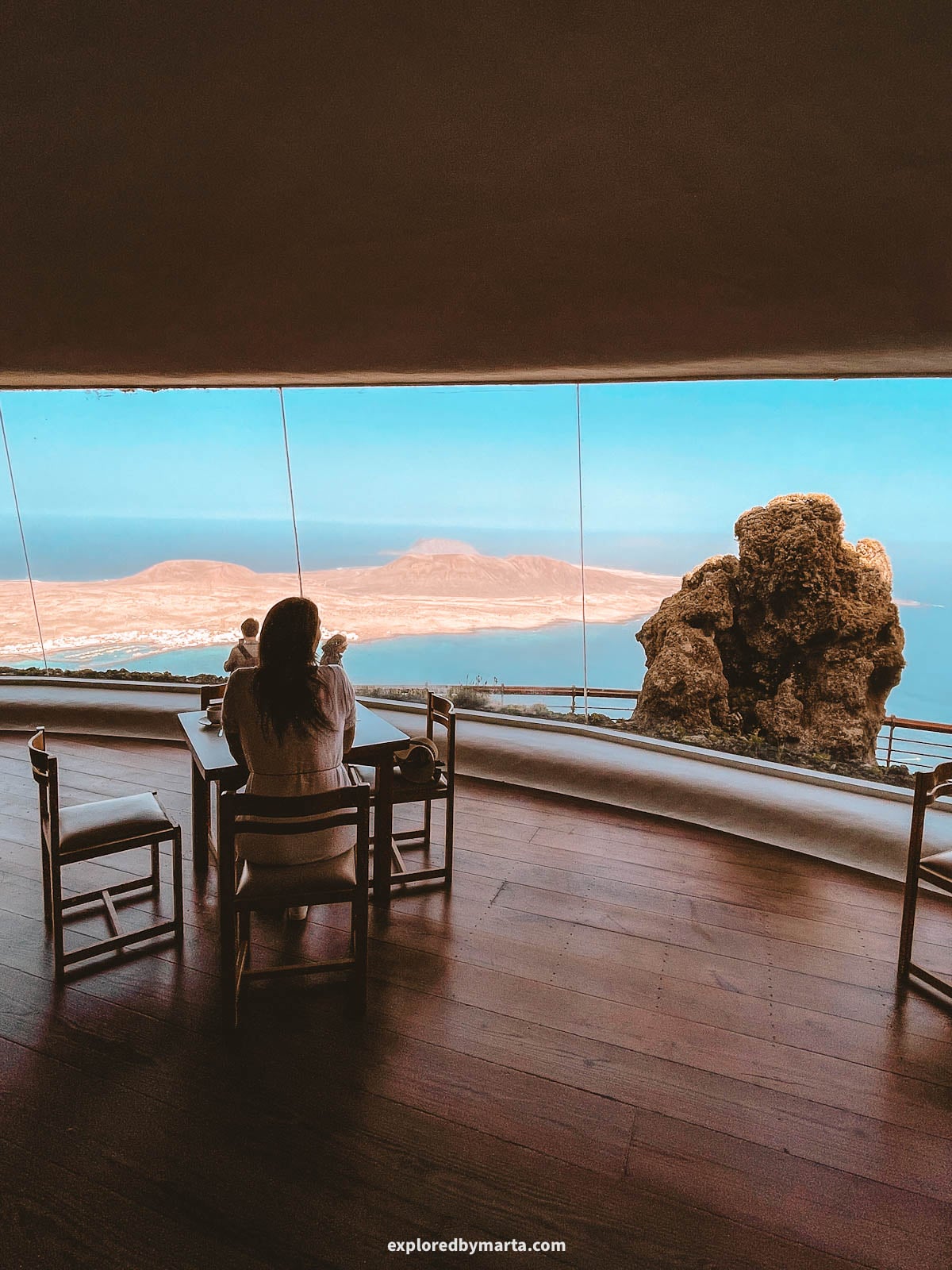
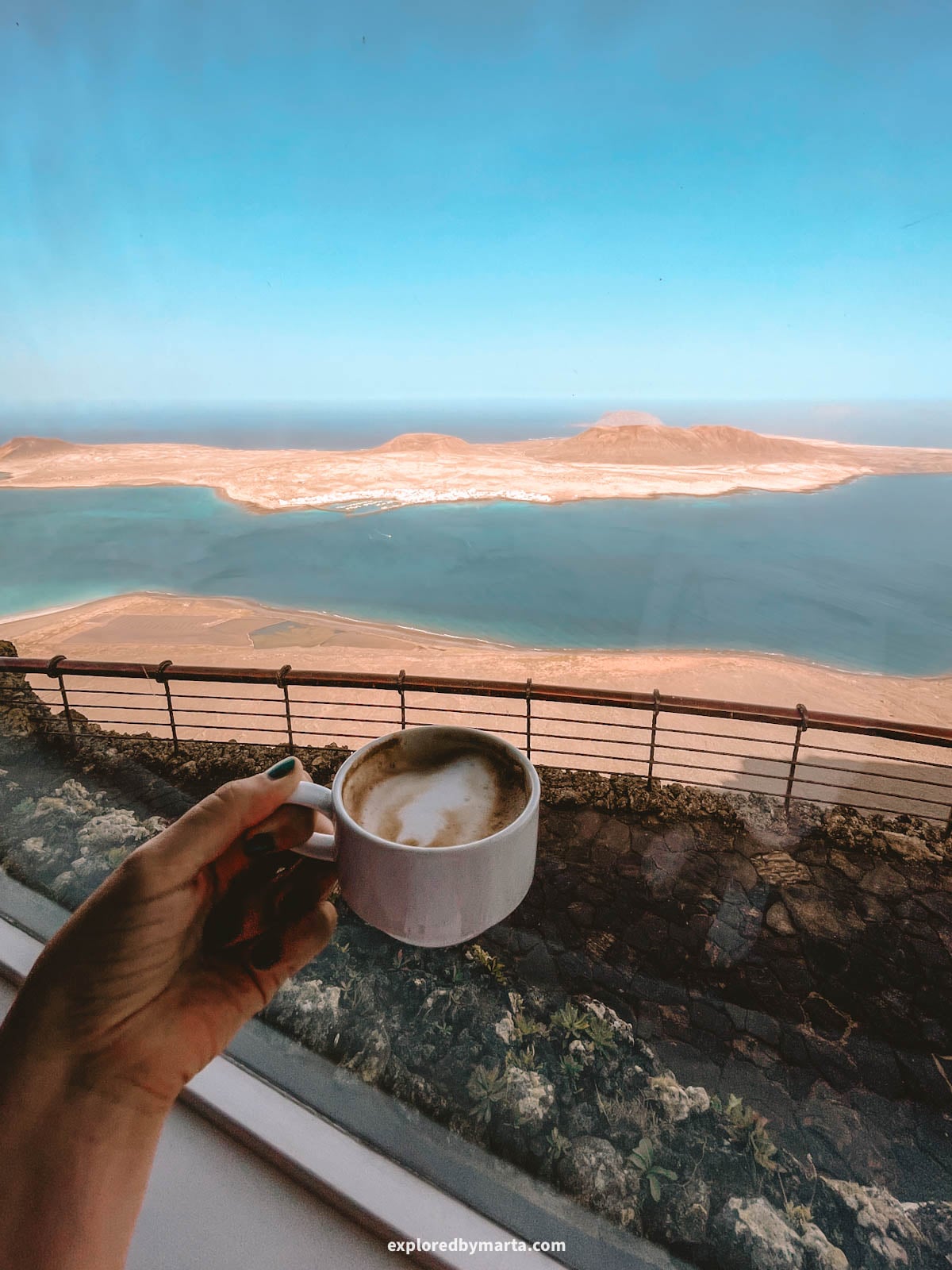
Through that glass you look out over La Graciosa, the little island just off the north coast, its full shape laid out across the water with the smaller islets of the Chinijo Archipelago beyond. Spectacular views, if you ask me!
The outside viewpoint area is free, but going inside the building costs an entry fee (9 EUR for adults), which you can buy ahead on the official CACT Lanzarote site or at the ticket office at Mirador del Río.
Although this is one of the bucket list places to visit in Lanzarote, most people just stay outside for the view, but we wanted to explore the work of César Manrique, so we bought tickets to visit the interior.
The ground floor has a café with that impressive wide-angle view over La Graciosa, so we sat with a café con leche and a Spanish pastry, taking in that view through the glass.
This viewpoint has a parking lot right next to the building, so it is quite easy to get to.
Location: Mirador del Río
3. Playa de Famara
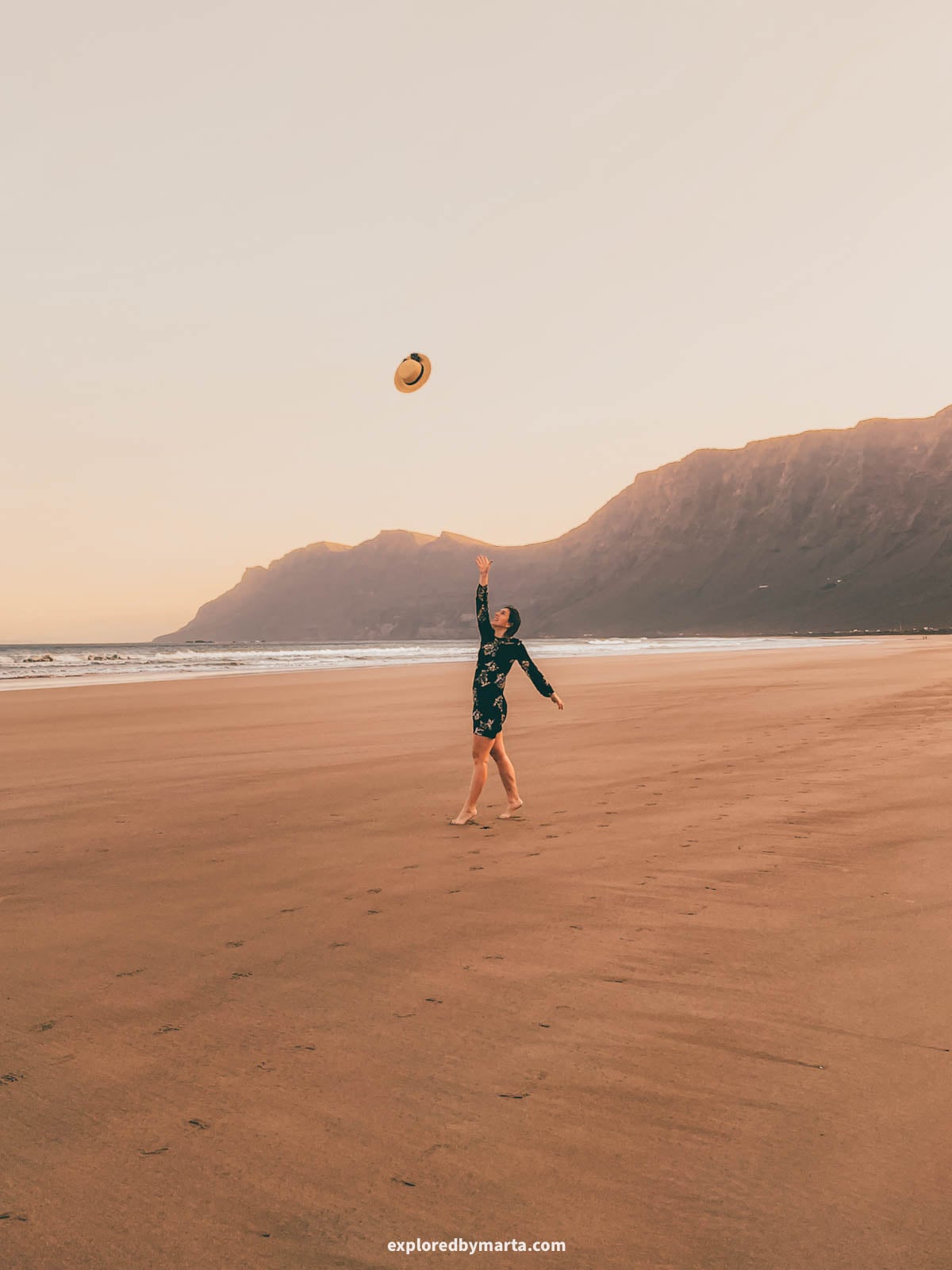
Famara is one of the most famous and photogenic beaches on the island, and one look tells you why. It’s a vast, wide stretch of golden sand with a dramatic backdrop of cliffs rising right behind it.
The Famara cliffs climb to around 600 meters (1,970 feet), including Peñas del Chache, the highest point in Lanzarote at 671 meters (2,201 feet). They make every photo here feel epic!
One thing’s guaranteed here: wind. It’s what makes Famara a favorite with surfers, and you’ll see plenty of them out on the water. If you are looking for a place to learn to surf, this is the place to go!
Come in the morning for empty sand, or in the evening for the chance of sunset light glowing on the cliffs. Both give you very different and very stunning experiences and photos!
Location: Playa de Famara – Parking along the road
4. Mirador de la Piedra and Mirador de Guinate
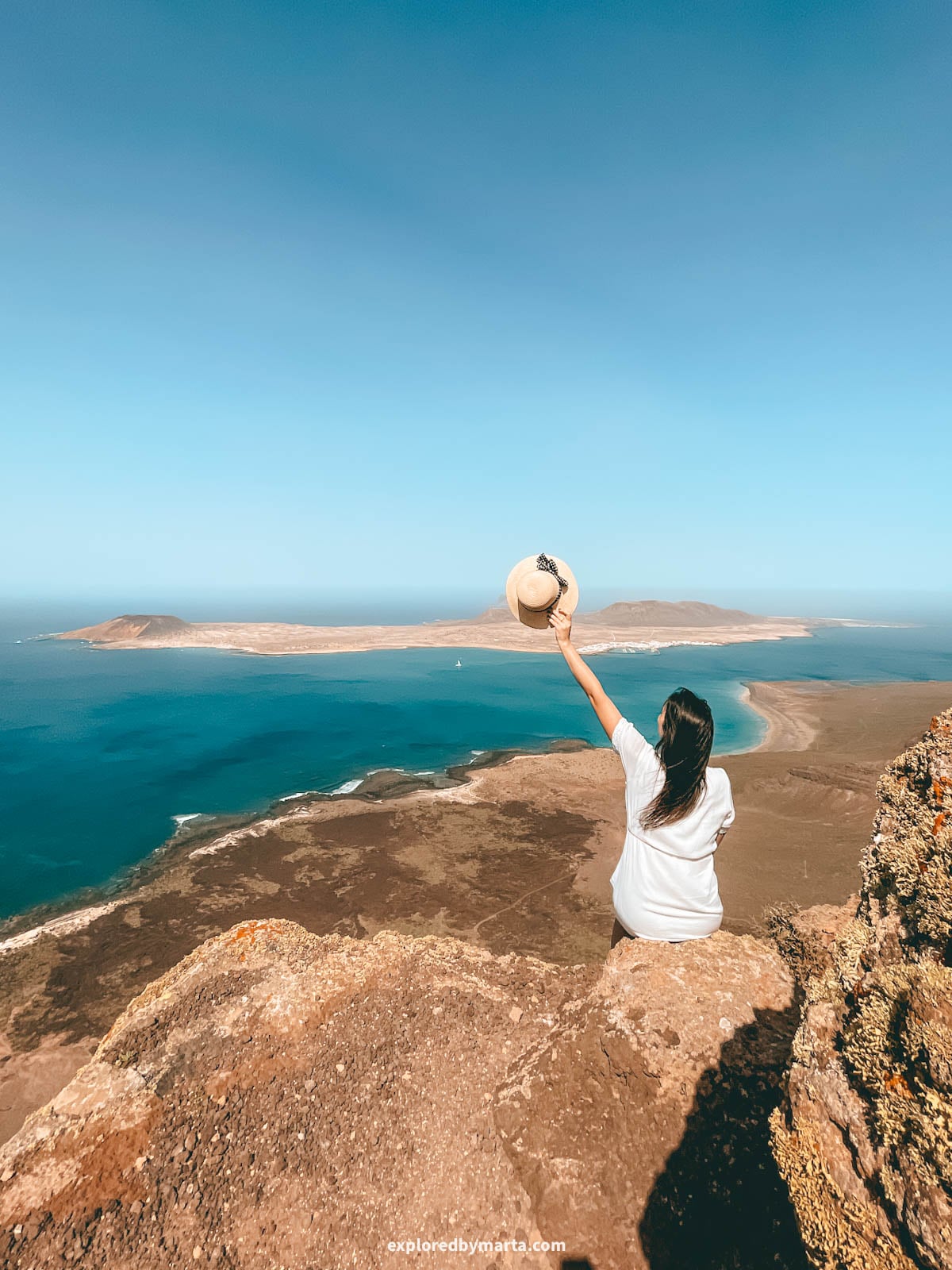
If you don’t love famous places with crowds (I’m talking to you, Mirador del Río!), then I have good news for you, because there are other fantastic viewpoints you can visit for views!
When we wanted a clean shot of La Graciosa island, we drove further along the Famara cliffs to Mirador de la Piedra and Mirador de Guinate.
These two are much quieter viewpoints than Mirador del Río, but have the same beautiful views of La Graciosa. They turned out to be some of my favorite photo spots on the island!
Mirador de la Piedra, in my opinion, has the best view of La Graciosa, with the whole island sitting perfectly in the frame with its volcanoes laid out across the blue water below. Just check my photo above, and you’ll see what I’m talking about!
Just nearby, Mirador de Guinate has its own bonus – right beside it, you can see a solidified lava waterfall from the old eruptions, frozen mid-flow down the cliff. A cool extra reward!
Best of all, both are far quieter than the famous Famara and Río viewpoints, so you can take your time without fighting a crowd. Sounds like a win!
Location: Mirador de la Piedra – Mirador de Guinate
5. Las Grietas
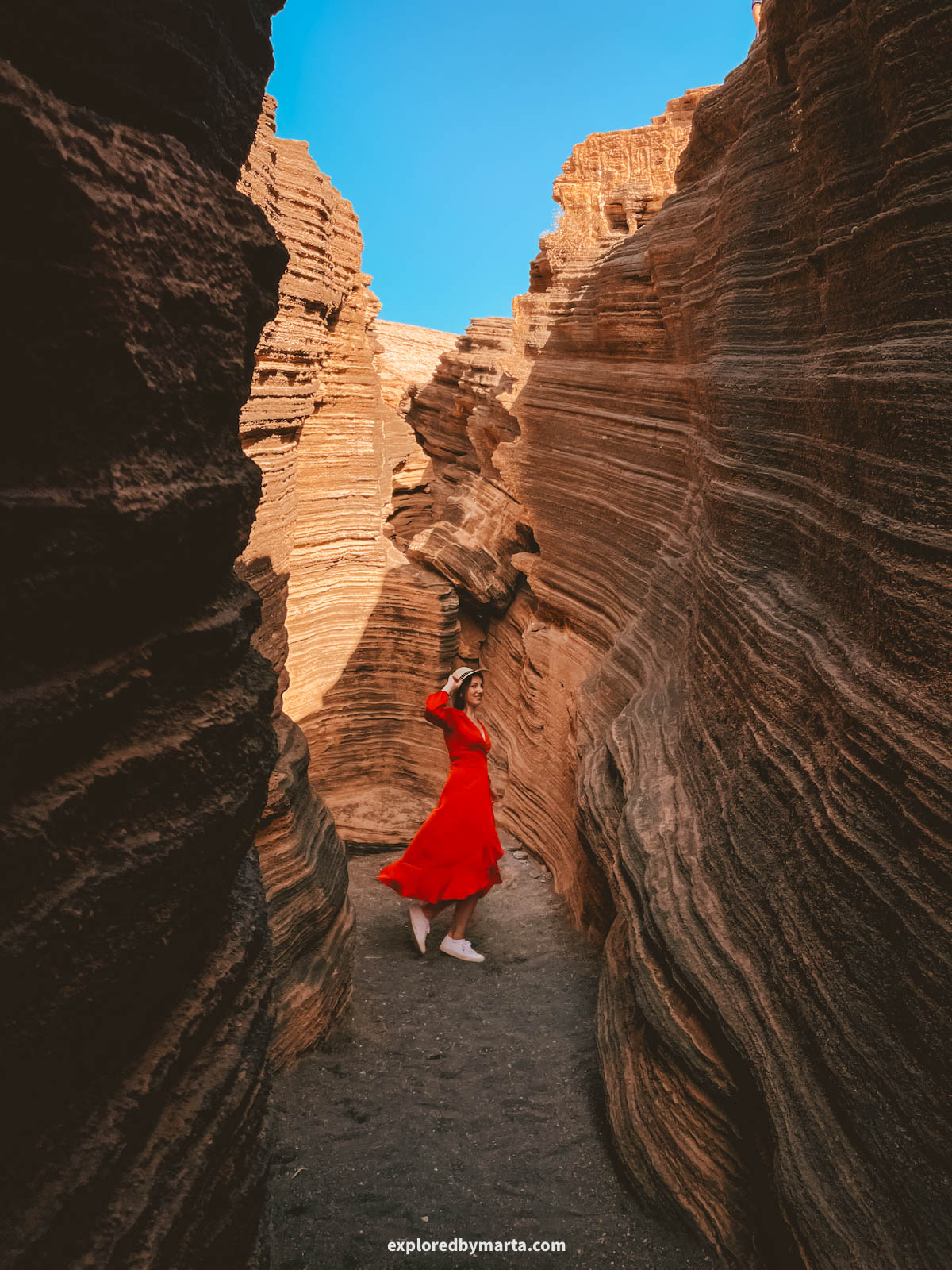
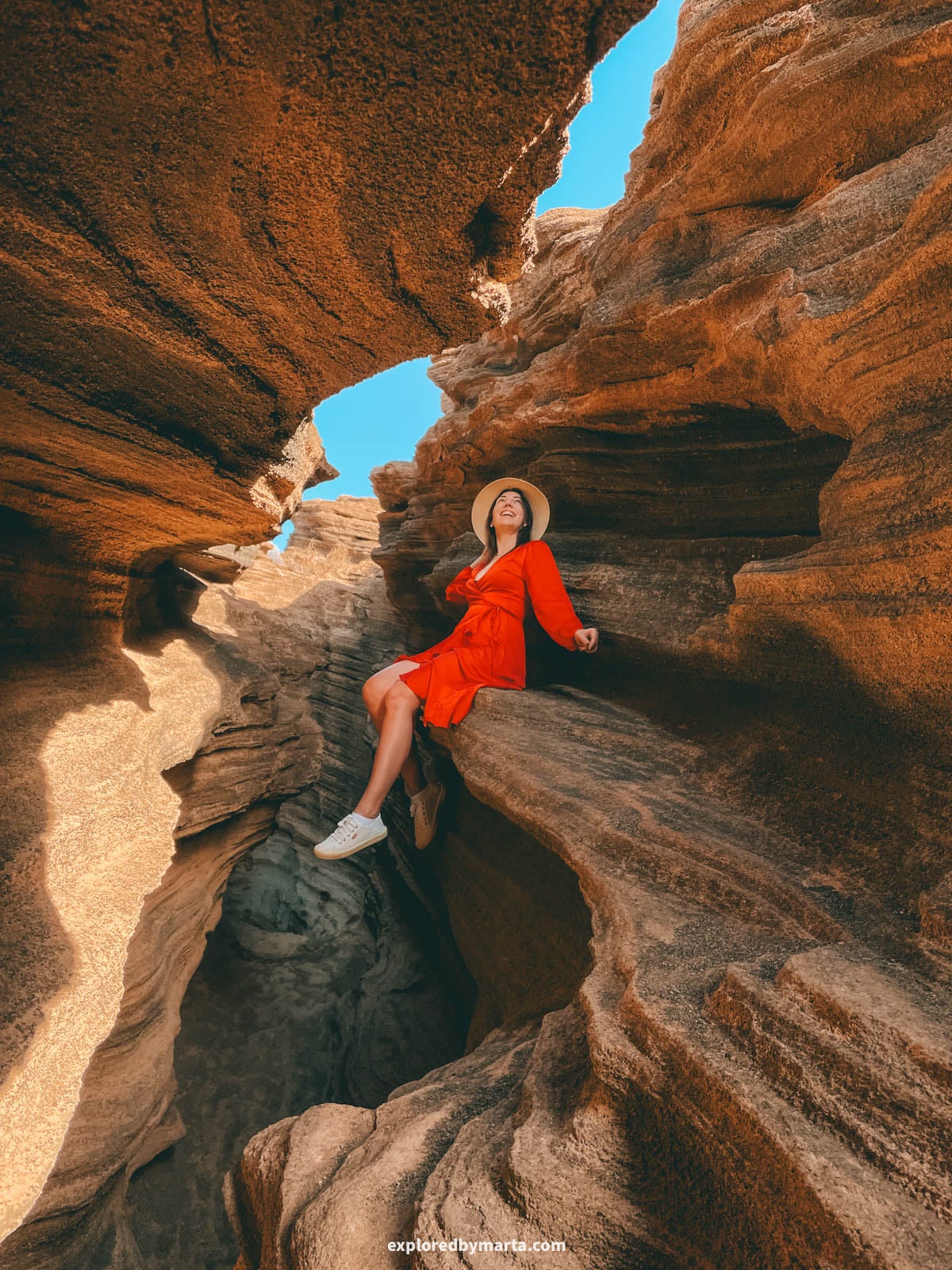
Las Grietas means “the cracks” in Spanish, and that’s exactly what you get – deep, narrow slots carved into the side of the Montaña Blanca volcano, just wide enough to walk right into.
Erosion opened these cracks in the volcanic rock and has been slowly widening them ever since, leaving a maze of twisting corridors tall enough to swallow you up. For a photo, that scale is everything.
The first crack you reach from the parking area is the widest and most popular, so it’s usually where everyone stops. Go as deep as you can go – the end section, to me, is the best for photos!
But don’t stop at the first crack. Follow the dirt path, and you’ll find more – some narrower, some wider, and much quieter. Out of all the unreal volcanic rock formations we found in Lanzarote, these cracks were definitely my favorites!
We came in the morning, when the sun had climbed just high enough to spill light down into the cracks. It looked beautiful, and we nearly had the place to ourselves. Midday is busier, but honestly any time of day works here.
It’s not an official tourist attraction, so there are no signs – just park at one of the two roadside areas (location below) and walk a couple hundred meters over to the cracks. Use the location coordinates below and switch to satellite view to find them.
Location: Las Grietas – Parking lot – Photo location
6. Airplane landing viewpoint
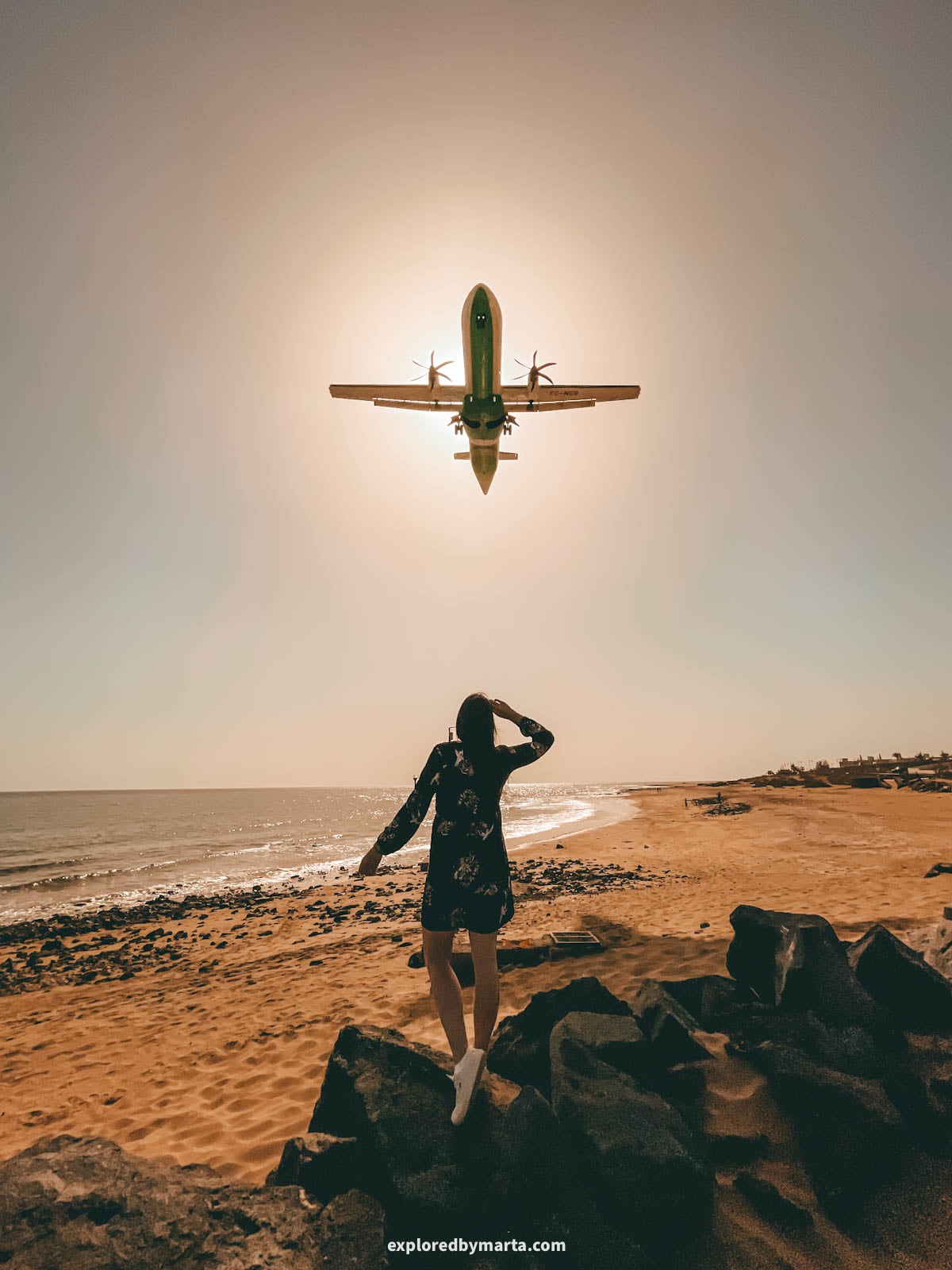
Island life often puts you right up close to the runway, and Lanzarote is a perfect example. You can stand just off the airfield and watch the planes roar in low over your head.
It’s a real adrenaline rush when a plane comes in to land just a few meters above you, and it makes for a fun, unexpected photo you won’t get in many other places.
We parked our car near the residential area (but we saw a dirt parking area right next to the airfield) and walked about 500 meters (1,600 feet) to the spot. It’s an easy walk, because there is a seaside promenade and many people do their daily walks there. Nothing unusual!
For the photo, use a wide-angle setting to fit the whole plane in against the sky.
To time your visit right, check the airport arrivals or flightradar24.com for incoming flights – those are the ones you want to catch approaching from the oceanside.
This was so fun we actually waited for a couple of planes. Interisland flights are quite often so we didn’t have to wait for too long.
Location: Photo location
7. La Geria volcanic wine fields
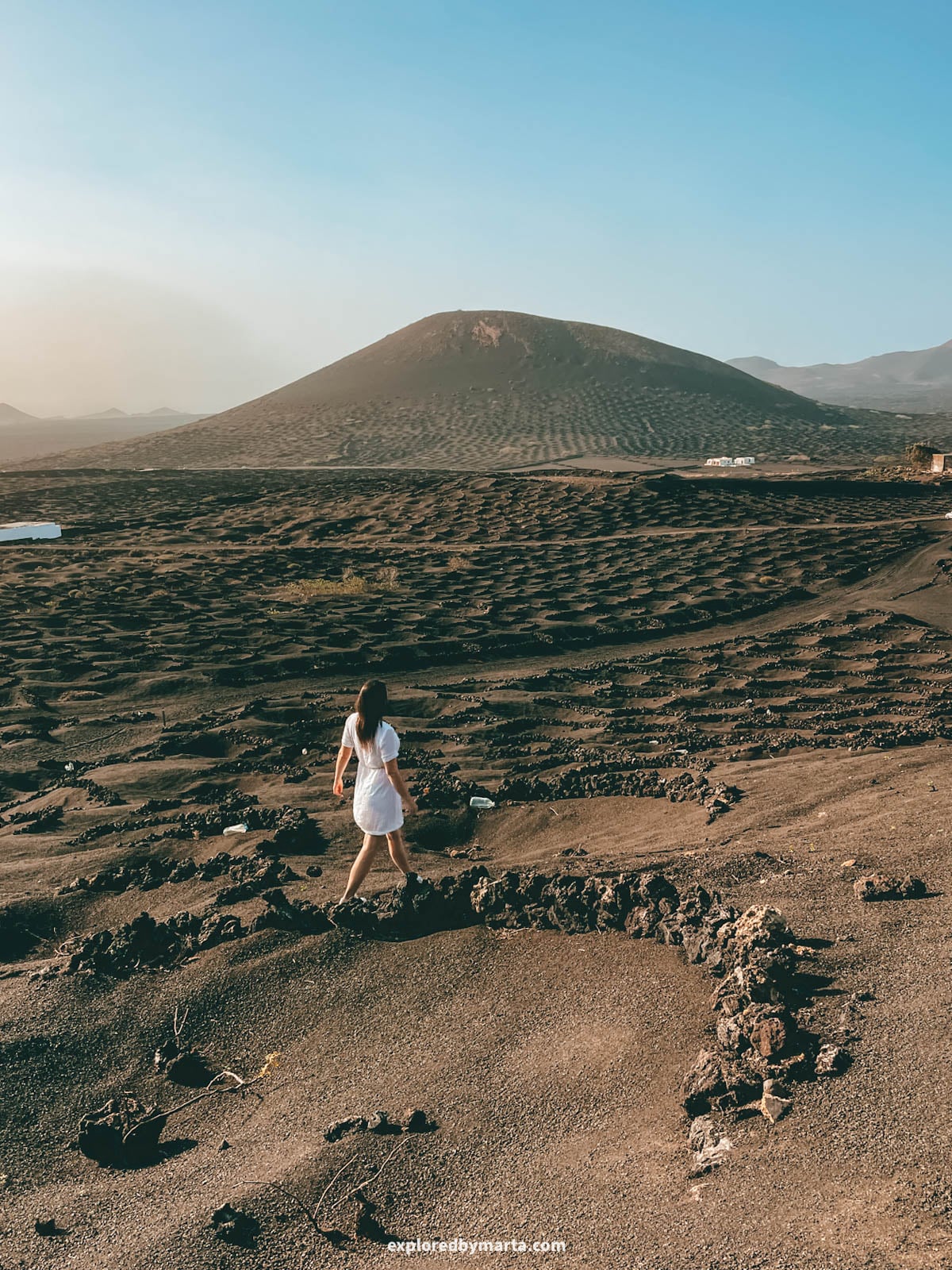
How unique do these grape fields look? Have you seen anything like this anywhere else in the world? La Geria is a whole valley of vines, each one growing in its own black lava pit – and it’s a landscape you won’t find anywhere else on Earth.
After the 1730s eruptions buried a quarter of Lanzarote in ash, farmers adapted by digging thousands of hollows down to the soil below, then ringing each one with a low stone wall to block the relentless wind.
Here’s the crazy part: that black volcanic ash actually traps moisture, which is how the vines grow here with almost no rain. And those black pits produce some seriously good wine!
For photos, the dark crescent-shaped pits stretch across the hillside as far as you can see, and they look their best in low sun when the shadows deepen across the field. You can pull right over along the road to take a photo of them.
My real tip, though: pick a bodega in the area (we picked Bodegas Rubicón), stop for some local wine and tapas, then take a walk through the fields with your camera. The perfect photo spots are all around you here!
Location: La Geria
8. The oasis in Jameos del Agua
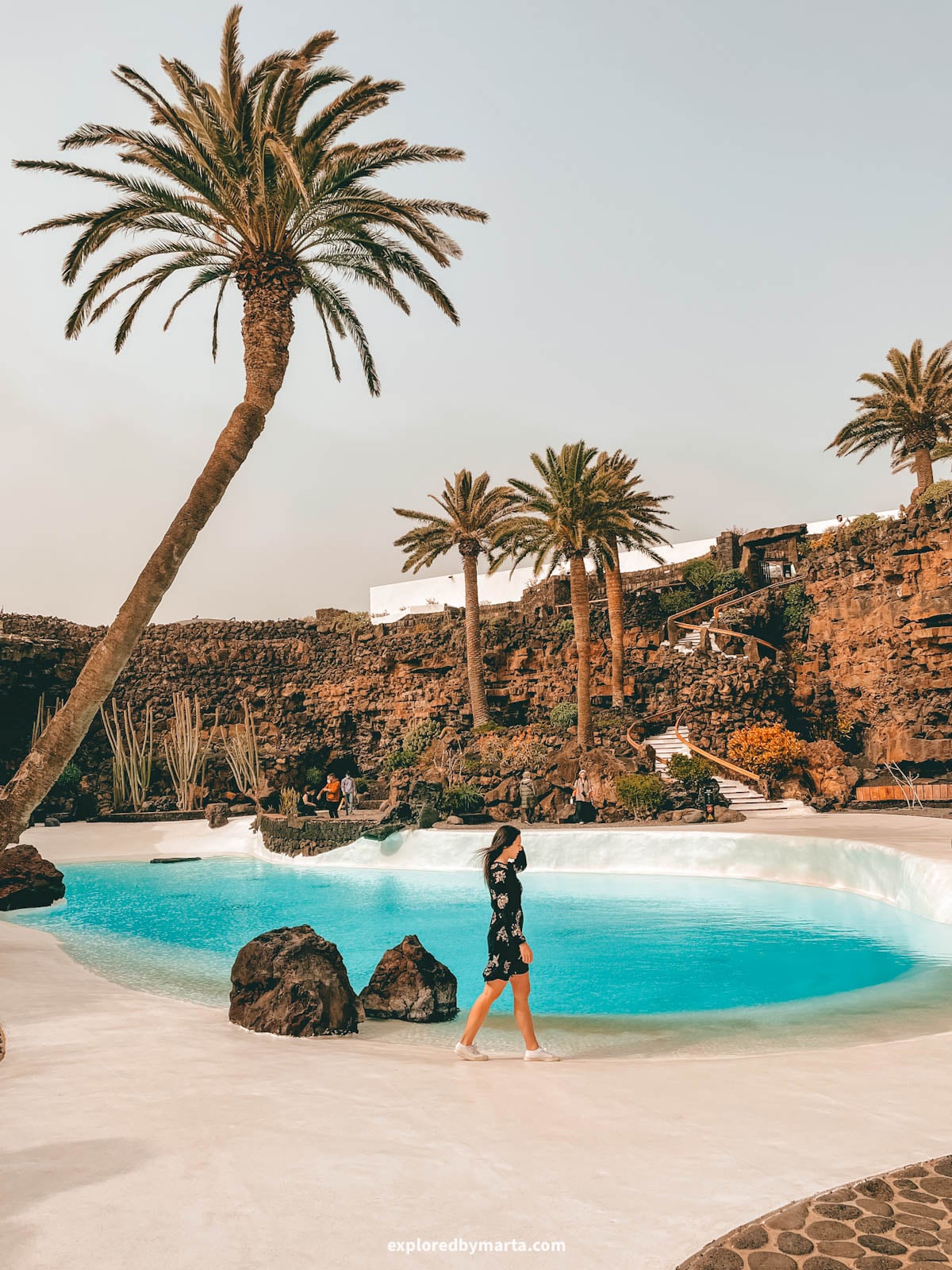
Jameos del Agua is another César Manrique masterpiece, built inside a collapsed lava tube.
And it’s a whole experience!
As you enter, you go down into the lava tube section, where there’s a still, crystal-clear natural lake. Look closely, and you’ll spot tiny blind albino crabs living in it – a rare species found nowhere else on Earth.
Walk on through the tube, past the café, and you reach the showstopper: the oasis at Jameo Grande. It’s a bright blue man-made pool ringed by a white floor, palm trees, rock walls, and little viewpoints looking down over it all.
That oasis is the photo everyone comes for, and it’s easily one of the most photogenic spots on the island. There’s also an auditorium built right into the rock, where concerts are still held.
Entry is 17 EUR for adults, which you can buy ahead on the official CACT Lanzarote site with no online surcharge. You can also buy tickets on site at the ticket office.
For the photos, it is best to arrive in the morning to enjoy the place before the tour groups pour in. It’s one of the most popular places on the island, and it fills up fast.
Location: Jameos del Agua
9. Cueva de los Verdes
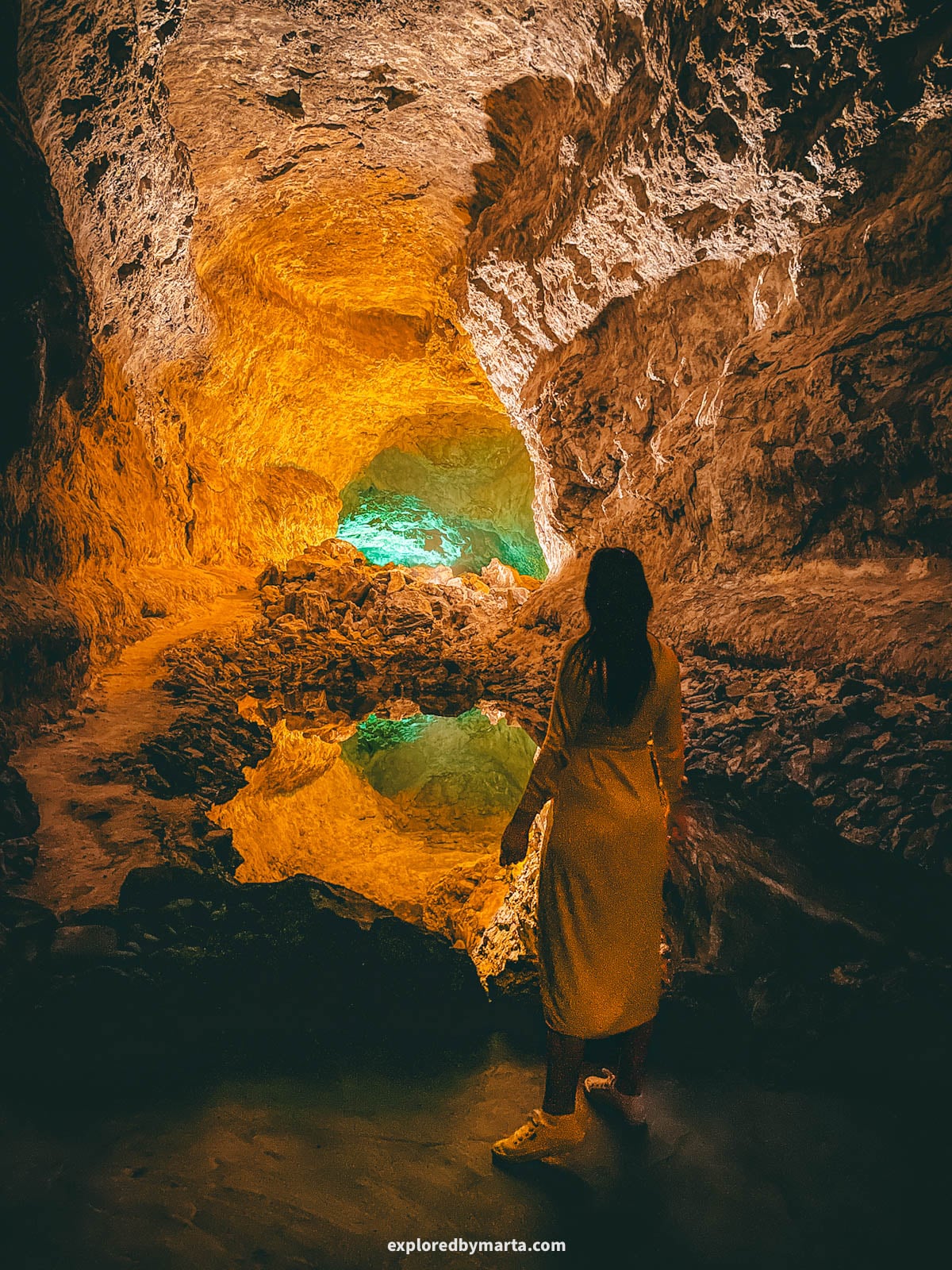
Cueva de los Verdes is an underground lava tube you explore on a guided tour, and it’s genuinely one of the most dramatic places to photograph on the island – all sculpted rock, deep shadows, and clever lighting.
This tube runs all the way out under the Atlantic, ending in a 1.5-kilometer (0.9-mile) underwater section called the Túnel de la Atlántida – the longest known volcanic submarine lava tube on Earth. How wild is that?
The interior lighting was designed by artist Jesús Soto to bring out the textures and colors of the rock, so the whole guided tour is set up to look striking. There’s a famous optical illusion near the end – you can see it in the photo above.
Can you guess what’s happening there, hehe?
Entry is 17 EUR for adults, bookable on the CACT Lanzarote site. This is probably the busiest place in all of Lanzarote, so you need to buy tickets in advance for a set time slot. Do not be late!
Despite its popularity, I highly recommend visiting this place! Out of all the caves we visited in Lanzarote, this was, without a doubt, the most spectacular cave of all. A memory for a lifetime!
Cueva de los Verdes sits right next to Jameos del Agua, so most people do both in one trip. We had different plans, so we visited them on different dates. That way, we managed to visit both in the morning hours and skip the crowds.
Location: Cueva de los Verdes
10. Playa de Papagayo
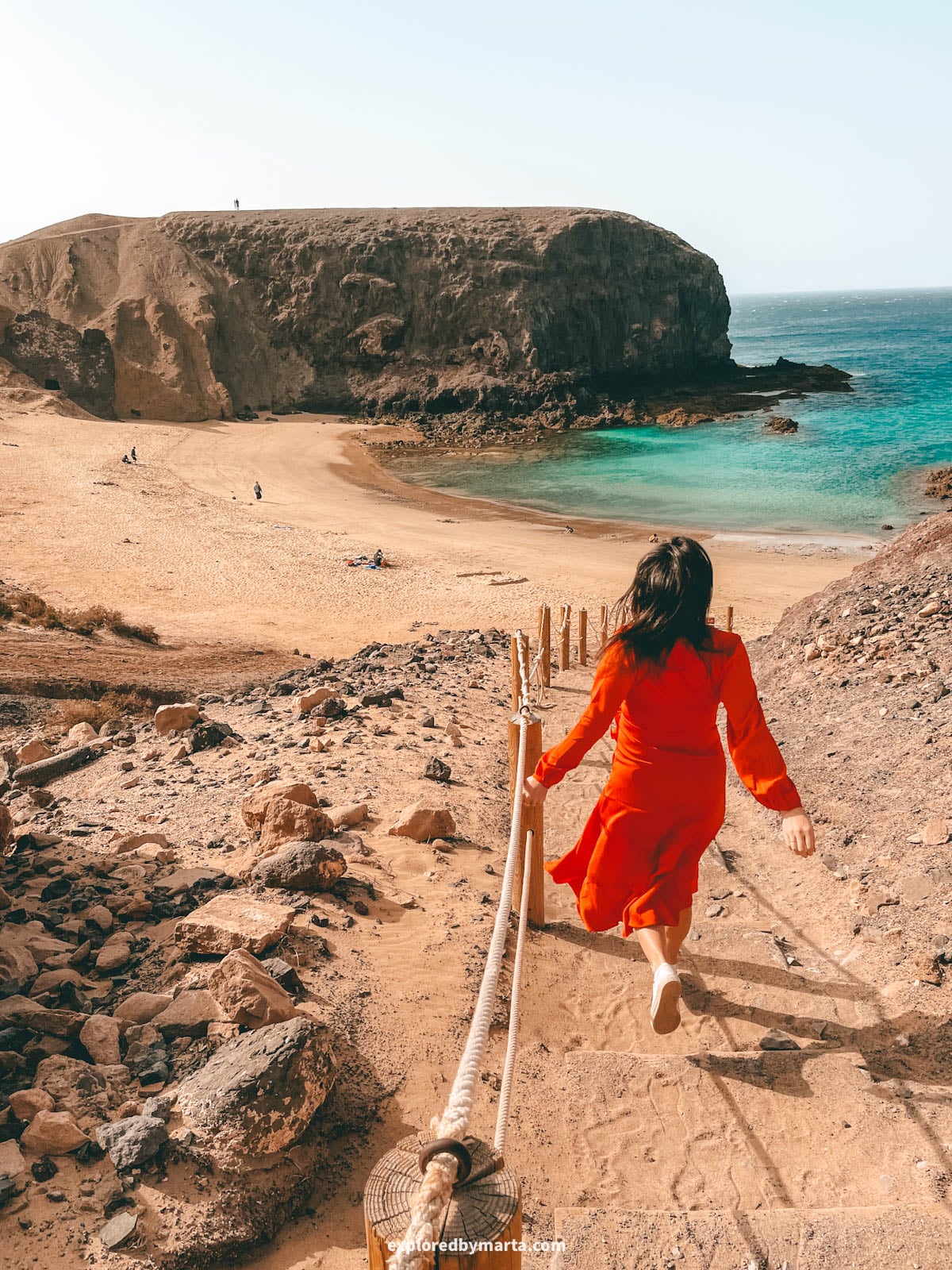
Playa de Papagayo is considered the most beautiful beach on the island – a shell-shaped cove of golden sand between tall cliffs, which shelter it from the wind and give it that postcard look from above. How iconic!?
The best photo is from the cliff looking down, where you get the whole curve of the bay and the turquoise water. It’s one of those beaches you’ll want a shot of before you even head down to the sand.
Getting there is part of the adventure – if you drive from the Playa Blanca direction, it will be a 6-kilometer (3.7-mile) drive on rough, bumpy roads. There’s a small hut along the way where you pay a 3 EUR per car nature fee (by card only), since it’s a protected area.
Honestly, it’s a small price for the views, but I do hope they can finally improve the access road one day… fingers crossed! If you plan to stay longer, there’s even a beach restaurant right by the beach where you can grab lunch.
Location: Playa de Papagayo
11. Mirador de El Risco de Famara
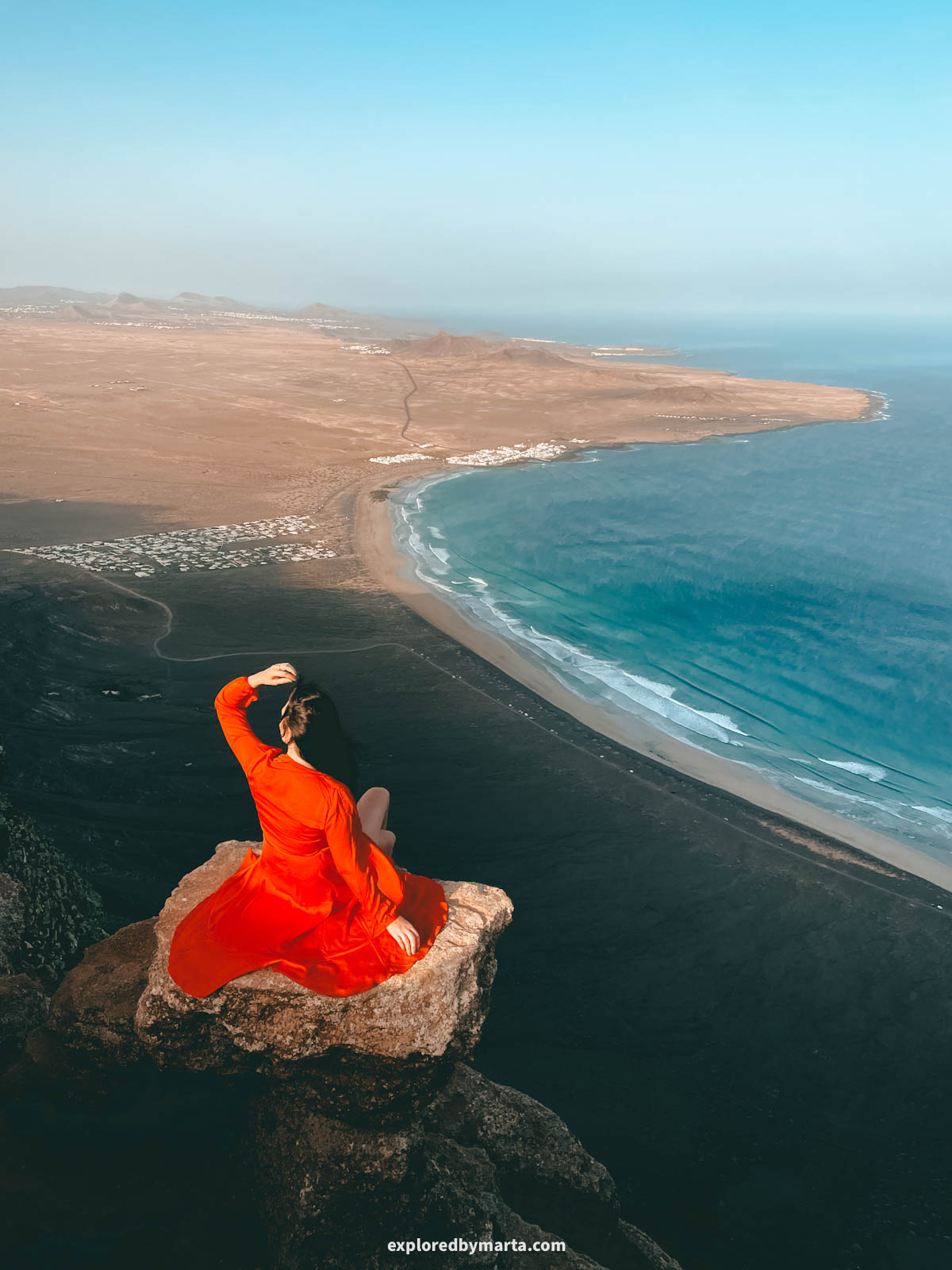
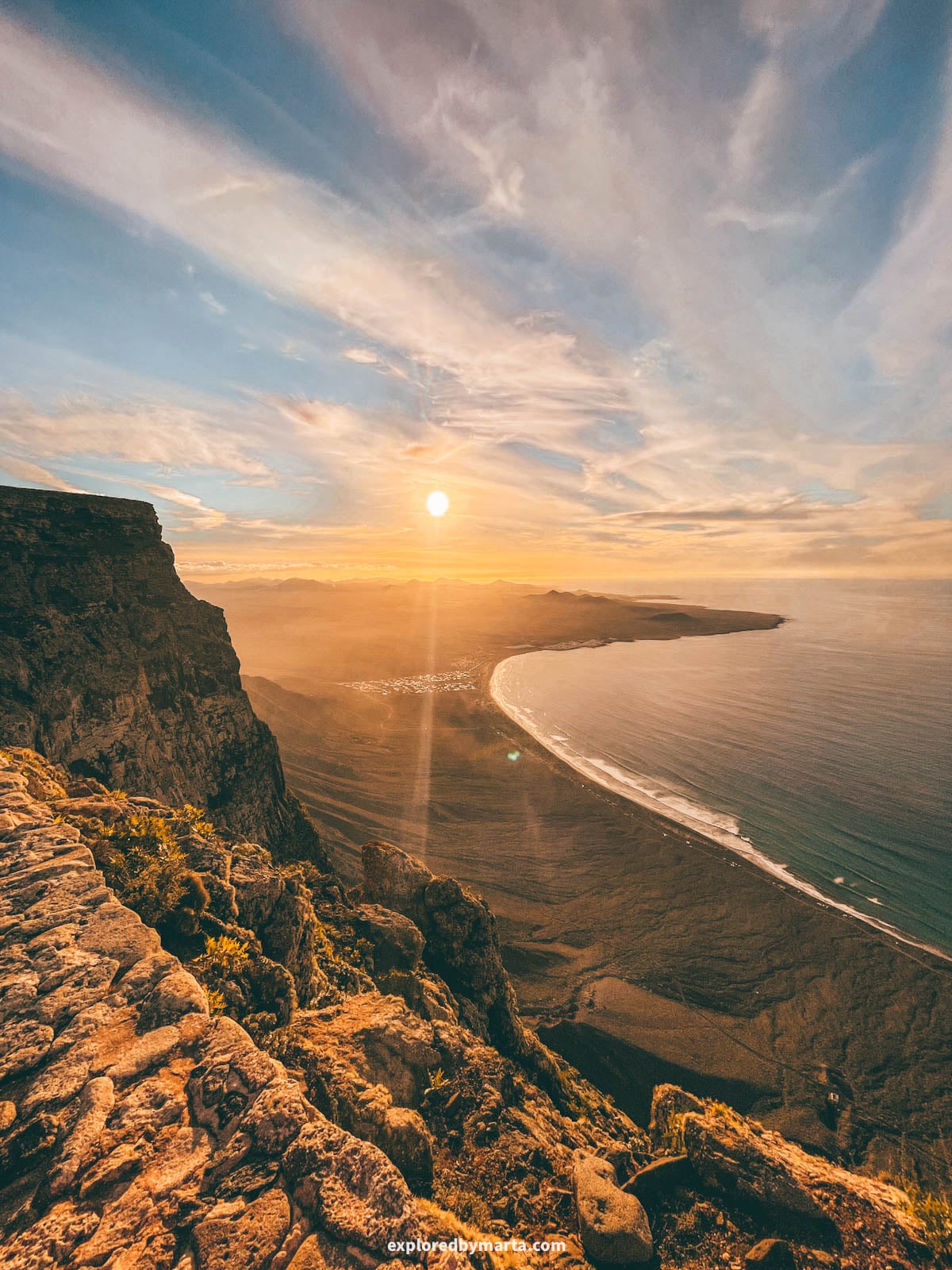
Mirador de El Risco de Famara is one of the best sunset spots on the island. Or maybe it is the most famous one? Could be.
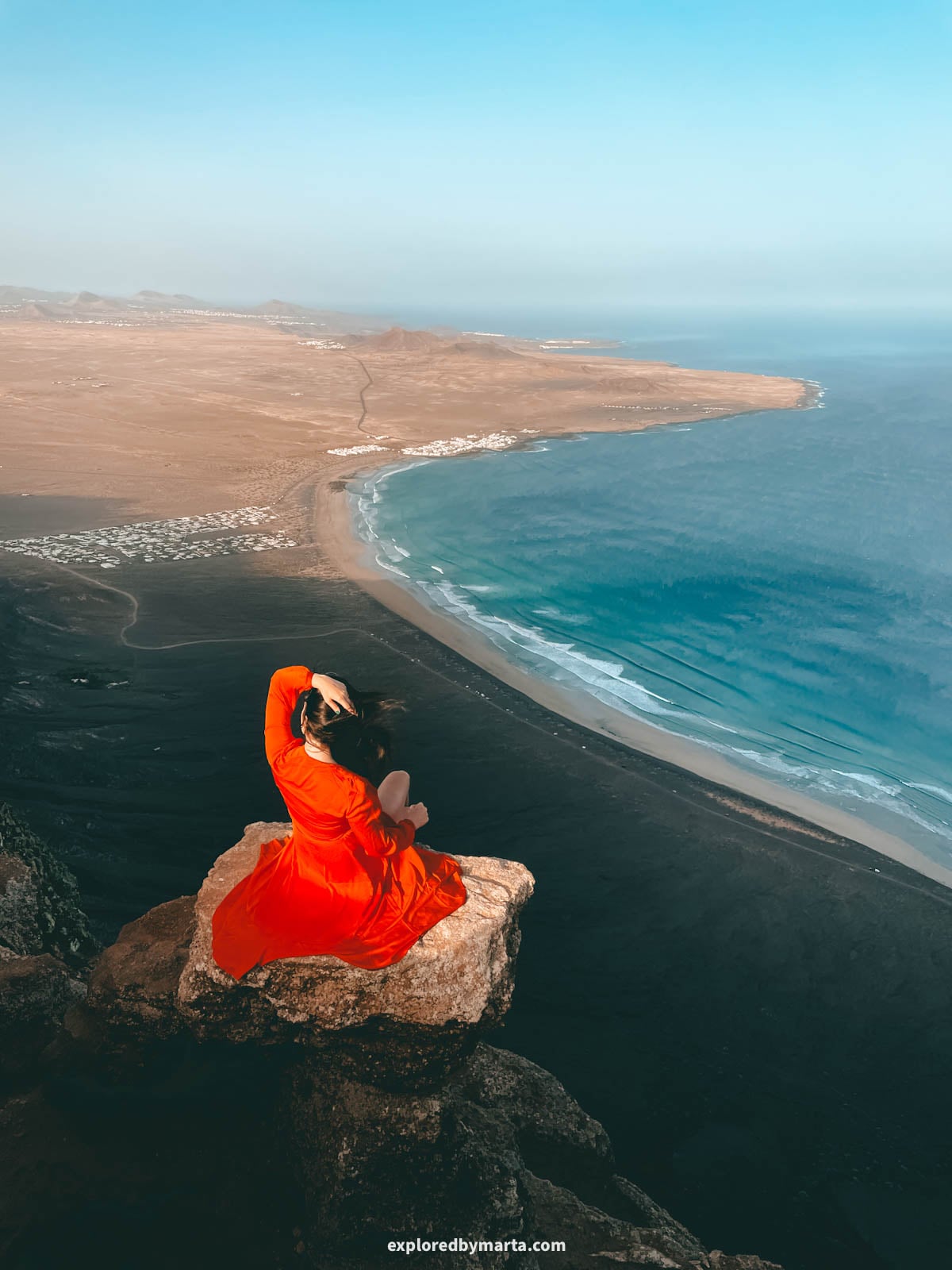
From high on the Famara cliffs, you look down over Caleta de Famara, the wide sweep of Playa de Famara, and the volcanic landscape behind – all glowing at golden hour.
Right near the same viewpoint spot hides a wild photo bonus: the floating rock. It’s a flat rock pillar separated from the main cliff, so when you sit on it, you look like you’re floating in thin air over the drop below.
Only for the daredevils who aren’t afraid of heights! It’s wider and sturdier than it looks, so I felt fine out there, but it is not completely safe – there is a big drop down the cliffs.
We actually came to the cliffs twice – in the morning to explore the area without crowds when we explored the Cueva de las Cabras cave and the floating rock, and then in the evening simply to watch the sunset from Mirador de El Risco de Famara.
But no matter what time you come, the views are stunning either way.
Location: Mirador de El Risco de Famara – Floating rock
12. Cueva de las Cabras
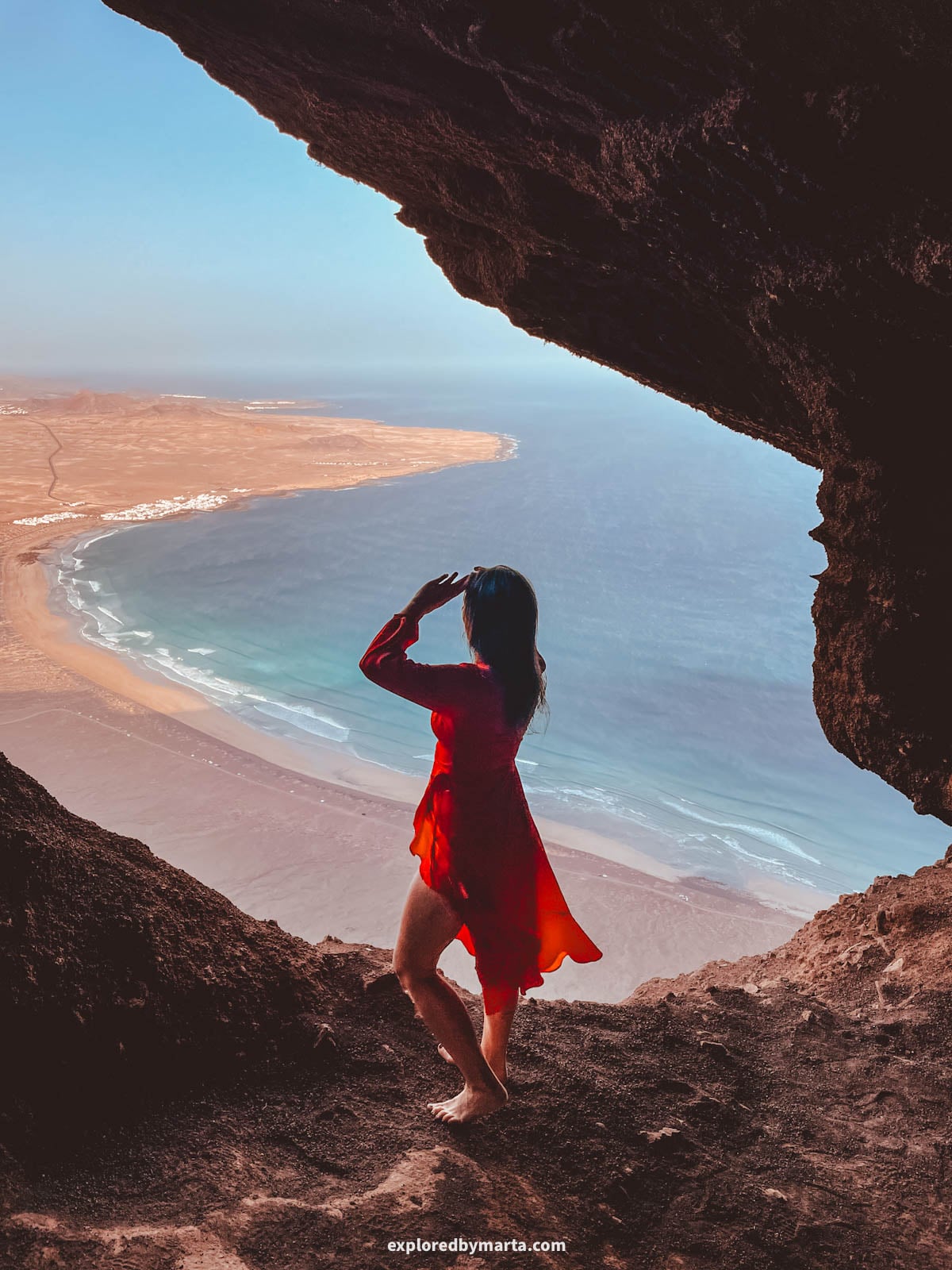
Just a few careful steps down the cliff from the floating rock, Cueva de las Cabras (also called Cueva de los Suecos) is a cave carved into the same Famara cliff face, and it makes a stunning natural frame.
The opening frames Famara beach and the town hundreds of meters below, like a window cut into the rock. Stand just inside and shoot outward for that classic cave-frame photo.
No special skills are needed to reach it – just climb slowly and carefully down, since it’s only a few meters from the clifftop and the floating rock. But there’s a real drop below, so this place is not for everyone.
If the climb feels too risky, the view from the clifftop is essentially the same, so you lose nothing by staying up top. Do what you think is best for you!
Location: Cueva de las Cabras
13. La Rofera (Stratified City)
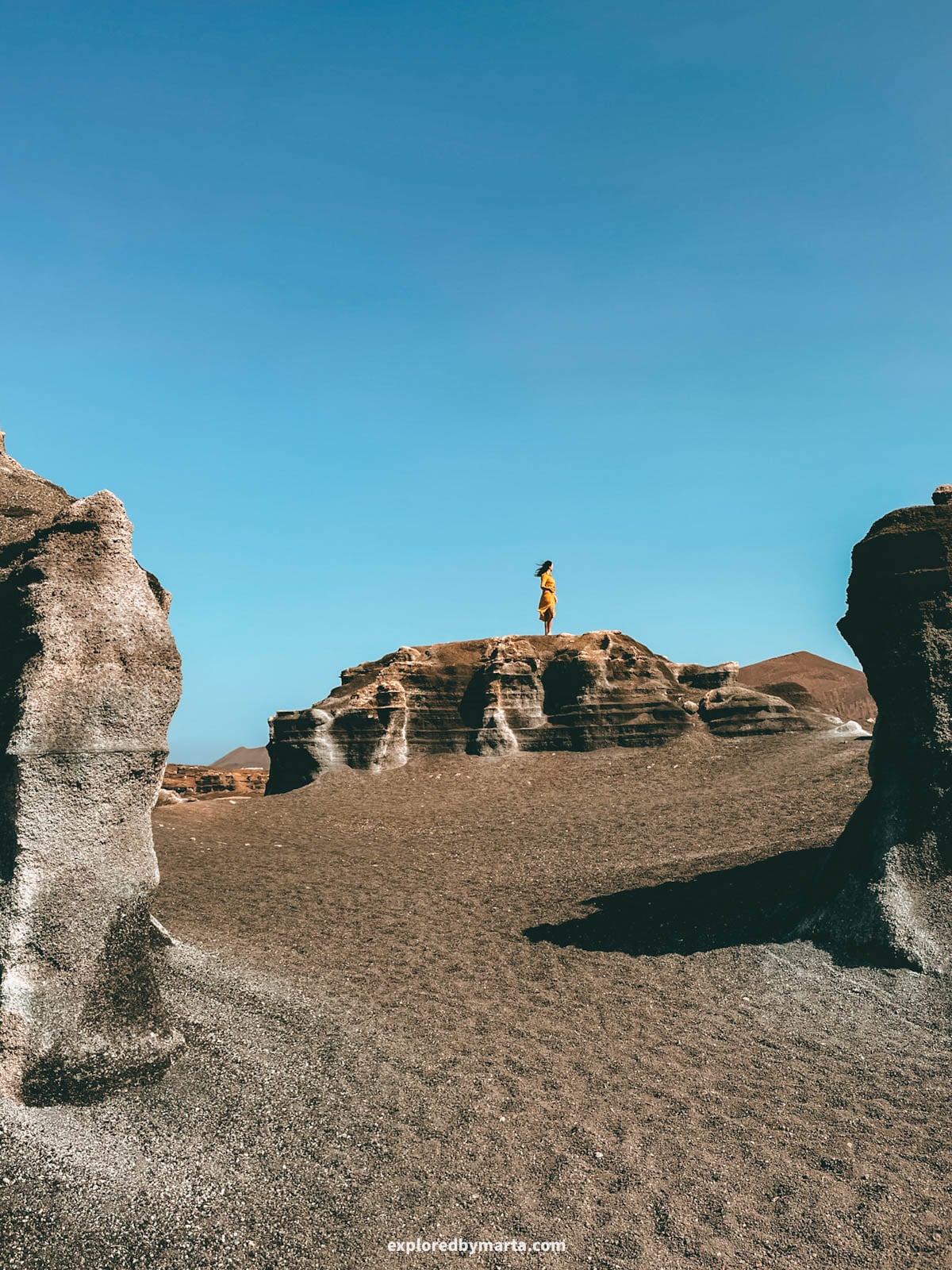
La Rofera, better known as the Stratified City, is a field of dark grey and black volcanic rock eroded into strange layered shapes – one of the most photogenic and otherworldly spots on the island.
It’s actually an old, abandoned quarry where locals once dug out volcanic sand, and between that and thousands of years of erosion, the ground became these stacked, ridged mounds. They’ve been featured in movies and series for good reason!
The best part? It’s completely free and out in the open, so you can visit this place any time of day.
Just park at the side of the road and walk in. Don’t stop at the first rocks, though – wander deeper, and you’ll find the strangest shapes, often with nobody else around.
Location: La Rofera (Stratified City)
14. El Lago Verde / Charco de los Clicos
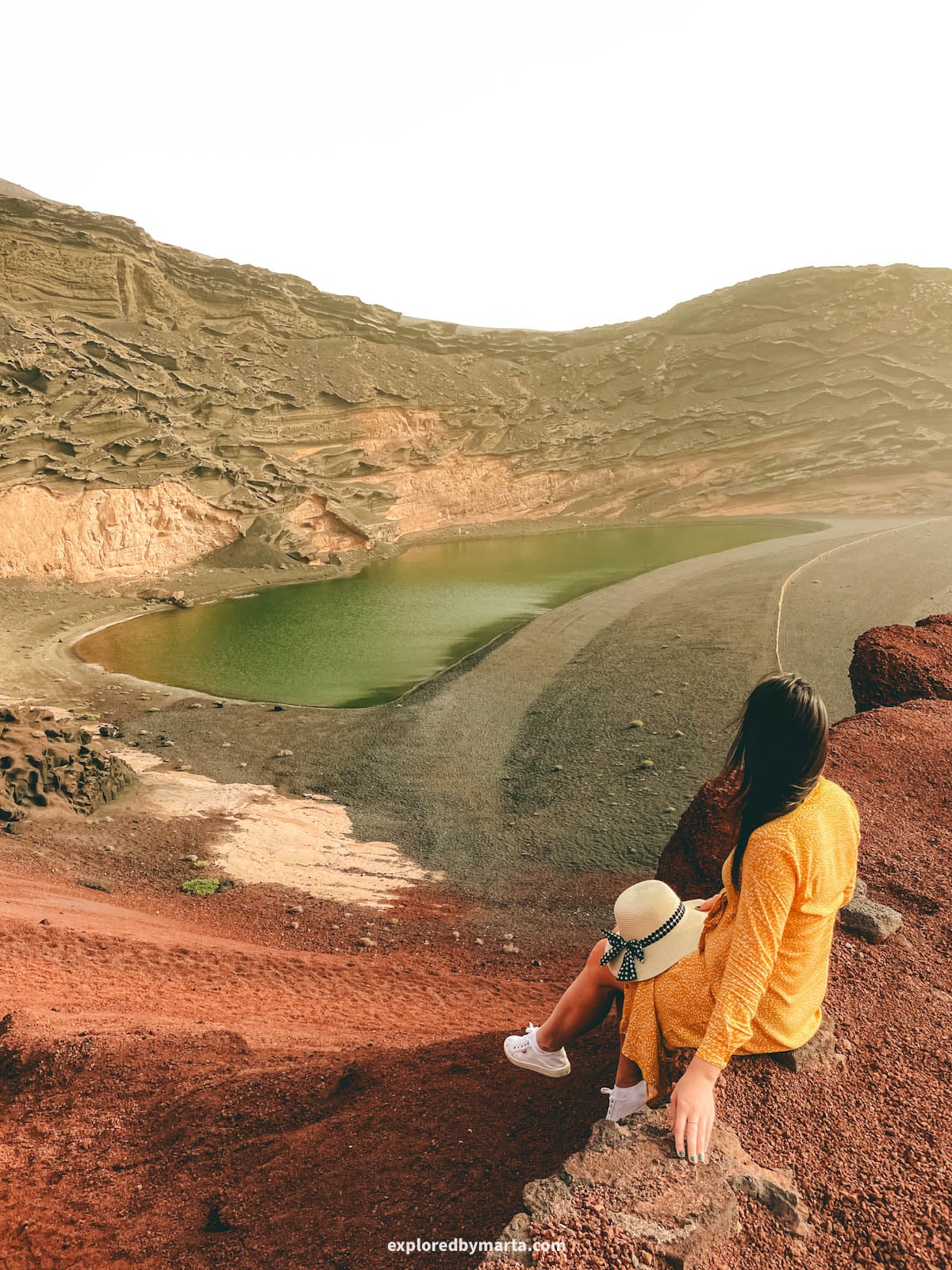
It’s not often you get to see a bright green lake, but Lanzarote has one – the Charco de los Clicos, also called El Golfo, a vivid green pool sitting against black sand and a backdrop of red-brown cliffs.
The startling green color comes from algae living in the water, and the contrast with the black sand beach and the Atlantic Ocean beyond makes it one of the most striking scenes on the island.
For the best photo, park next to the coffee shop and walk the path along the coastline about 200 meters (660 feet) to the lookout point. That elevated view gives you the whole lake and its colors.
You can’t go right up to the lake – there’s a fence protecting it – and from ground level you won’t get the nice overview, so the lookout is the spot.
A small tip for the best color: on a clear day with the sun shining above you’ll get the brightest green shade. On a cloudy day it’ll look a bit muddy and faded. We didn’t have the best day (there was calima in the air), but it was still pretty green.
Location: El Lago Verde – Mirador del Charco de Los Clicos
15. Los Charcones volcanic pools
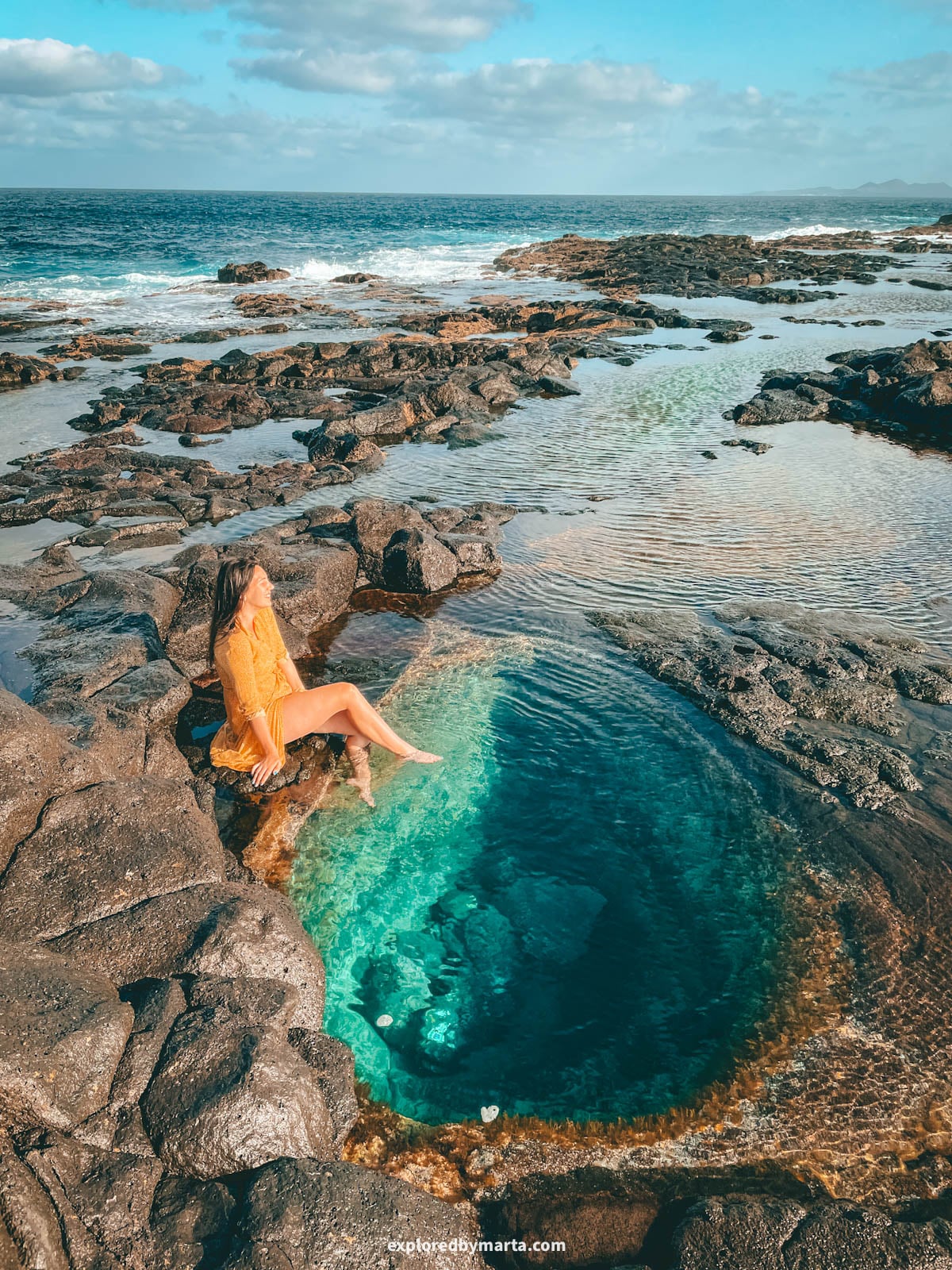
Down in the southwest corner, Los Charcones is a stretch of coastline dotted with natural volcanic pools – turquoise bathing spots carved right into the black lava rock. They look almost like jacuzzis.
The pools formed where lava met the ocean and hardened into strange shapes, and the sea now fills the hollows with crystal-clear water. There are so many, you could spend a whole day hopping between them!
Getting here is the tricky part. The roads down are very rough gravel that a lot of people won’t risk in a rental car. With a 4×4, it’s manageable, but most park at the start of the gravel path and walk the last 2 to 3 kilometers (1 to 2 miles) on foot.
We nursed our little Fiat 500 almost all the way to the abandoned Hotel Atlante del Sol. Not our comfiest driving, but it saved our legs and time, as it was our final day in Lanzarote and we were heading for the ferry to Fuerteventura.
Tip! You need to come at low tide, and I mean it – at high tide the waves crash over the rocks and the pools are neither safe nor pretty. For me, this is Lanzarote at its wildest, and exactly the kind of place I love.
Location: Los Charcones – Photo location – Parking area
16. Caldera Blanca
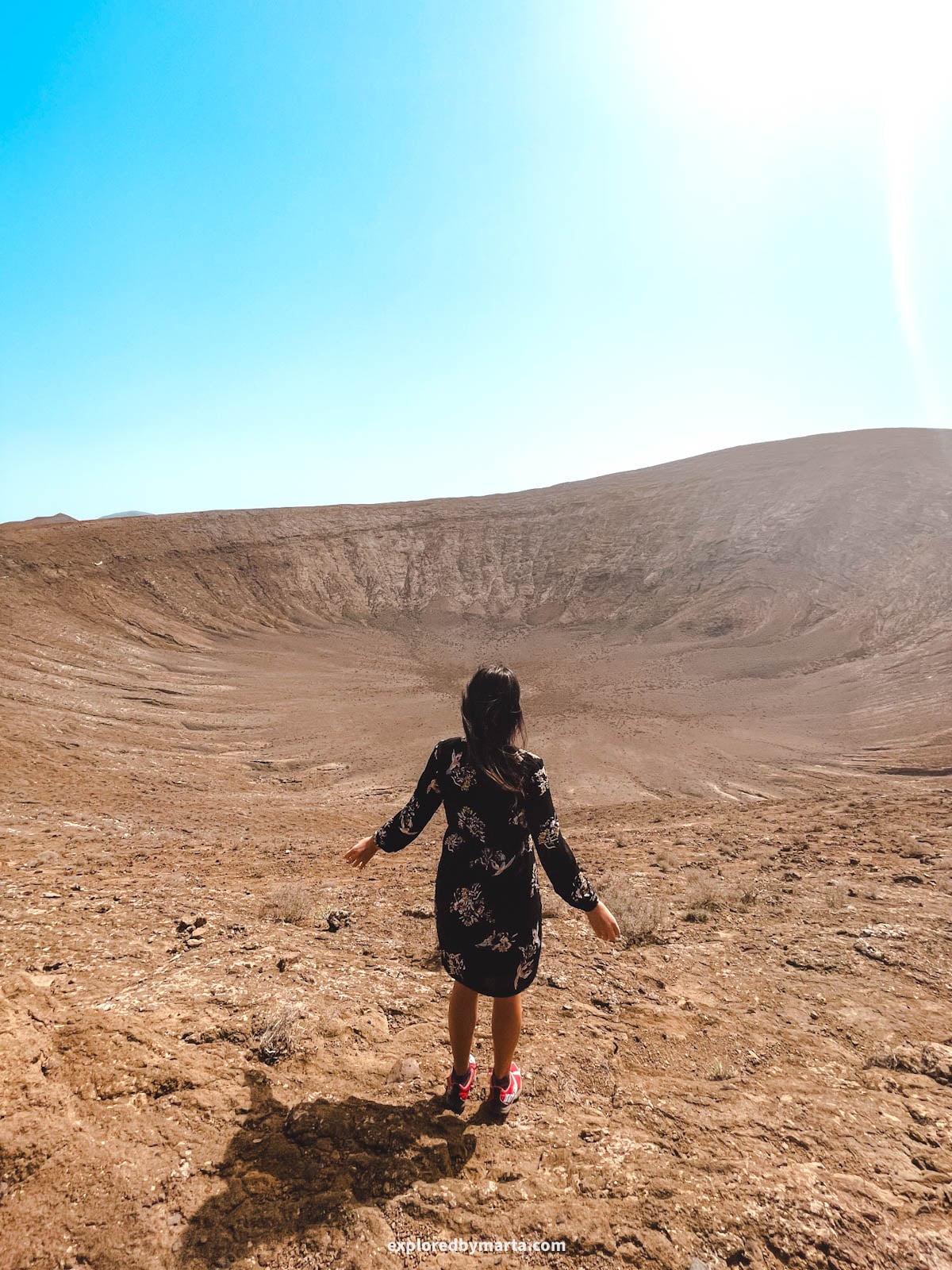
Caldera Blanca, the “white cauldron,” is the most impressive volcanic crater on the island – and standing inside its giant bowl makes for a photo that really shows the scale.
Unlike the young 1730s volcanoes, Caldera Blanca is ancient, its rocks bleached pale with age – which is where the “white” in its name comes from.
The crater is enormous, roughly 1.2 kilometers (0.75 miles) across and almost perfectly circular. Standing on the rim looking down into that bowl is humbling, and the view from the top out over the black Timanfaya fire mountains is one of the best on the island.
This is a photo you earn, though. The hike is around 10 kilometers (6 miles) round trip if you circle the rim, with a climb up, zero shade, and serious wind at the top. Bring water, sun cover, and proper shoes.
You can do a shorter version – just climb to the rim, take it in, and walk back. Either way, hiking the rim of this giant volcano was a proper Lanzarote bucket-list moment. Tough, but worth it!
Location: Caldera Blanca – Parking lot
17. Cueva de Montaña Cabrera
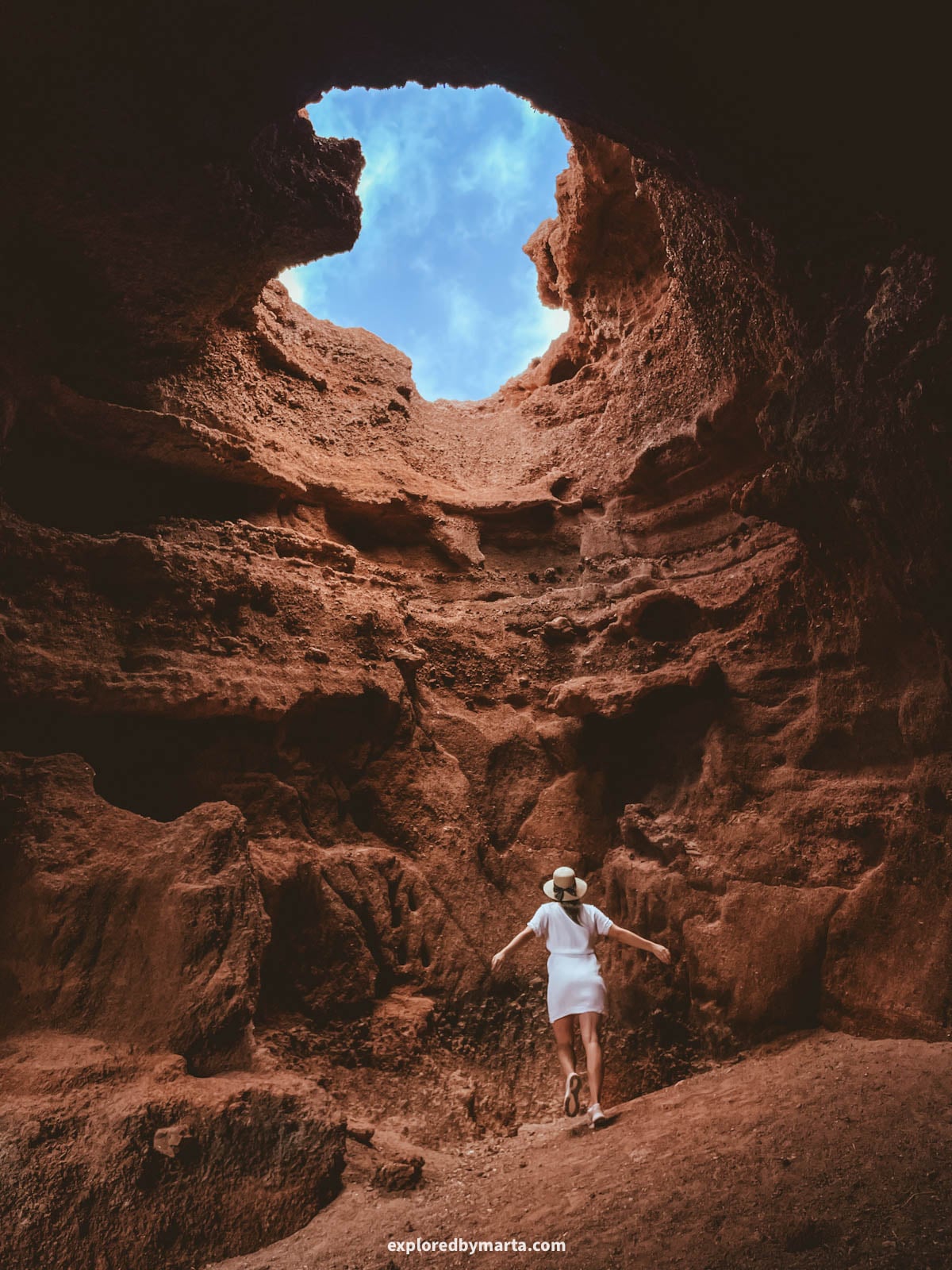
Montaña Cabrera is a volcano with a secret – a cave hollowed right inside it, with an open hole in the ceiling and a side entrance you can walk into. It’s a wild, off-the-radar photo spot.
The light through that ceiling hole is what makes the shot, spilling down into the dark cave. That is, if you actually get the sunrays, haha.
This place is off the beaten path. There are no signs or trails – just park near the houses at the base and hike up the loose slope, aiming for the hole furthest to the right, or follow the location pin below.
Don’t expect crowds or facilities here, just a cool cave inside a volcano that most visitors never find. That’s exactly what makes it special. And don’t forget to wear proper shoes, since the stones slide.
Location: Cueva de Montaña Cabrera
18. Cueva de Órzola
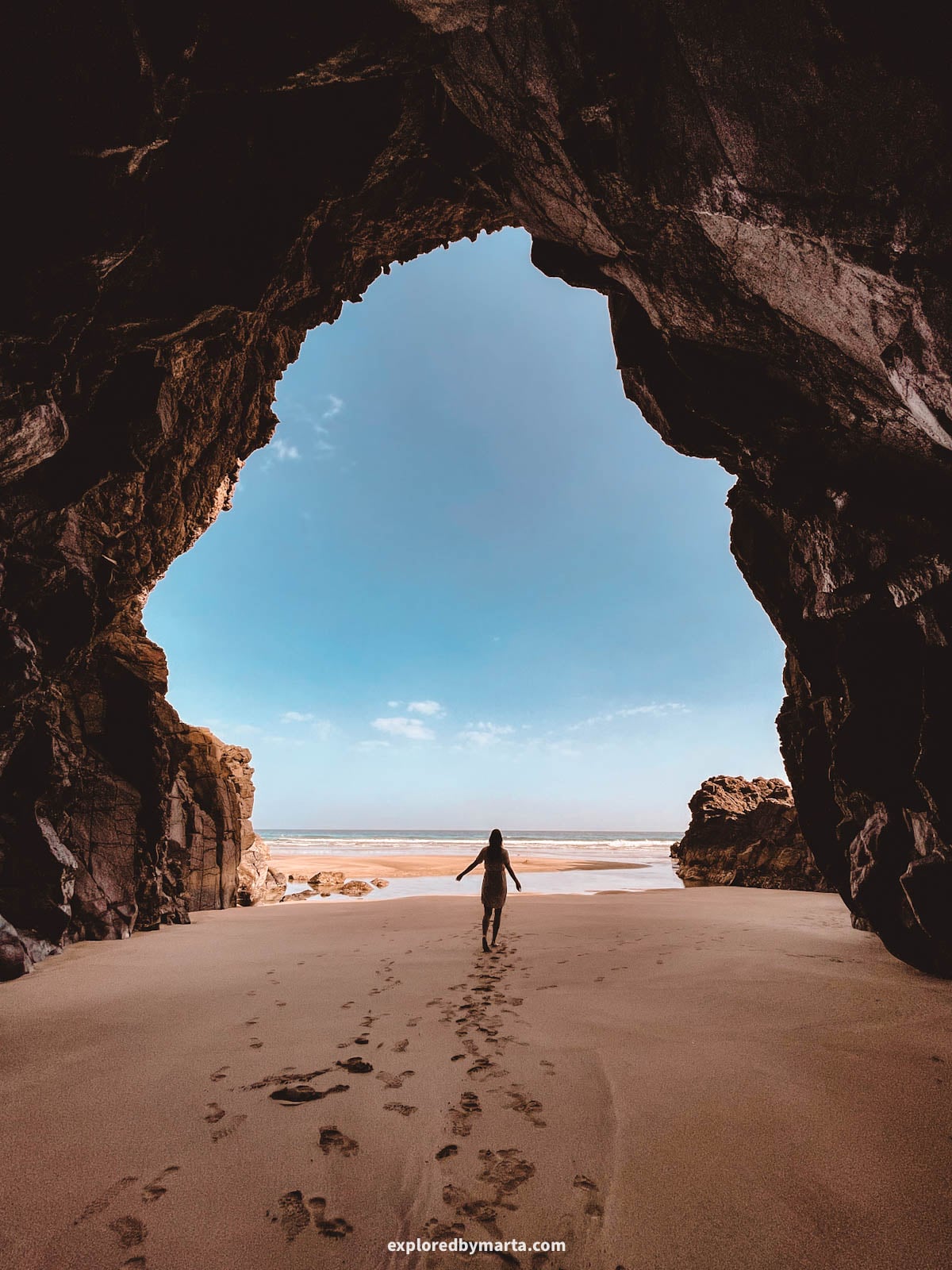
Up on the far north coast of Lanzarote near Órzola town, the Atlantic has carved a small, scenic sea cave into the gray coastal rock – and it frames the ocean beautifully for a photo.
Sea caves like this form slowly, as waves pound the same weak point in the rock over centuries until they hollow it out. So while the island’s tubes and craters were built by fire, this one was carved by water.
To find it, walk along Playa de Órzola until you spot the dark rocks reaching into the sea – the cave sits just behind them. Stand inside and shoot outward to frame the ocean in the cave mouth.
The catch is you can only reach it at low tide. At high tide, the water floods right in and the waves crash against the rocks, so it’s not an option. So check a tide table before you go!
Location: Cueva de Órzola
19. Palmera Inclinada
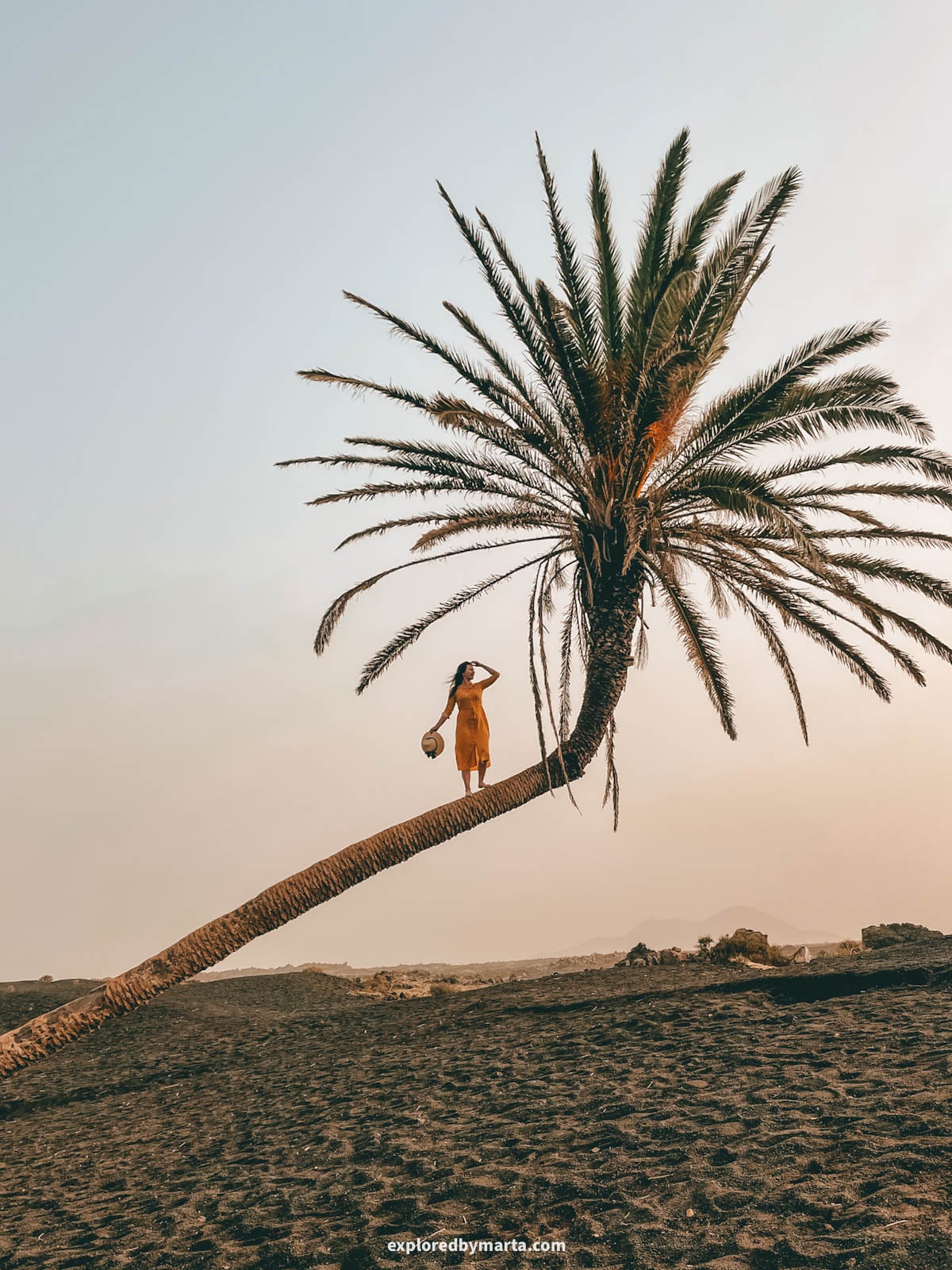
Update: this one’s no longer alive. In October 2022, vandals cut down the famous leaning palm tree with a saw. So if you’ve seen it all over Instagram and come looking, this is your heads-up – the tree is gone.
For years, the Palmera Inclinada in Masdache was one of the most photographed spots on the island. It sat at the base of Montaña Negra, out among the vineyards, and grew almost sideways – bent nearly horizontal by the constant wind sweeping across the volcanic landscape.
I’m leaving this spot on the list on purpose – not to send you there, but so anyone still searching for it knows what happened and doesn’t waste a trip. Luckily, Lanzarote is full of unique and beautiful places you can visit and explore instead!
20. La Graciosa Island
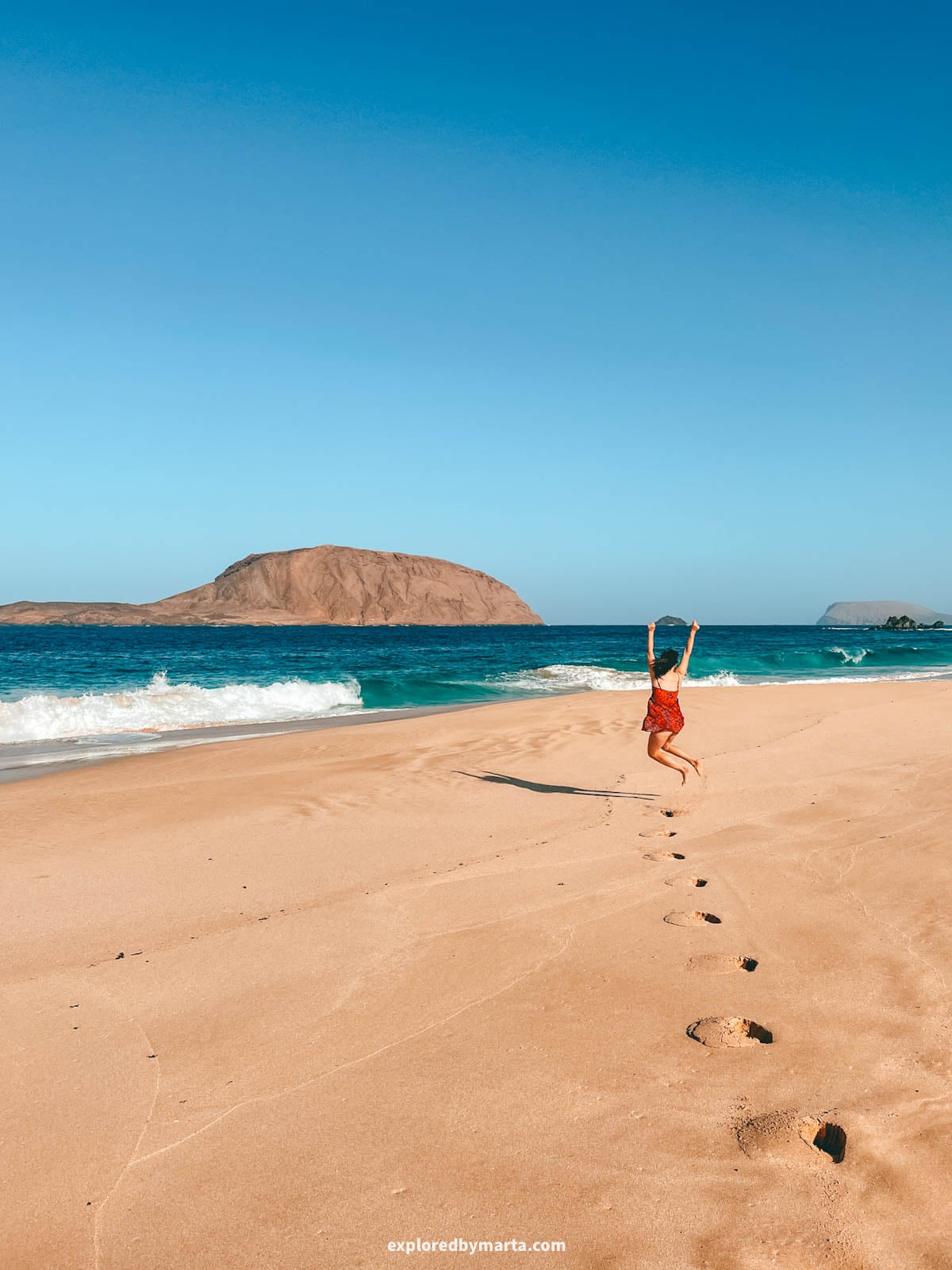
You’ve spotted La Graciosa from nearly every viewpoint on this list – so why not go?
This tiny island just off the north coast is one of the most beautiful places you will find in the Canary Islands, and, for us, it made for a perfect day trip from Lanzarote.
What makes it special is how remote and untouched it feels.
There’s not a single paved road or traffic light, just sandy streets, white houses, and a handful of cars. A short ferry runs across from Órzola, and once you land, you rent a bike and explore at your own quiet pace.
There is no crowded tourist attraction you have to run to get there before others. It’s just you, the island, and whatever time you have to spend there.
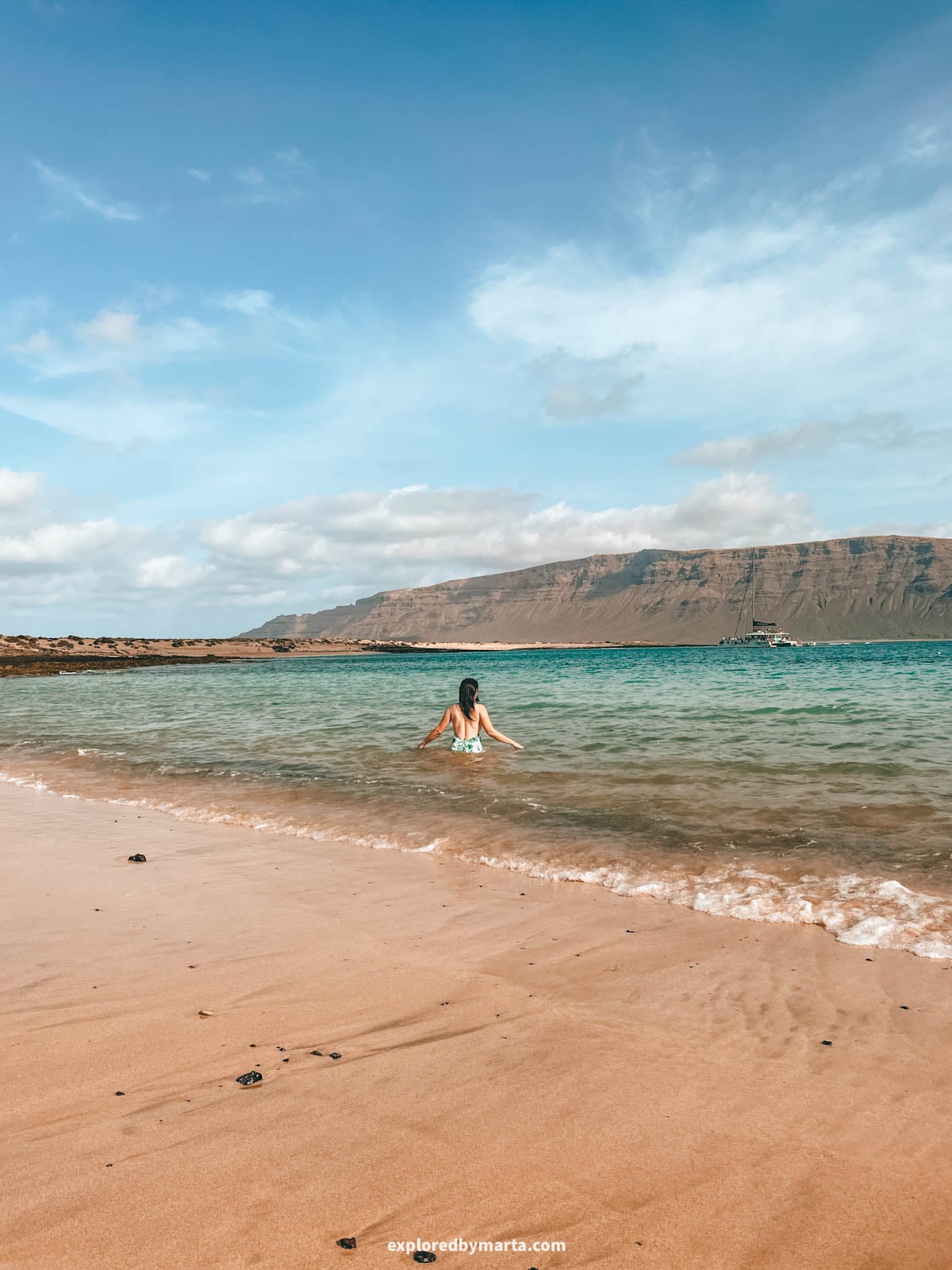
Playa de las Conchas is the island’s showstopper – a long white-sand beach against deep blue Atlantic water, with the red island of Montaña Clara rising across the strait.
It’s stunning to photograph, though the currents make it unsafe for swimming.
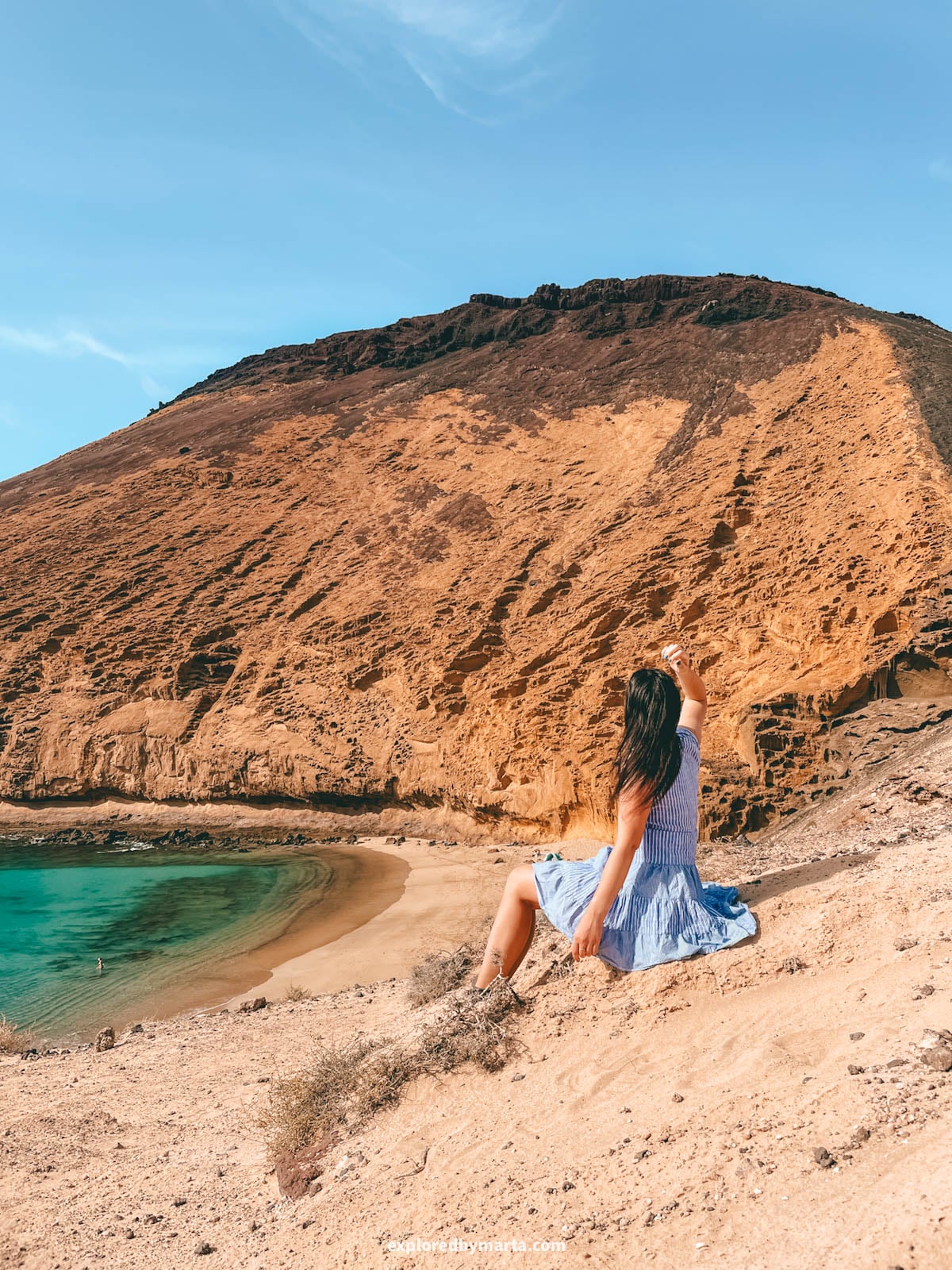
Right beside it, the red volcano Montaña Bermeja rises 157 meters (515 feet), an easy climb with sweeping views over the north of the island. It’s one of three colored volcanoes here – there’s also the yellow Montaña Amarilla and the tall central La Aguja Grande.
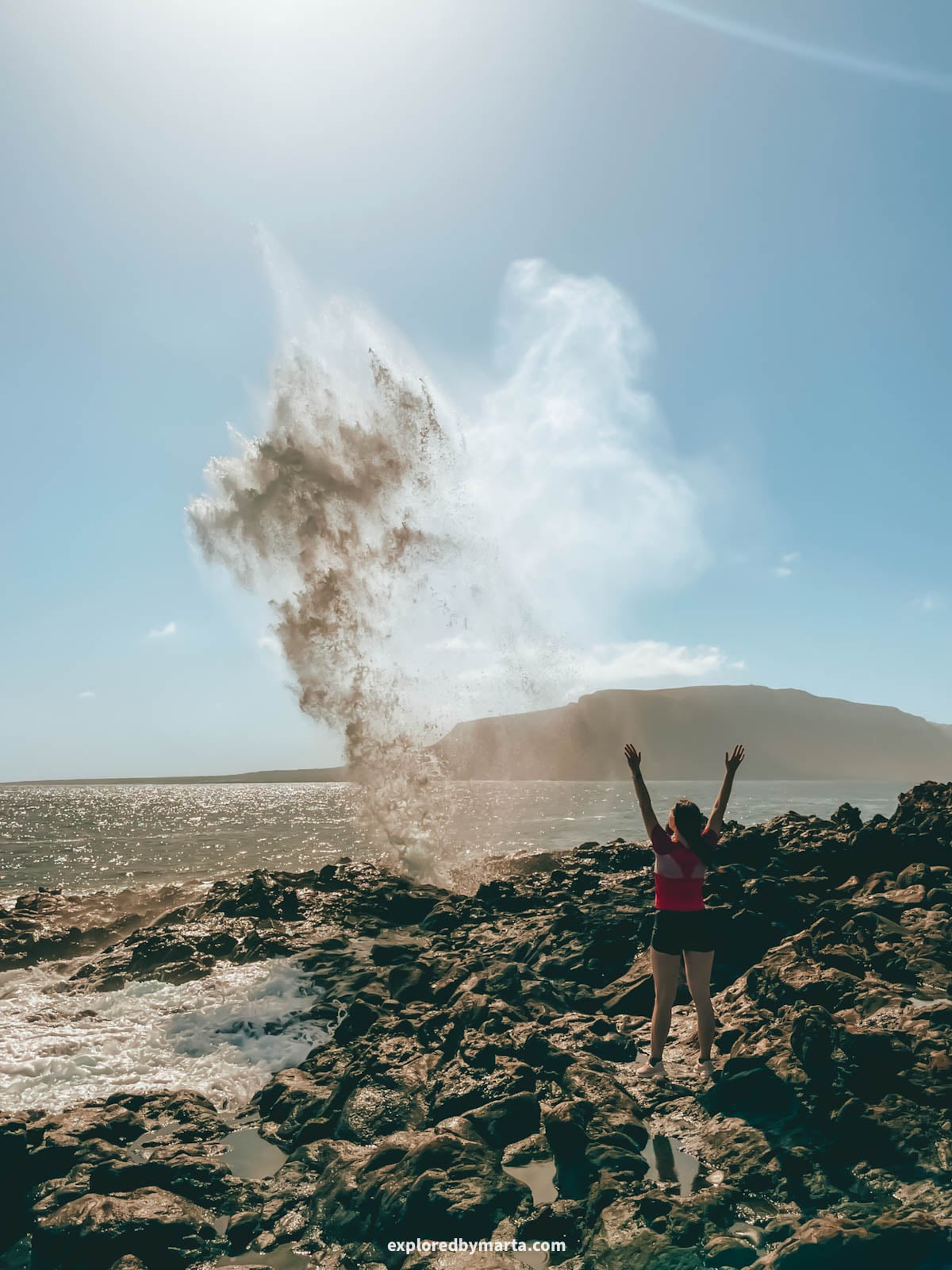
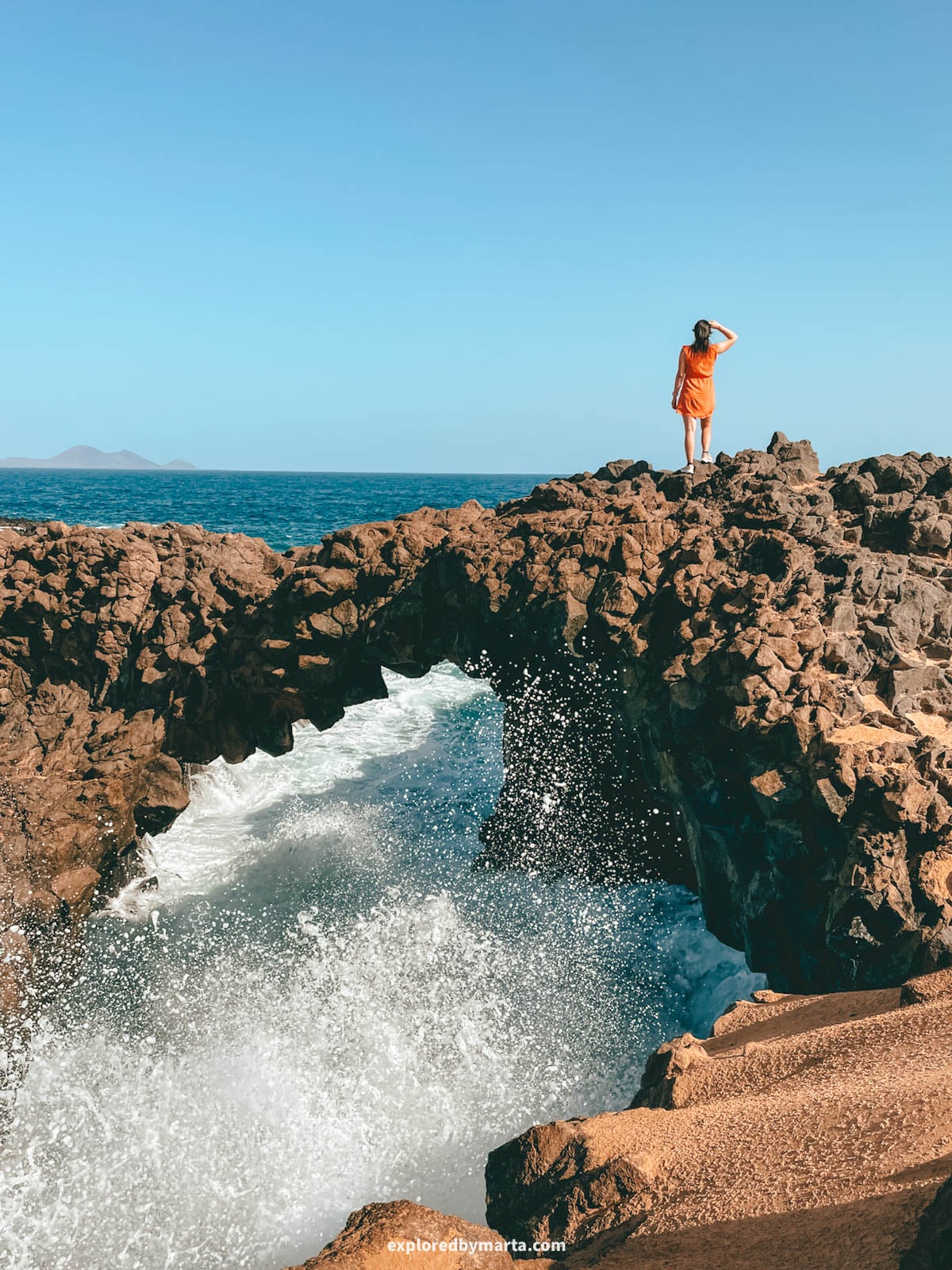
My favorite spot, though, was El Bufón de Graciosa – a blowhole where the ocean surges through a gap in the coastal cliff and shoots up like a geyser.
We stood watching it for a good 15 minutes. In the north, the Arcos de los Caletones rock bridge makes another dramatic shot as the waves crash through it.
For calmer water, Playa La Cocina is a hidden turquoise bay sheltered beneath the yellow volcano, and Playa Francesa looks straight back at the Famara cliffs of Lanzarote – one of the best beach views on the island.
There’s more than a day can hold, so if the island pulls you in, my complete guide to the best things to do on La Graciosa walks you through all of them.
FAQs about photo spots in Lanzarote
What are the best photo spots in Lanzarote?
Some of the best are the Mirador del Rio viewpoint, the green lake at Charco de los Clicos, the vineyards of La Geria, the Famara cliffs at sunset, and the gorgeous Las Grietas cracks.
Do you need a car to reach the photo spots in Lanzarote?
Yes, a rental car makes a huge difference. Many of the best spots are unmarked and sit at the end of gravel roads or quiet turnoffs, so a car lets you reach them at your own pace and time the light.
How much are the famous César Manrique attractions in Lanzarote?
Jameos del Agua and Cueva de los Verdes are around 17 EUR for adults, and Mirador del Rio is 9 EUR. Buy tickets at cactlanzarote.com.
When is the best time of day for photos in Lanzarote?
Early morning and golden hour are ideal – softer light, fewer crowds, and long shadows across the volcanic landscape. Sunset is stunning at the Famara cliffs or Famara beach.
Which are the most beautiful places in Lanzarote?
It’s hard to pick just one! Some of the most beautiful are the Mirador del Rio viewpoint, Famara beach and its cliffs, the Las Grietas cracks, the vineyards of La Geria, the oasis at Jameos del Agua, and the cove of Playa de Papagayo.
Read more about traveling in the Canary Islands
Of everywhere we explored in four weeks on the island, it was how photogenic Lanzarote is that surprised me most. Around every corner there’s a black-lava coastline, a green lake, or a crater that looks like another planet.
The best part is how many of these spots are free, wild, and unmarked – so rent a car, chase the golden-hour light, and go find the ones that speak to you.
If you’re planning a longer trip to Lanzarote or the Canary Islands and want to learn more about these volcanic islands, check out my other guides below.
Read more about Lanzarote:
- 23 best things to do in Lanzarote, Spain (bucket list spots)
- 15 unreal rock formations in Lanzarote, Spain
- 7 best caves in Lanzarote, Spain (lava tubes and sea caves)
- Ultimate places to see on La Graciosa island
Read more about the Canary Islands:
- The best photo spots in Fuerteventura
- The best photo spots in Tenerife
- The best photo spots in La Palma
- The best photo spots in Gran Canaria
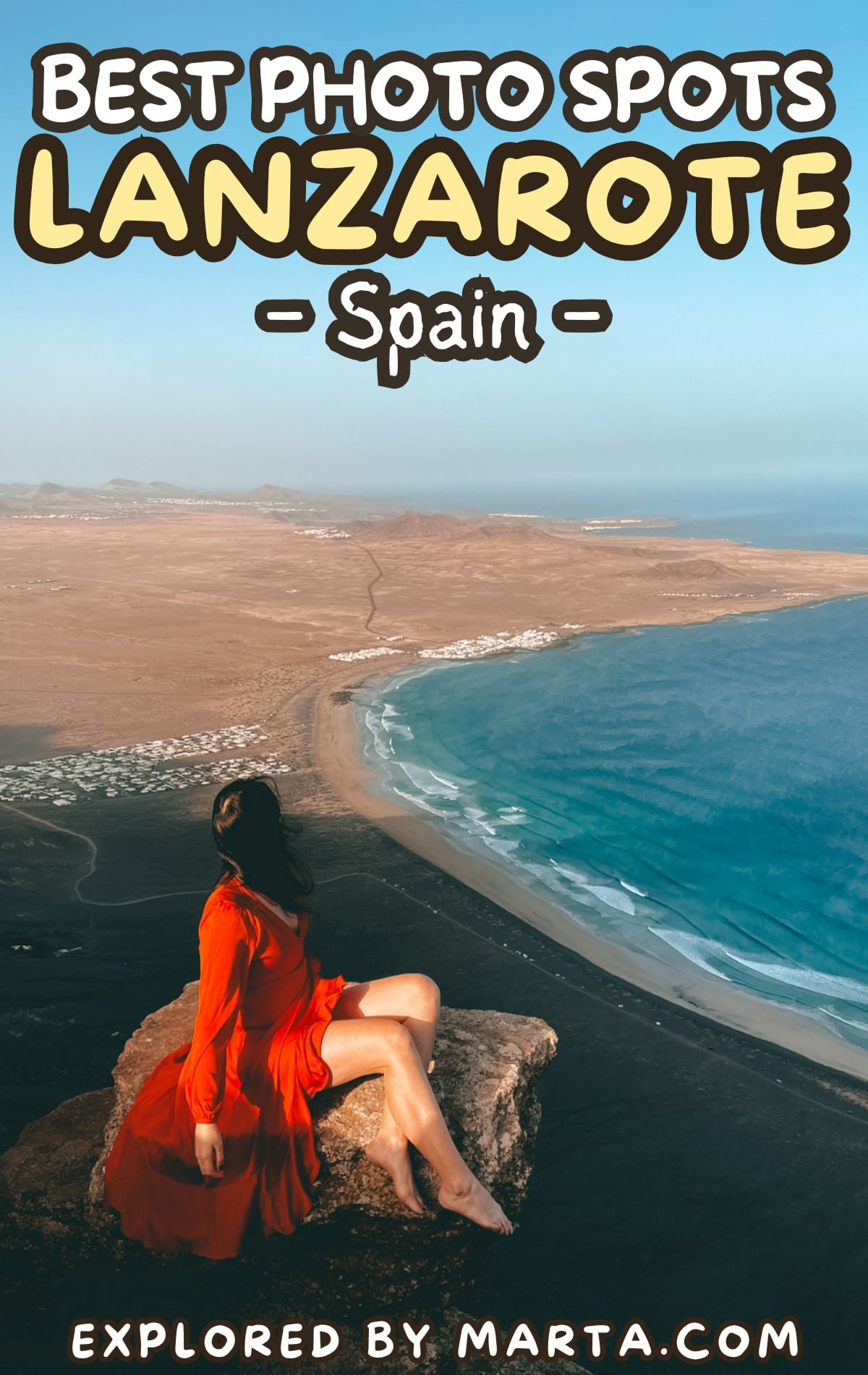
PIN FOR LATER!


Such an excellent post. Having the location and direct Google link of each photo is the most useful thing I have found in a long time. Thank you very much for that. Couple of questions:
1. Red quarry in Tinamala Mountain: Can you drive directly to the quarry?
2. Is the “El Cuervo volcano” photo location accurate?
Thanks
Hi! Thank you so much! It means a lot to me when all of this is somehow useful to other people 🙂
El Cuervo photo location is correct, I take it from photo coordinates that my phone records. We climbed to the top of Montana Negra volcano and realized that there is a better angle for the photo a bit below the summit. You can see for yourself which place seems better. The background, however, is zoomed in a little in the photo.
About the quarry – you can park your car at the side of the road at the bottom of the mountain. Then there is a path uphill – there is a hiking route that goes right by the quarry. However, I am not sure if the quarry is still accessible. When I went, it was open and there were no signs that it would be forbidden. I have since exchanged the quarry with a different spot on this blog post. But you can check it out for yourself and let me know 🙂 Have a great trip!
Hey, thank you for such a helpful post, especially for the google maps links! Do you have a list on Google Maps with all those places already saved in one place? This would be extremely helpful for us. Thank you so much in advance!
All the best
Anna
Hi! Thanks a lot! To be honest, I do not keep those lists as we travel a lot and that would mean having a long, long list of places. However, I might consider creating them someday. At the moment you can just click on the Google Maps links, then press ‘Save’ and then create a new list about Lanzarote, and then save all the places you wish to visit in that list. Have a great trip and thanks for the idea – I’ll see what I can do in the future. Marta
Merci, très bien de laisser les coordonnées google.
Par contre, les egophoto ne sont pas toujours indispensables, les mêmes sites sans personne dessus sont magnifiques.
Excellent post. It served as a map for everything we wanted to see. Thank you
Happy to help! Cheers!
Hi! Thanks a lot for this super clear overview with location tags. Very helpful for planning my vacation ☺️. I have a question about the wine fields/bodega’s in La Geria:
– can you walk straight in the wine fields for a picture (like yours) or do you need to book a specific tour with guidance to get access? Or do you have access when you buy a drink.
Thank you for your help!
Hi, Laura! Thank you for your kind words! Those fields are just out there without any fences or prohibiting signs. We did buy a glass of wine before that, but this spot is just a remote part of the fields where we just walked in and took a photo. We made sure to walk very carefully to not damage any of the pits.