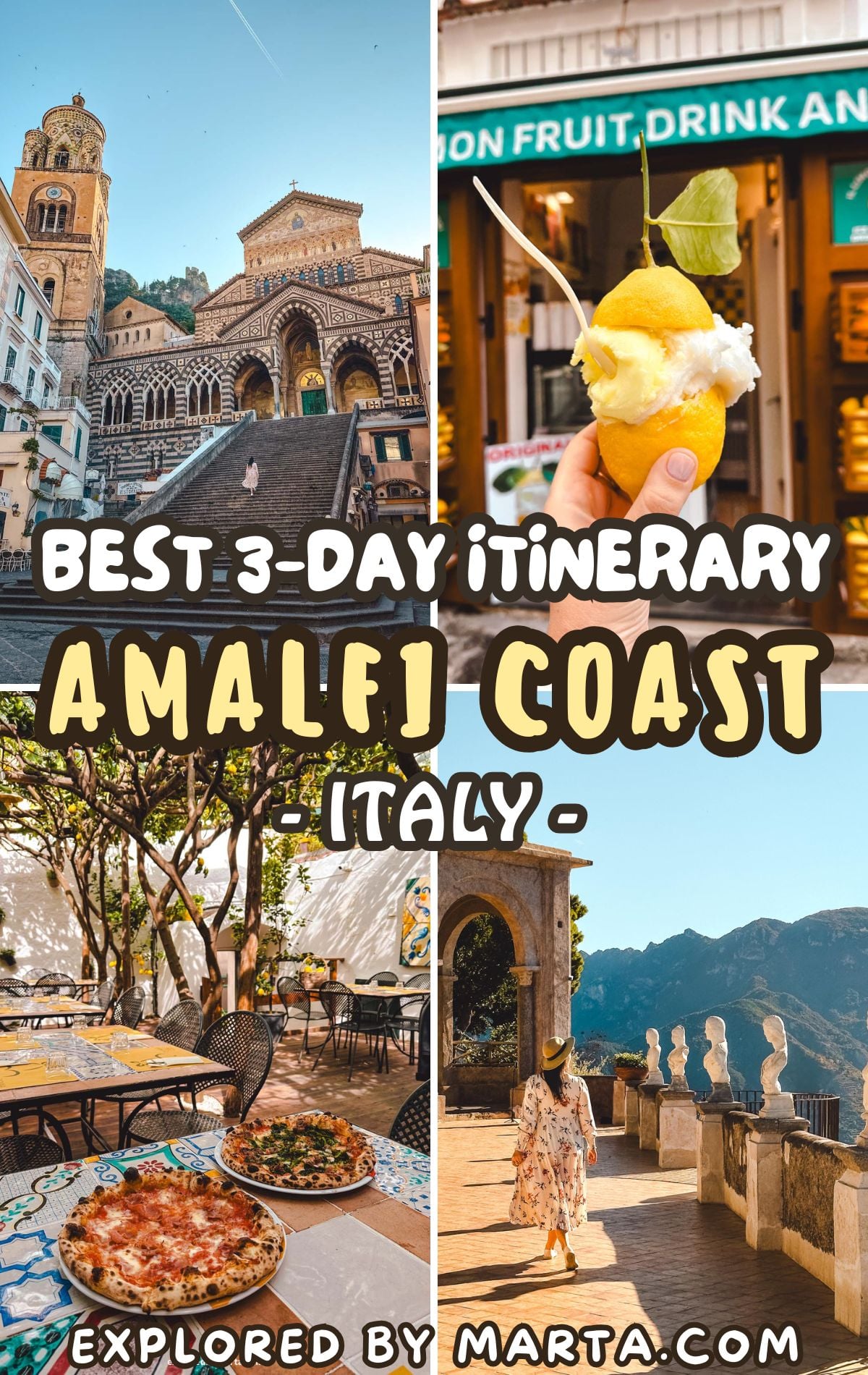
Best 3-day Amalfi Coast itinerary for first-time visitors
This post may contain affiliate links. If you use these links to make a purchase or booking, I may earn a small commission at no extra cost to you! Thank you for your support!
Planning a 3-day Amalfi Coast itinerary can feel a bit overwhelming at first. There are so many beautiful, colorful towns, viewpoints, beaches, and food spots packed into one stretch of coastline that it’s hard to know where to even start. 😅
We spent about six months living in and exploring this part of Italy, and I can tell you this – you don’t need a full week to enjoy the beauty of the Amalfi Coast.
Yes, I admit, I’d actually recommend spending 5 days here, but with this itinerary, even just 3 days will be enough to experience the best of it. If I had to show the Amalfi Coast to someone who’s never been there, I’d do exactly this route!
How to spend 3 days on the Amalfi Coast?
Can I assume that you’re not coming to the Amalfi Coast just to eat gelato and pasta, but that you also want to explore the coastline and see what makes the so-called Divine Coast so special? Yeah, I thought so.
Who is this itinerary best for?
If you are a curious solo traveler, a travel-loving couple or friends, or an active family (with active children!) and travel with or without a car, then this is the best way to spend 3 days on the Amalfi Coast:
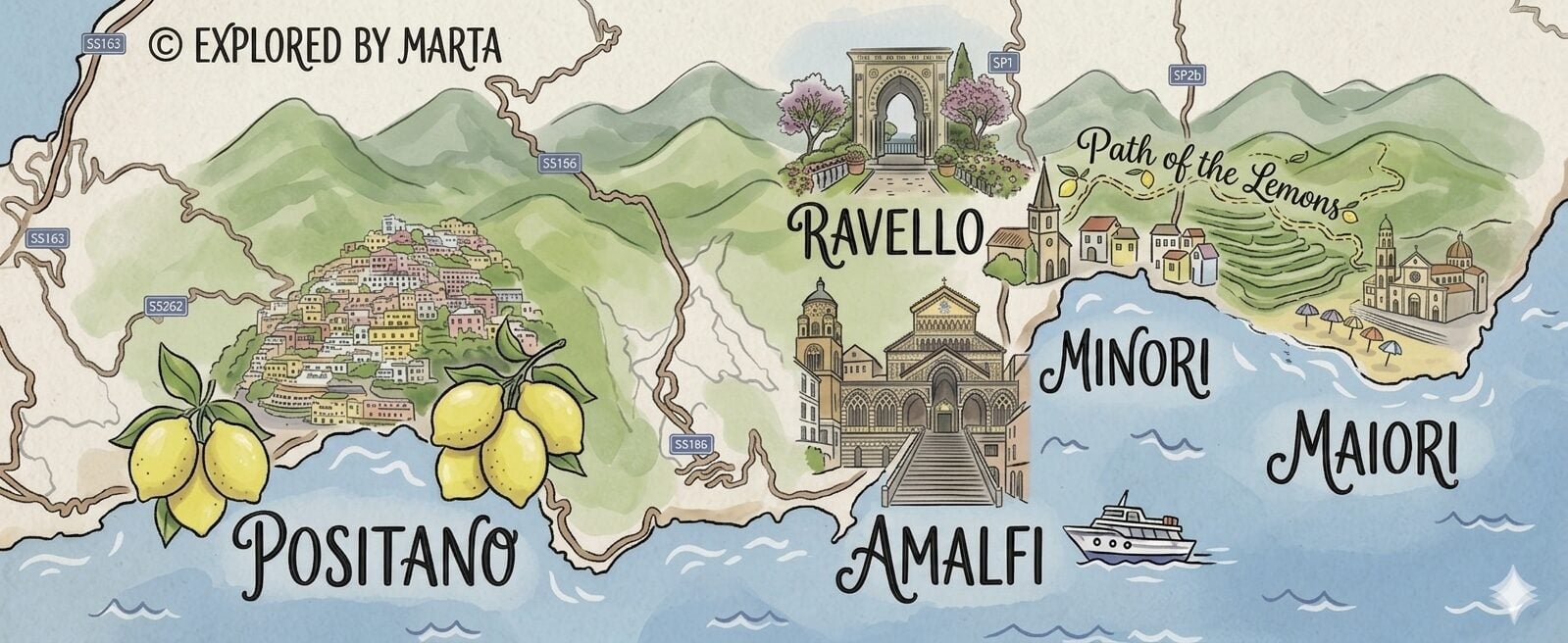
- Day 1: Amalfi, the namesake town of the Amalfi Coast, and its scenic neighbour, Atrani
- Day 2: Morning in Ravello, afternoon – Path of the Lemons walk between Maiori & Minori + Maiori Beach, the largest beach on the Amalfi Coast
- Day 3: Positano, finish strong with the postcard-perfect vertical town
I’ll just say it – this route makes the most sense. It covers the most charming villages and includes many of the top things to do on the Amalfi Coast, while still feeling very realistic for 3 days.
But if you have a special Amalfi Coast bucket list place in mind you really want to visit, don’t hesitate to switch things up and make a change!
So let’s dive in.
Day 1: Explore Amalfi town and walk over to Atrani

Before researching the Amalfi Coast, I didn’t even know there was a town called Amalfi. 🫠 But there is, and it is very much the heartbeat of the coastline, so starting this 3-day Amalfi Coast itinerary in Amalfi town just made sense to me.
Amalfi, the namesake of the Amalfi Coast, was once a powerful maritime republic, and you can still feel that old importance in the town today – in its cathedral, its little museums, and even in the way Amalfi opens dramatically to the sea at the bottom of a steep valley.
This is the kind of place where you’ll want to start early. Amalfi gets busy very fast, especially once the buses and boats start arriving, so the earlier you get here, the better the experience will be. My recommendation? Arrive around 9 to 10 AM.
1. Walk through Porta della Marina and try pastries in Piazza del Duomo
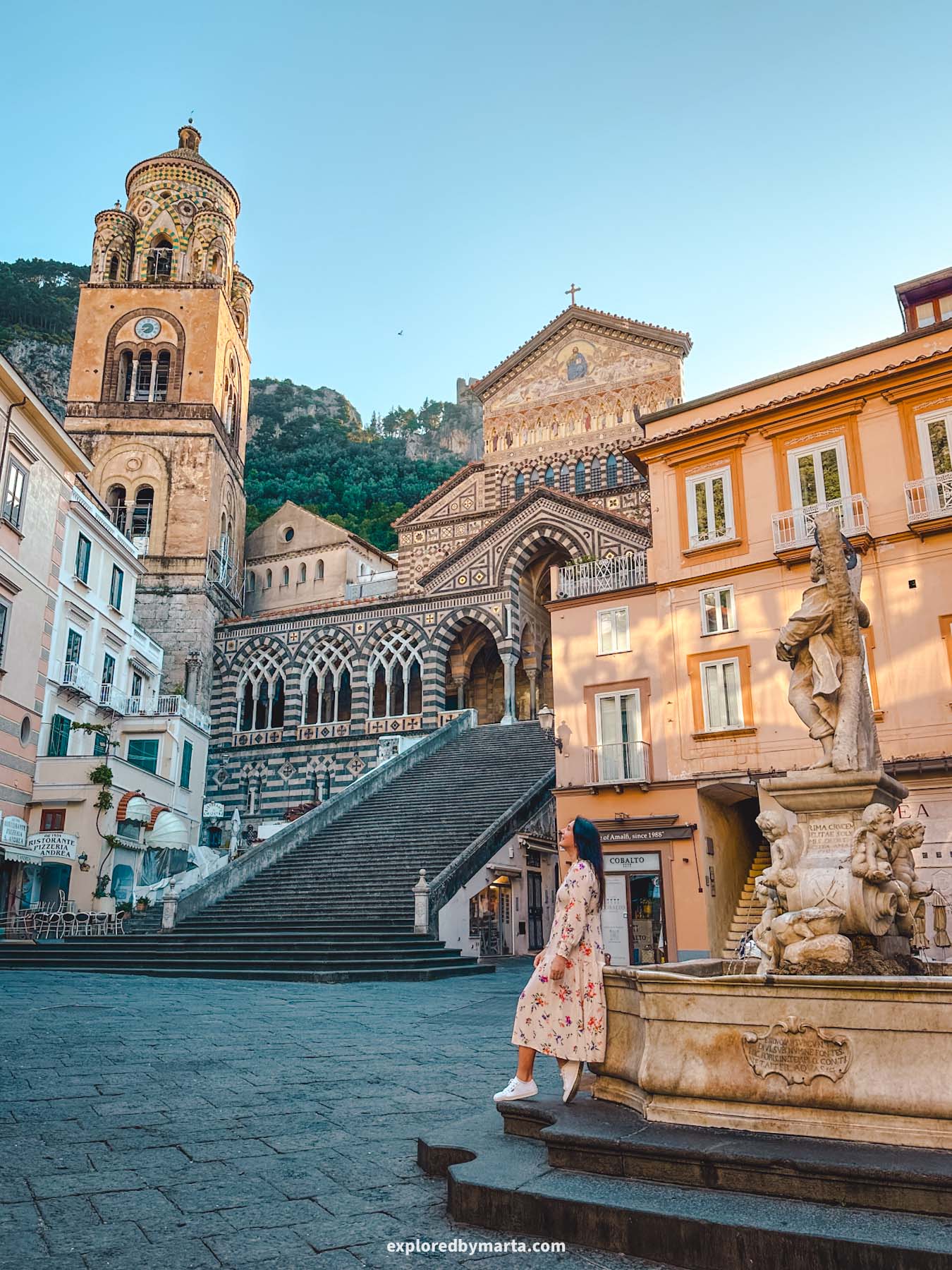
You will most likely arrive in Amalfi from the seafront, whether by bus, boat, or taxi, so the best way to enter the town is through Porta della Marina, Amalfi’s historic seaside gateway.
There has been a city gate here since the 12th century, which is pretty amazing when you think about how many travelers, traders, and sailors must have passed through this exact spot over the centuries.
Once you pass through the tunnel (be careful, it crosses a street), you come out right into the heart of the town. Your first stop should be Piazza del Duomo, Amalfi’s main square and the place where everything starts.
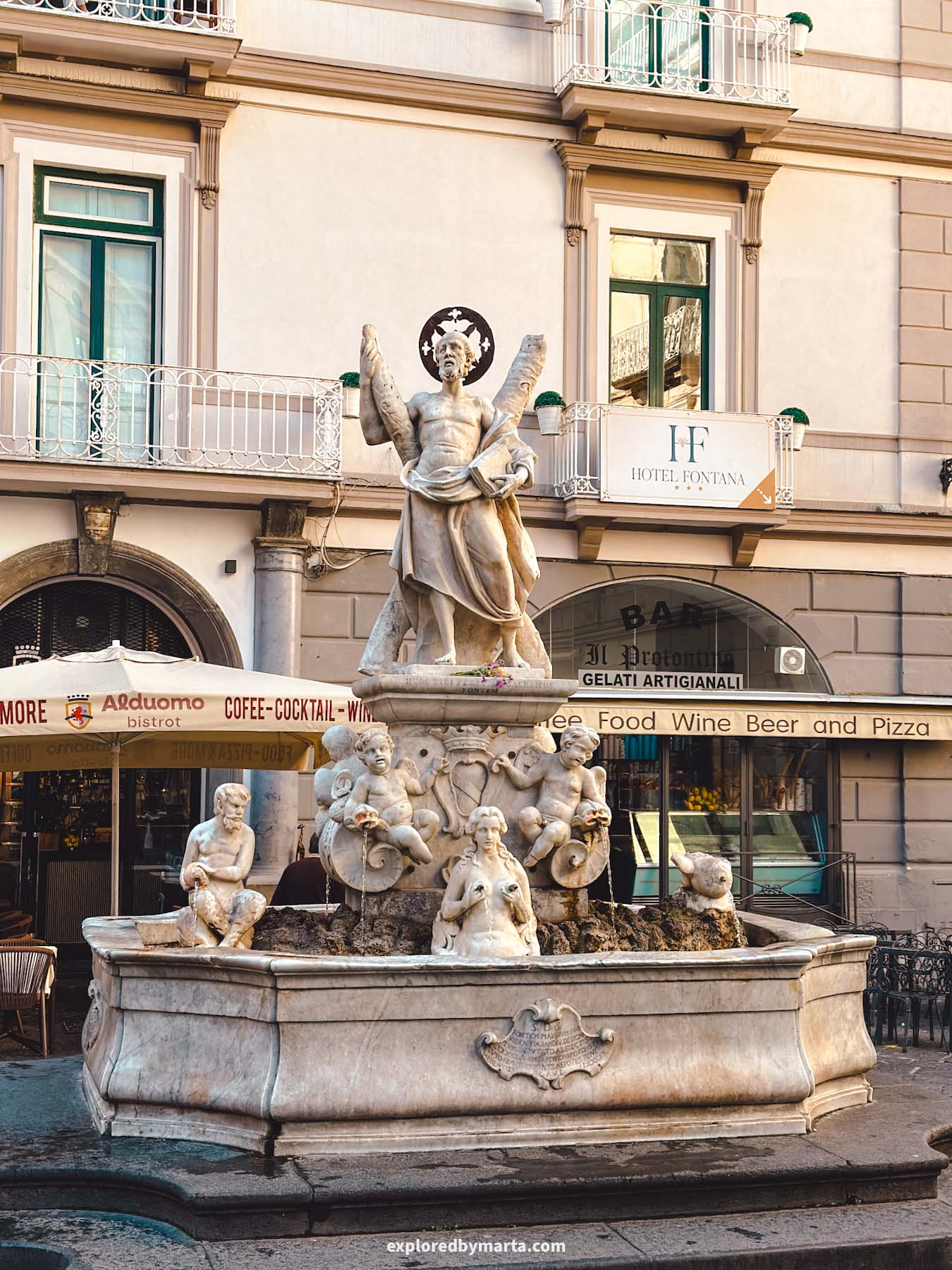
This is where you’ll see the famous staircase of the Duomo di Amalfi, and right in front of it, the Fountain of Saint Andrew, dedicated to Amalfi’s patron saint. The fountain dates back to the 18th century and is one of the town’s best-known landmarks.
This is the perfect moment to snap a photo of that iconic staircase!

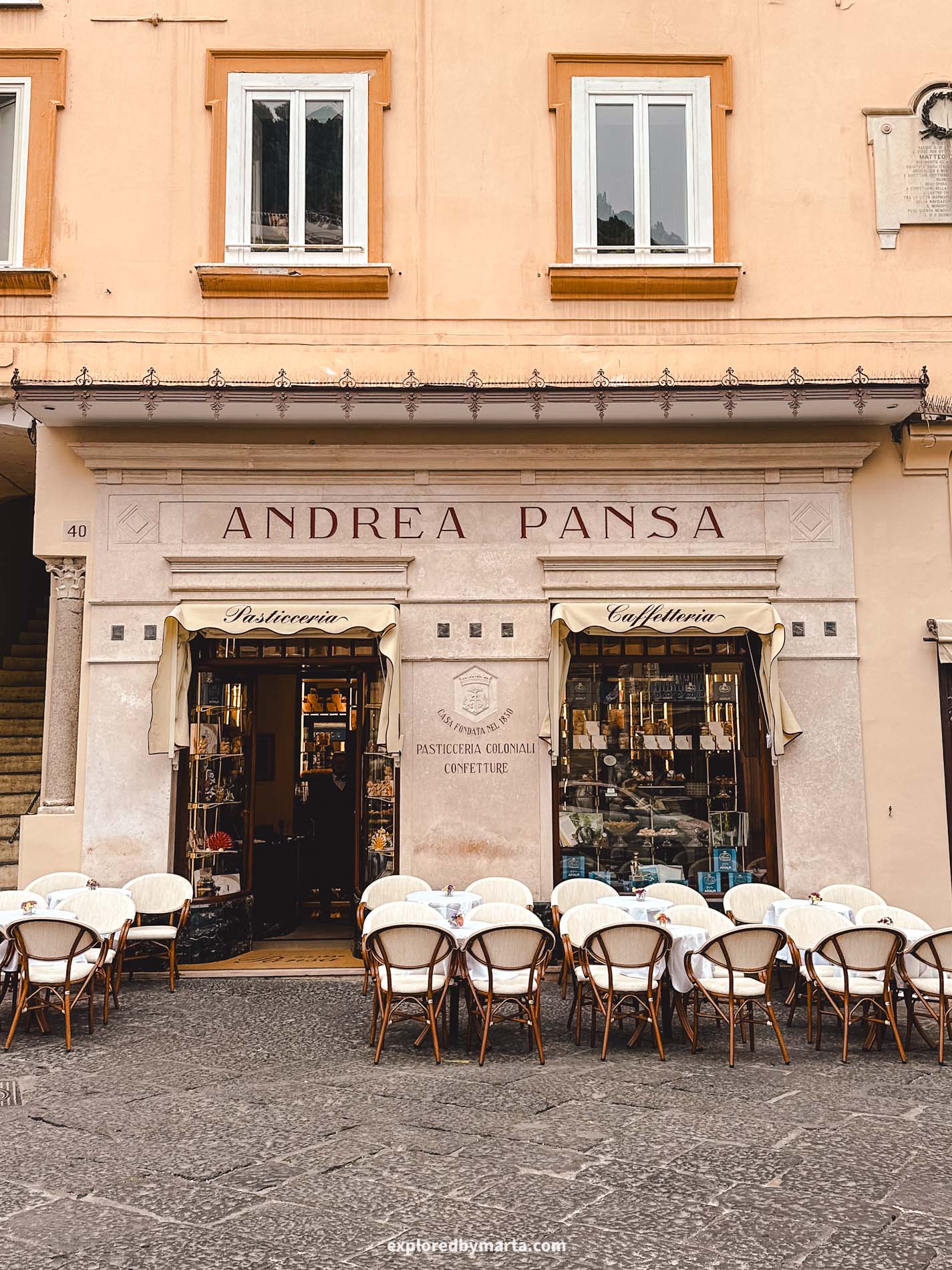
The square is usually busy, lively, and exactly the kind of place where you sit down and feel like, okay, I’ve arrived. This is a great time for a quick breakfast, the Italian way. I recommend stopping at Pasticceria Andrea Pansa right on the square.
It is the most iconic pastry shop in Amalfi and has been here since 1830, so it has that old-world charm that just fits the setting perfectly.
Grab a coffee and try two of the Amalfi Coast’s most famous pastries – sfogliatella Santa Rosa and delizia al limone. Both were invented in this area and are among the must-try foods when visiting the Amalfi Coast.
It’s the perfect occasion, because you’re already sitting in one of the prettiest squares on the Amalfi Coast, soaking in that dolce vita atmosphere you came to Italy for.
Tip! If you’re traveling as a couple, I’d just share a few pastries like we did. That way you can try more things without ruining lunch five minutes into the day. 😅 You’ll be eating well today! Plus, those pastries are a bit pricey here, so don’t go all in.
2. Climb up to Belvedere Cimitero (do it while you have energy!)


After breakfast, while you still have energy, head up to Belvedere Cimitero, the best viewpoint in Amalfi.
Yes, it is a viewpoint near the cemetery, and yes, that sounds a little random, but somehow on the Amalfi Coast, the best viewpoints often seem to be next to cemeteries. Amalfi is no exception.
You can reach it by climbing the stairs behind the cathedral – go to Via Supportico Sant’Andrea (tunnel between the pastry shop and the cathedral), then turn onto Salita Sopra Muro street and start climbing up, and finally turn onto Salita S. Lorenzo del Piano.
This street will lead you to the cemetery entrance. The view is right there, no need to go inside to greet the sleeping ancestors.
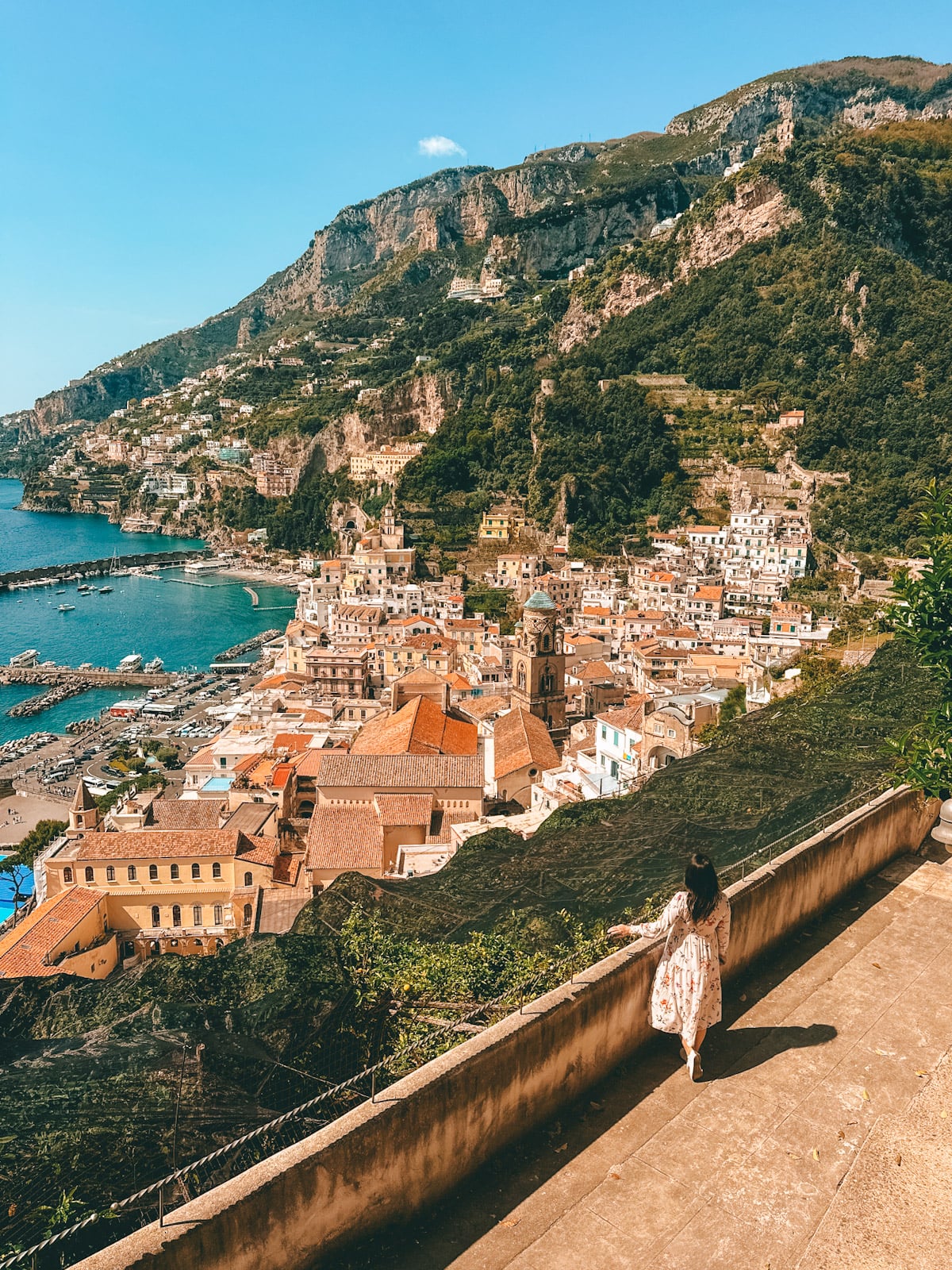
From Belvedere Cimitero, you’ll get one of the best views over Amalfi town – the beach, the ferry port, the tightly packed buildings, and the steep mountains all around. It is just wonderful!
The area is also surrounded by lemon trees and greenery, which makes the whole climb feel very Amalfi. This was one of my favorite places in the town of Amalfi!
3. Go inside the cathedral and Paradise Cloister (optional, but recommended)


Once you come back down, it’s time to visit the Duomo di Amalfi and the Paradise Cloister. The cathedral is one of the most important landmarks on the Amalfi Coast and absolutely worth visiting, not just photographing from outside.
It dates back to the 9th century and is dedicated to Saint Andrew, whose relics are kept inside the crypt below (yes, you can visit the stunning crypt!).
What makes it especially interesting is how much Amalfi’s old trading history shows in the architecture. You can really see that mix of influences here – Arab-Norman, Gothic, and Baroque details all layered together.
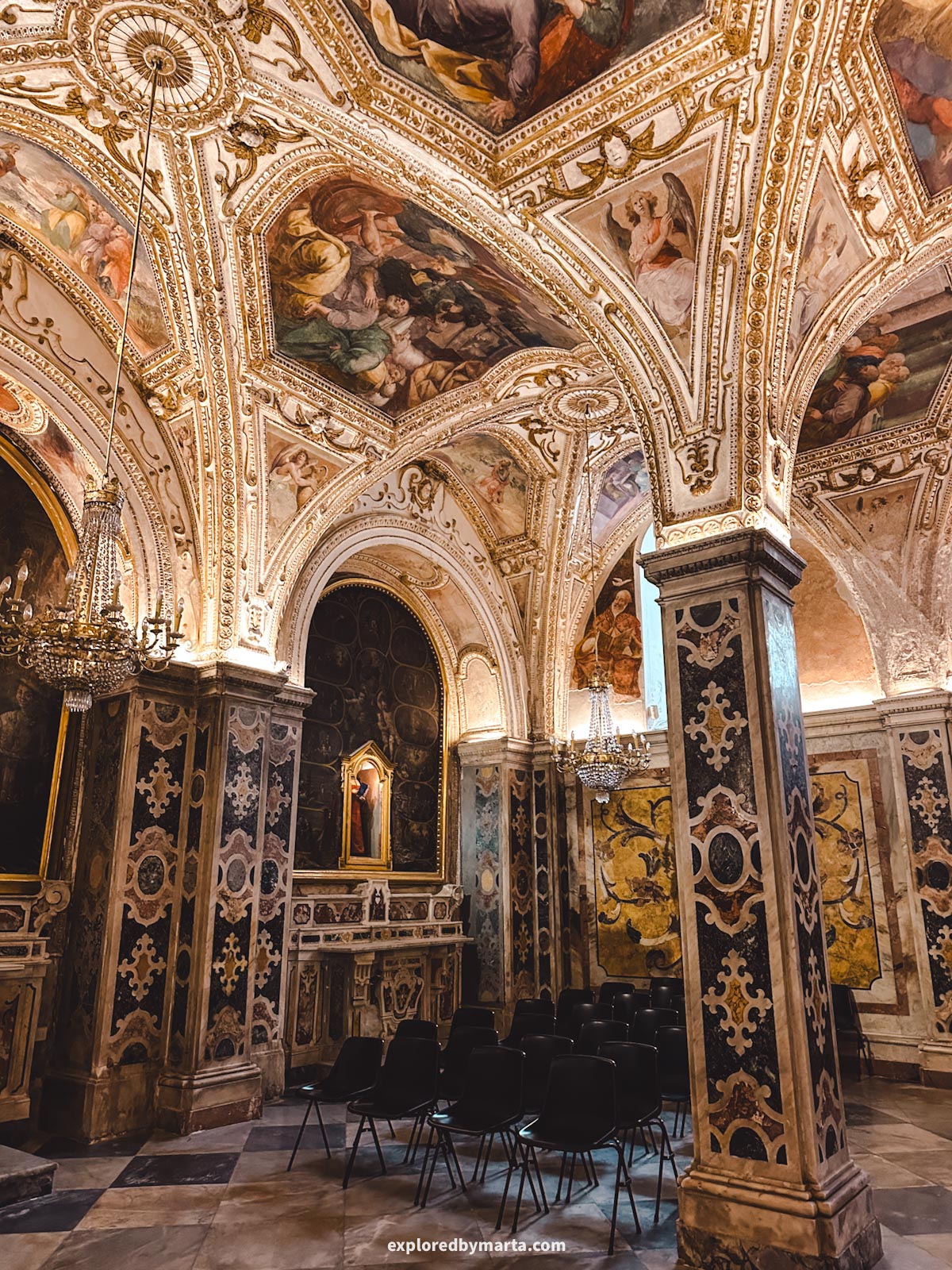

Even the massive bronze entrance doors were made in Constantinople in the 11th century, and they are actually the oldest bronze church doors in Italy!!!
You can enter the cathedral through the adjacent Paradise Cloister. There is an entrance fee of a couple of euros, but I felt it was worth it.
At first, you’ll visit the 13th-century cloister (built as a burial place for noble Amalfi families), then go down to the crypt, and then walk back up to the central nave of the cathedral, before ending your visit and exiting back into the square.
Not everyone goes inside, but if you like architecture, history, or just beautiful places, you’ll love this stop.
4. Grab a lemon sorbet inside a lemon


After all the sightseeing, you’ve earned yourself one of the most iconic treats you can get on the Amalfi Coast – a lemon sorbet served inside a real Amalfi lemon.
The Amalfi Coast really is all about the lemons. The local lemon, sfusato amalfitano, is basically the symbol of the whole region – the scent, the color, the flavor, everything.
You’ll see shops selling these sorbets around town. You can choose the touristy option and get it in the same square by the cathedral (iconic view, but more expensive). We actually went to the nearby square (just steps away), Piazza dei Dogi, and got a much cheaper one.
Ours was below 10 EUR, but the ones in the main square are over 10 EUR per lemon. Tip for saving money – buy one to share if you are traveling together with someone.
5. Shop for ceramics on Amalfi’s main street, Via Lorenzo d’Amalfi


Next, head along Via Lorenzo d’Amalfi, the town’s main shopping street.
This street starts right by the square and climbs gently uphill through the valley. It’s lined with local shops, cafés, gourmet boutiques, gelato places, and souvenir stores. If you’re looking for souvenirs, this is the place.
There are also lots of other good things to buy along this street – lemon products, limoncello, soaps, candies, and even Amalfi’s signature pasta, scialatielli, which was actually invented in this town.
Just check that what you’re buying is made in Italy, because, like everywhere, there are a few not-so-local tourist items mixed in.
One thing people should absolutely look out for here is hand-painted Amalfi Coast ceramics. This whole region is famous for them! I bought a lemon-print mug when we visited the Amalfi Coast, and I still use it every day, and I love it!
6. Optional: Museo della Carta


If you keep walking uphill, you’ll eventually reach one of Amalfi’s most interesting attractions – Museo della Carta, or the Paper Museum (which is also a store, where you can buy stuff).
Amalfi has a long paper-making tradition, and this museum is set inside a 13th-century paper mill. It is actually much more interesting than it might sound at first.
You can join a guided tour through the old mill, see the original machines, learn how the paper was pressed and dried, and even make your own sheet of paper (they give you a small Amalfi paper piece as a souvenir after the tour).
Because Amalfi sits in a valley with a river running through it, the paper industry was able to grow here for centuries. The paper made in Amalfi was known as carta bambagina, and this little museum does a really nice job of showing that side of the town’s history.
It’s only a short walk from the center and a good optional extra if you want to add something a bit more unique to the day. We did the tour and quite enjoyed it. But it’s not a must-see place.
7. Have pizza under the lemon trees

By now, it’s probably time for lunch, and I have the perfect place for you – Pizzeria Donna Stella, where you can have pizza under lemon trees. It sounds exactly as nice as it is.
It’s one of those places that just feels very Amalfi Coast in the best way. Sitting in a small courtyard with lemons hanging above your head while eating Neapolitan pizza is honestly hard to beat.


Alternative 1: If you’re not super hungry and want a quick grab-and-go option, I highly recommend trying a cuoppo di mare from Pescheria CICA or another cuoppo spot in town.
A cuoppo di mare is basically a paper cone filled with a mix of freshly fried seafood – squid rings, anchovies, little fish, and all sorts of crispy things. It’s one of the classic snacks to try in this region.
They also have cuoppos for meat lovers, so don’t worry if seafood is not your thing. I don’t love seafood, and this still ended up being one of my favorite snacks. That’s all I’m gonna say!
Alternative 2: If you’re more of an Italian sandwich kind of person, head straight to Piazza dei Dogi and grab a gourmet panini. These are made fresh in front of you using local ingredients like Italian cheeses, pesto, sun-dried tomatoes, and cured meats.
I highly recommend Luisa Gastronomia Artigianale – I’m in love with their sandwiches!
8. Optional: do a limoncello tour and tasting at Antichi Sapori d’Amalfi
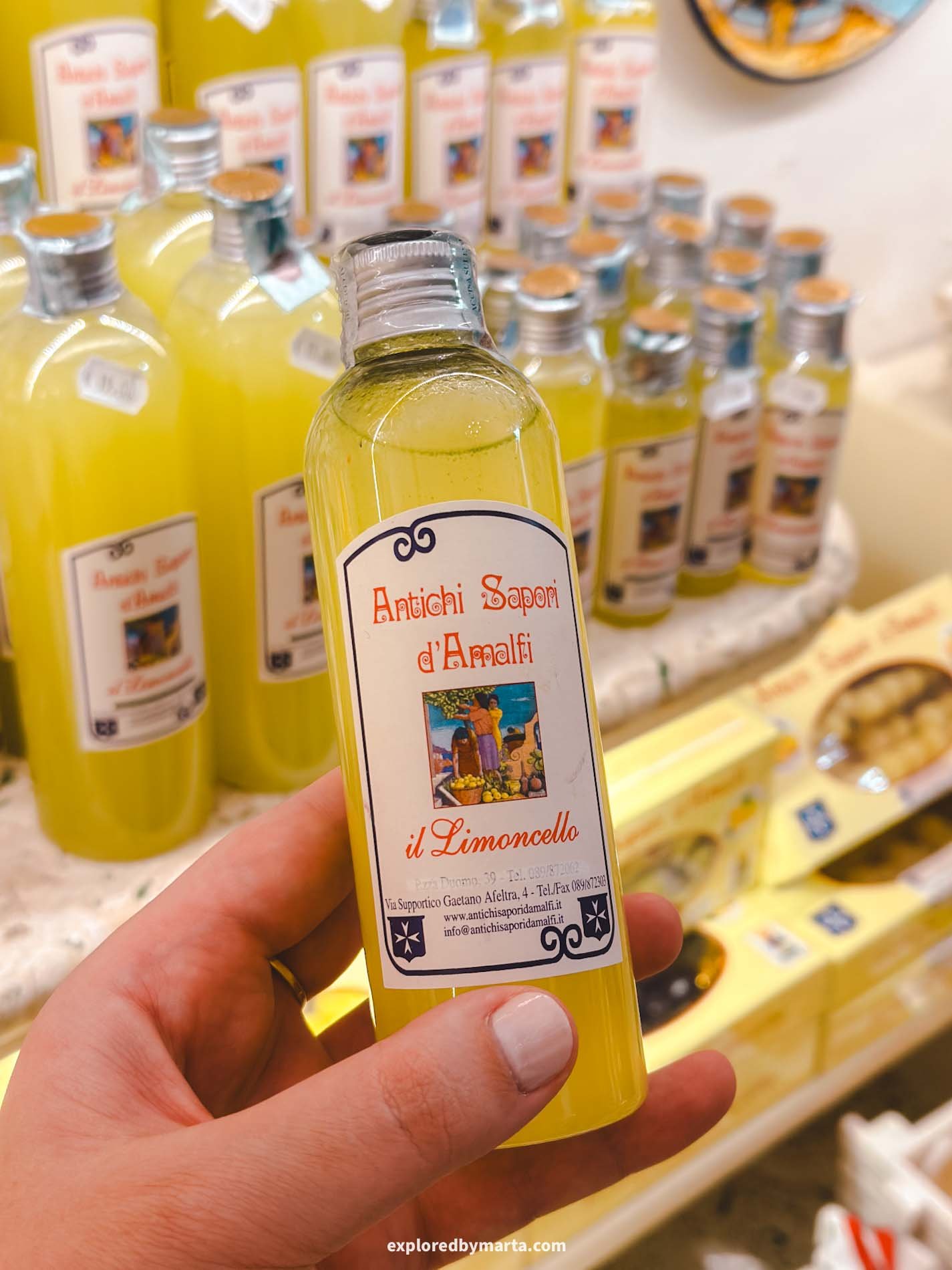
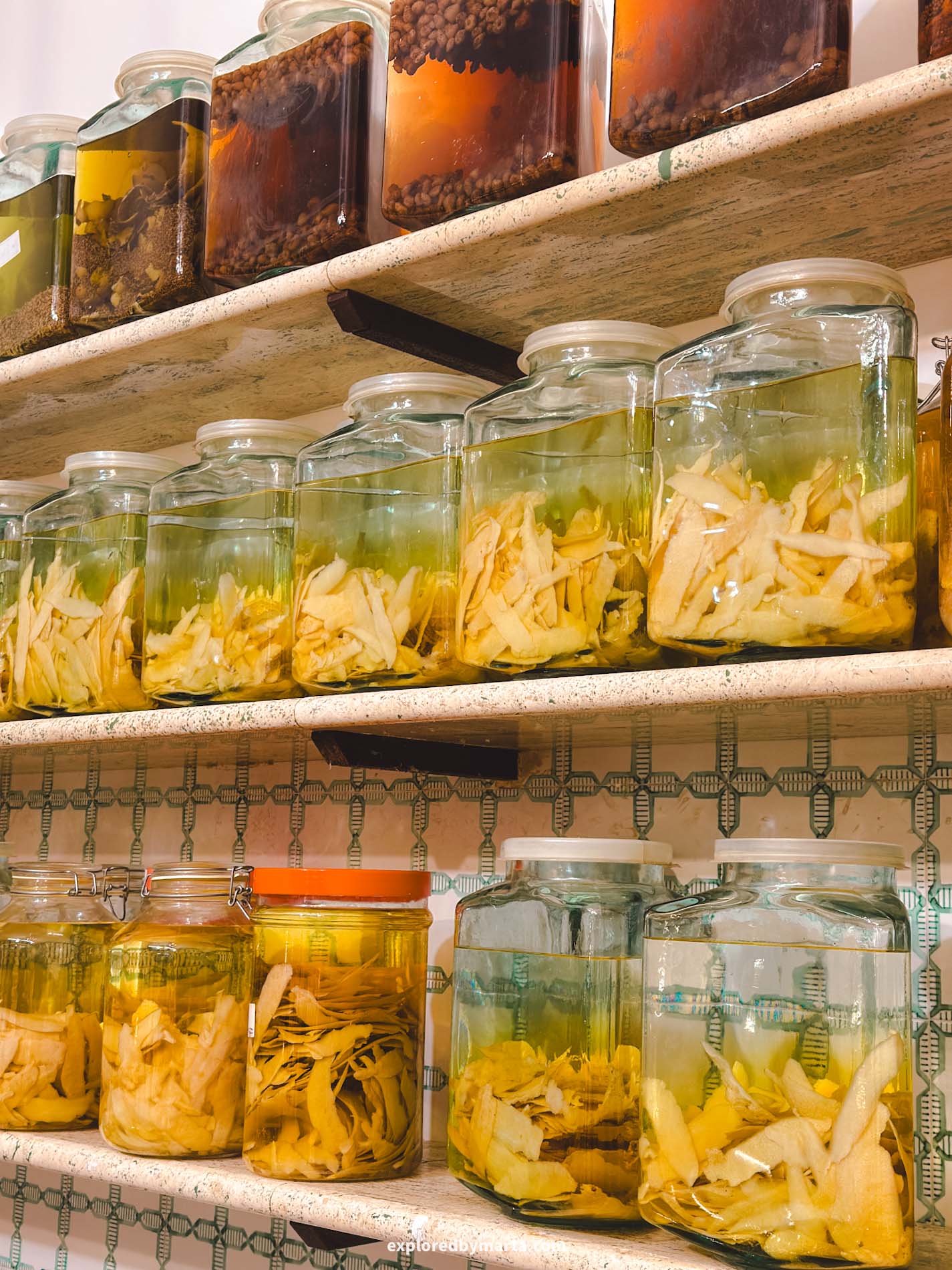
Every local will tell you that there is one thing you need to do after eating – a small shot of limoncello, the world-famous lemon liqueur (it helps with digestion).
There is a small family-run factory shop, Antichi Sapori d’Amalfi, right next to Piazza dei Dogi in Amalfi, where they offer limoncello tastings and show the traditional way of making it.
We did the tour, and it was really interesting to learn how limoncello is made, see the lemons being peeled and infused, and try different flavors. They also have a shop, and we bought a couple of bottles to bring home with us. This is the tour we did:
9. Walk over to Atrani and see the iconic view of Spiaggia di Atrani

From Amalfi, walk over to Atrani, the smallest town in Italy (go through the pedestrian tunnel carved into the mountain, then cross the road and follow the path along the cliffside through a restaurant).
This walk only takes about 10 minutes, but it feels like stepping into a different version of the Amalfi Coast. Amalfi is lively and buzzing, while Atrani feels much quieter, smaller, and more local.
These two towns have been linked for centuries and are often referred to as twin towns. During the time of the Duchy of Amalfi, the dukes were crowned right here in Atrani, at the church of San Salvatore de’ Birecto.


The main thing to do here is to see the famous view of Spiaggia di Atrani, one of the most iconic views on the Amalfi Coast. You’ve probably seen this postcard view all over the internet, right?
The cliffs, the beach, the arcades, the little square – it all feels postcard-perfect, but much calmer than Amalfi. If you have some time to spare, you can walk down to the beach or climb the iconic church steps, where the dukes were crowned centuries ago.
Atrani is a really nice place to end the day because it gives you that classic Amalfi Coast beauty, just in a quieter, more relaxed setting. I love this town so much!
10. Walk back to Amalfi and see the town from the end of the pier


Okay, not so fast, Amalfi also has an iconic view!
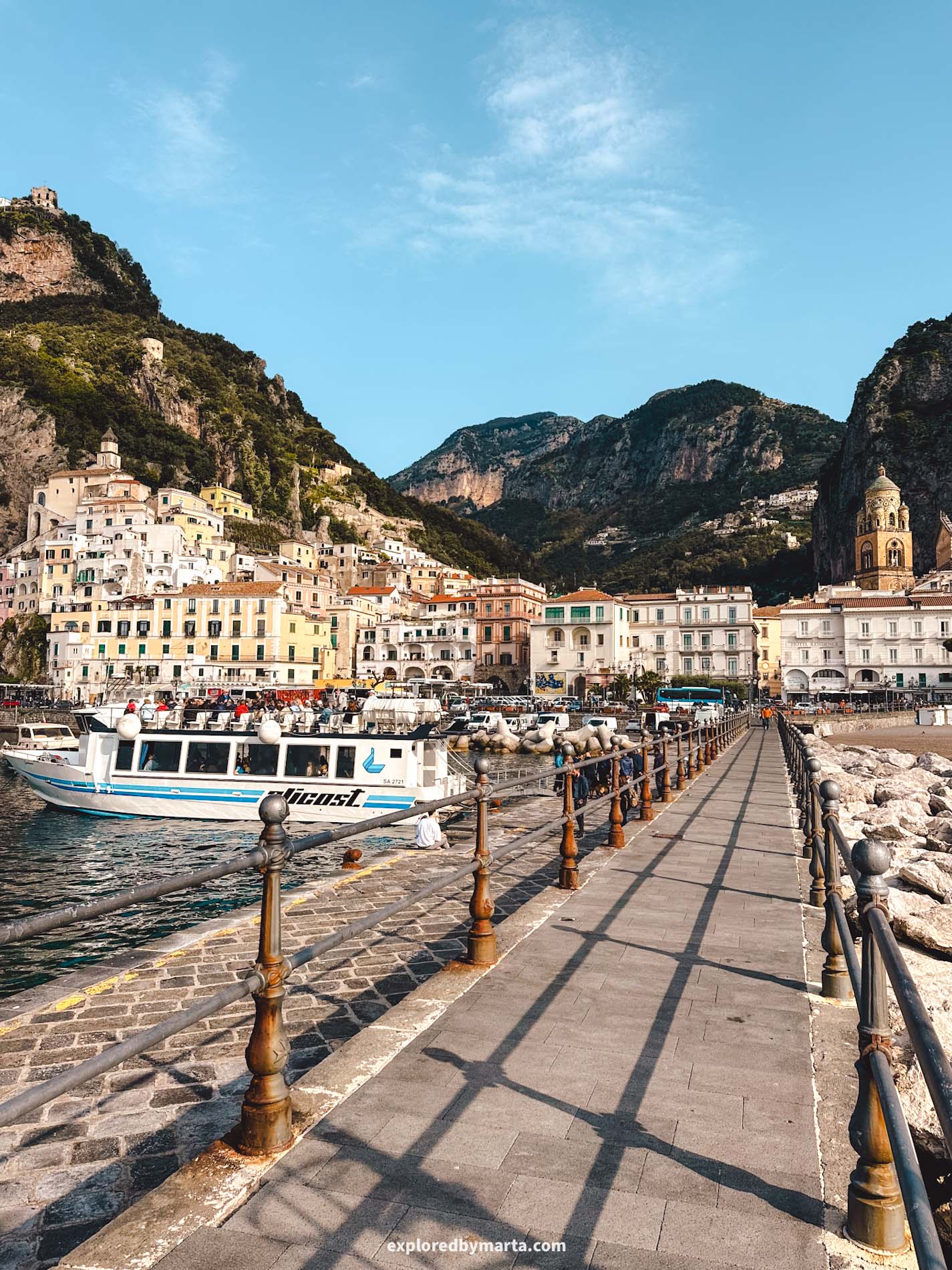
Once you walk back to Amalfi, there is one quick thing to do before you call it a day and head back to your hotel – go to the end of the Amalfi pier (where the boats dock) and turn around to see a different perspective of the town.
If you arrived by boat, you probably already saw this postcard view looking back toward Amalfi, with the buildings stacked up the valley and the mountains towering behind them. It’s one of the prettiest angles of the town.
It’s like one last look back at this iconic place before you finish day 1 and head back to your hotel.
Day 2: See Ravello, walk the Path of the Lemons, and relax in Maiori
After a full first day in Amalfi, day 2 takes you a bit higher – literally.
Today starts in Ravello, the Amalfi Coast’s romantic clifftop town, and ends down by the sea in Maiori. In between, you’ll do one of the most famous short hikes on the Amalfi Coast – the Path of the Lemons – and yes, it is exactly as dreamy as it sounds.
Ravello was founded back in the 5th century, when people moved higher up the mountain to hide from pirates, which makes it one of the oldest towns on the Amalfi Coast.
This is another day where I’d recommend starting early – around 9 to 10 AM would be great. Ravello is very popular, and once the day-trippers arrive, you’ll feel it.
1. Have breakfast in Piazza Duomo


Once you arrive in Ravello, head straight to Piazza Duomo, the main square and the heart of the town. You know the drill from yesterday 😄
Find a nice café, order a cappuccino and a pastry, and take a moment to just sit there and enjoy it. Mornings in Ravello feel much calmer than in Amalfi, and honestly, that’s part of the charm.
Right in front of you, you’ll see the Duomo di Ravello, the town’s 11th-century cathedral, standing slightly elevated above the square.
One thing I really liked here is that this square is not just pretty, but also scenic. There is a small viewpoint tucked between the trees where you can already get a first little look at the coastline and mountains around Ravello. Easy to miss!
2. Head to the iconic Villa Cimbrone and see the Terrace of Infinity


After breakfast, go straight to Villa Cimbrone.
Let’s be honest – this is the big one. This is the reason so many people come to Ravello.
Villa Cimbrone dates back to the 11th century and has changed a lot over the centuries, eventually becoming the luxury hotel it is today. You can’t visit the hotel part unless you’re staying there, but most of the estate is open to visitors, and that is more than enough.
The walk to Villa Cimbrone is already beautiful, but once you get inside, my advice is simple – don’t get distracted too long by all the pretty corners at first, and head straight to the Terrace of Infinity.
This is the most famous place to visit in Ravello and one of the most iconic viewpoints in all of Italy.
A long cliffside terrace lined with marble busts, endless sea views, and that dramatic drop that makes the whole thing feel almost unreal. Many people call it one of the most beautiful places in Italy, and honestly, for once, the hype is not exaggerated.

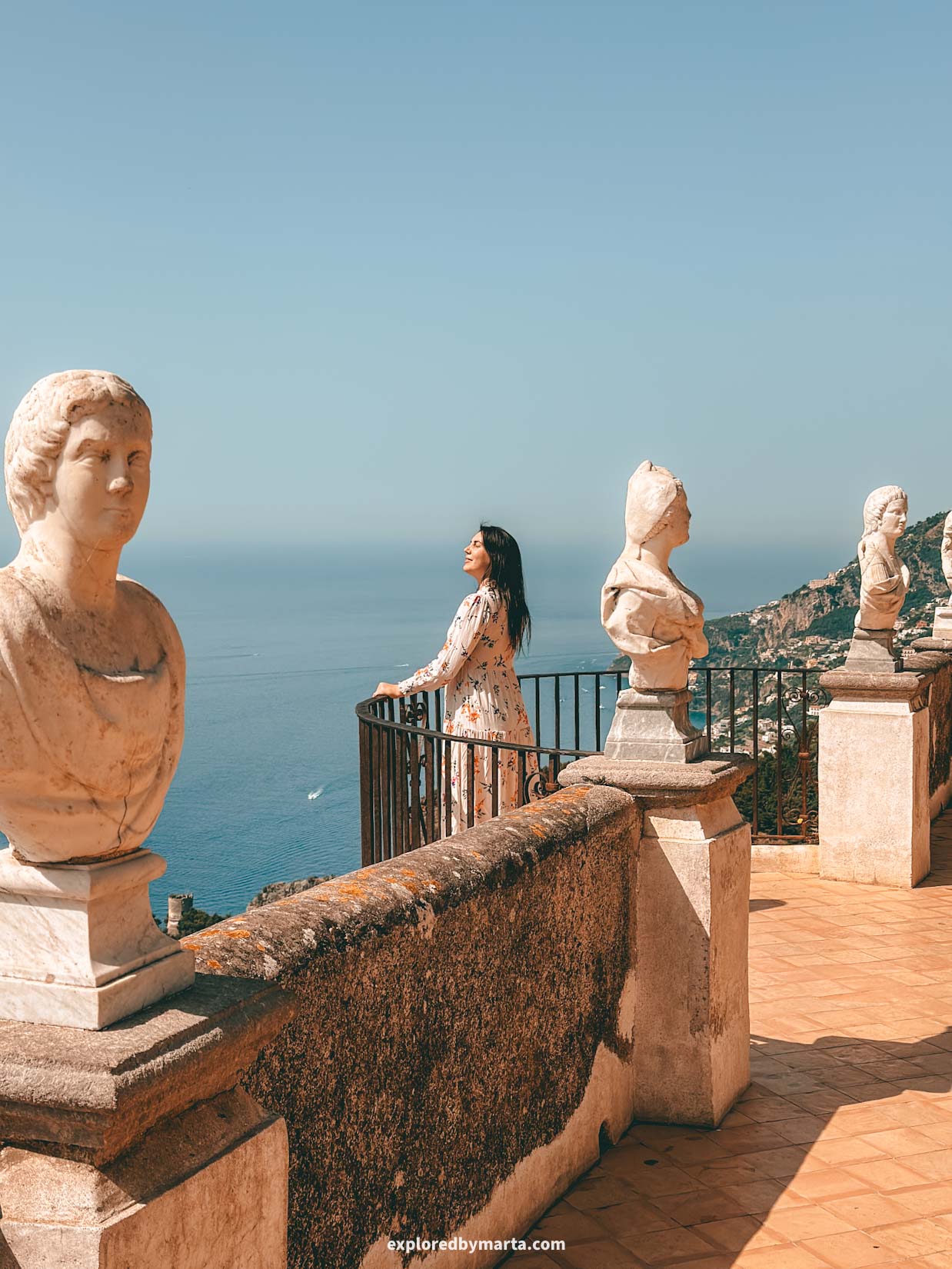
It really is that beautiful.
We came here right when it opened, and I’d do exactly the same again. First, because the light is lovely in the morning. Second, because later in the day it gets much busier, and this is one of those places you really want to enjoy before the crowds fully take over.
After the terrace, take your time with the rest of the estate – there are gardens, statues, shaded paths, a cloister, the Temple of Bacchus, and lots of little corners that make the whole place feel elegant and a bit dreamy in that very Italian way.
This is not a quick in-and-out stop. This is one of the highlights of your 3-day Amalfi Coast itinerary, so enjoy it properly!
3. Optional: visit Villa Rufolo


Ravello has another popular villa, Villa Rufolo, right by the main square, back in the center of Ravello. I would personally skip this place, but if you love beautiful gardens and photo-perfect views, then go for it. But you’ve seen those already in Villa Cimbrone.
Villa Rufolo dates back to the 13th century and belonged to one of Ravello’s most important merchant families.
Today, it’s one of Ravello’s main landmarks and one of the key places behind the town’s nickname, the City of Music. Every year, Ravello hosts the famous Ravello Festival here, one of Italy’s oldest festivals.
Villa Rufolo is smaller than Villa Cimbrone. The gardens are beautiful, the cloister is lovely, and there is one especially iconic viewpoint overlooking the church towers, a pine tree, and the coastline behind.
You’ve probably seen this exact view before on postcards and souvenirs. If I had to choose only one villa, I’d still choose Villa Cimbrone. But if you really want to, Villa Rufolo is a very good add-on.
4. Head down to Maiori
After all the exploring, you’ve earned a proper Italian gelato. For that, head to Baffone Gelateria Artigianale on Via Roma. You know when a gelato place is so good you go back twice? Yeah. That kind of place.
Next, make your way down to Maiori. You can get there by bus, taxi, or car if you have one. The ride is short (about 30 minutes), but the whole vibe changes once you get there.
Maiori feels much more open than Ravello. Less cliff drama, more space. It is one of the larger towns on the Amalfi Coast, and it’s known for having the largest beach on the coast and the longest promenade.
5. Start the Path of the Lemons from Maiori 🍋
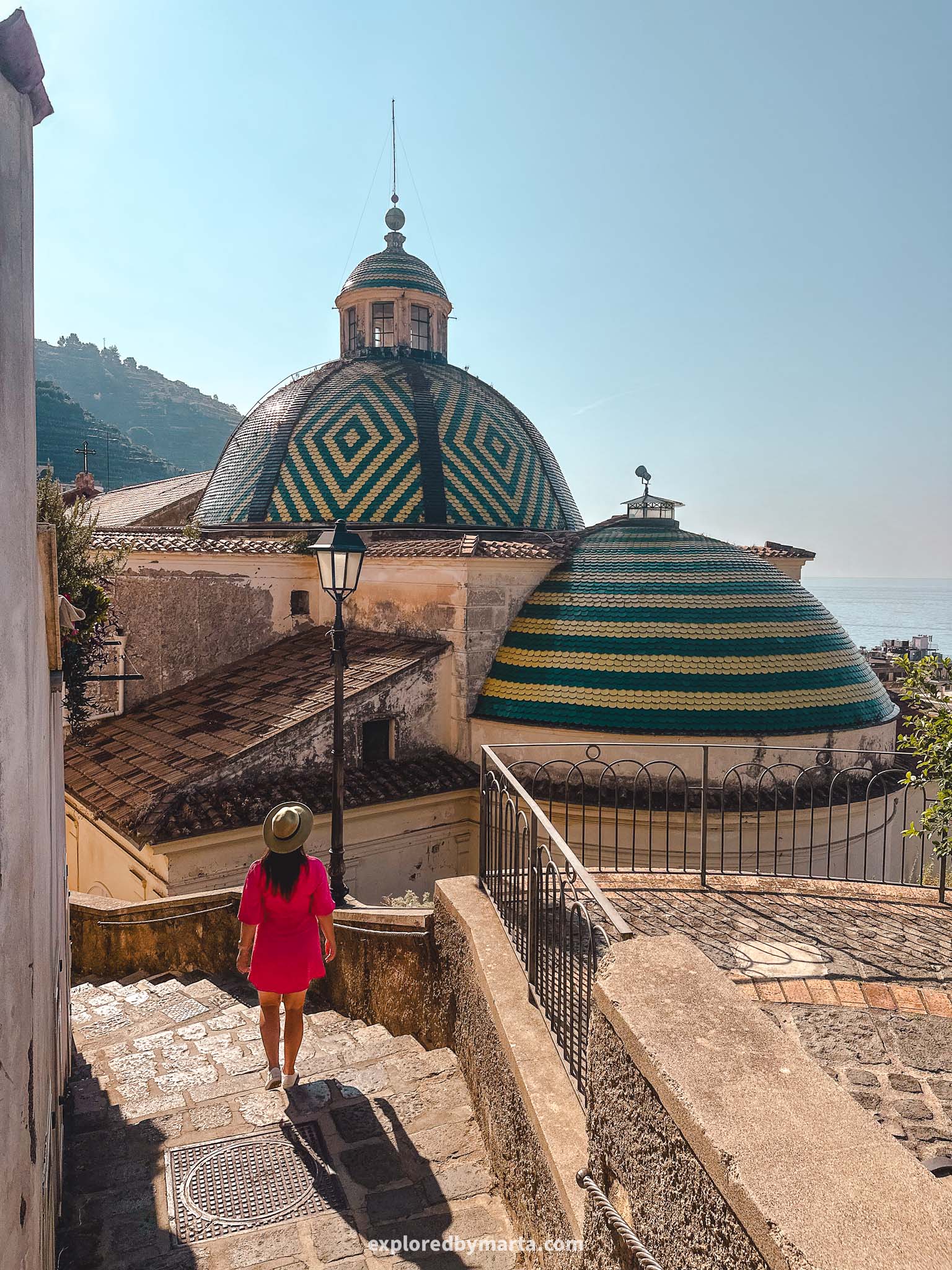
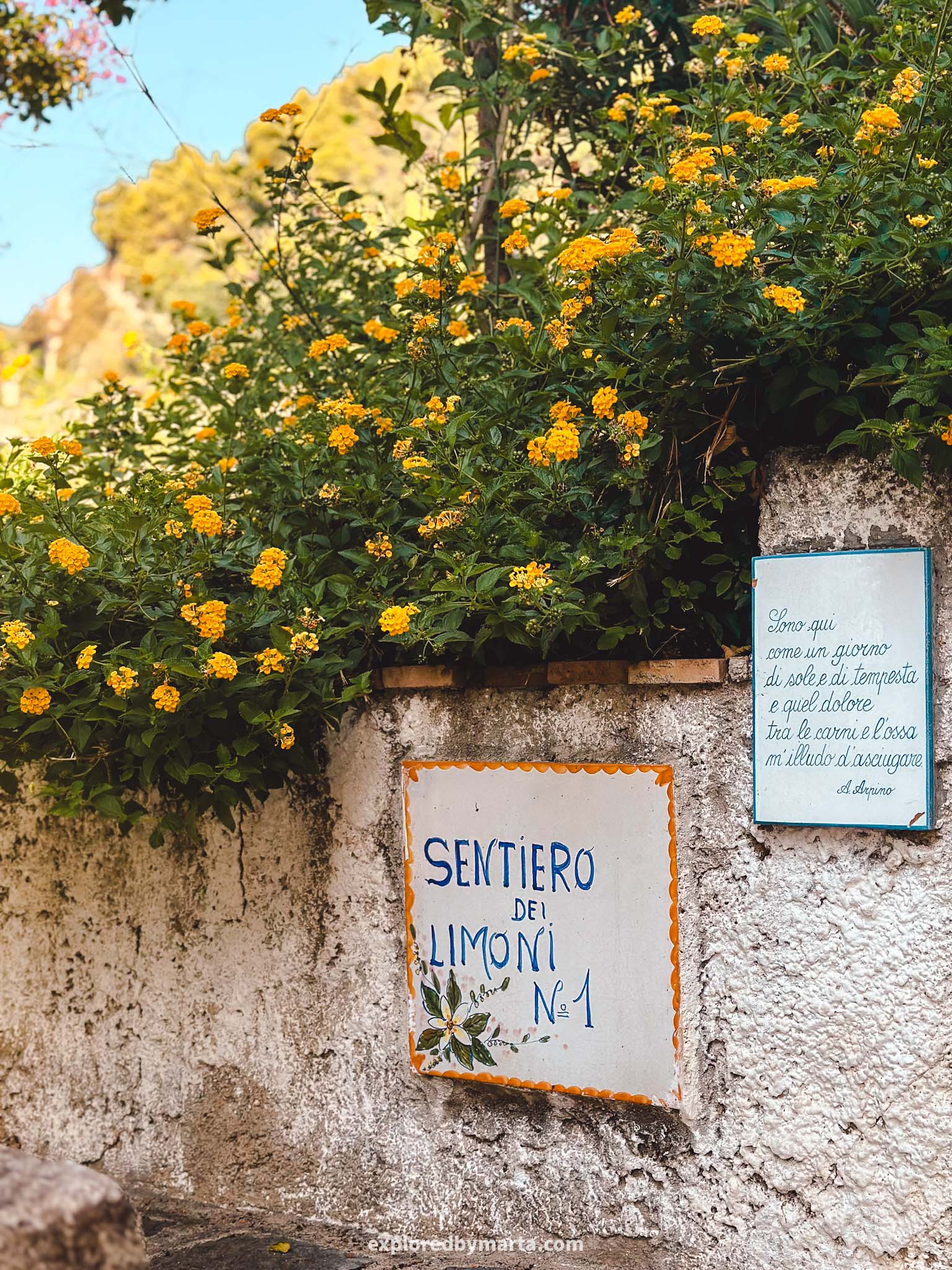
Once in Maiori, head toward the Church of Santa Maria a Mare.
This colorful church is one of the landmarks of the town and sits slightly above the center, with a terrace that gives you really nice views over Maiori.
This is also where the famous Sentiero dei Limoni, the Path of the Lemons, begins.
This trail connects Maiori and Minori, two sister towns, over the hill between them, and is one of the most charming walks on the Amalfi Coast.
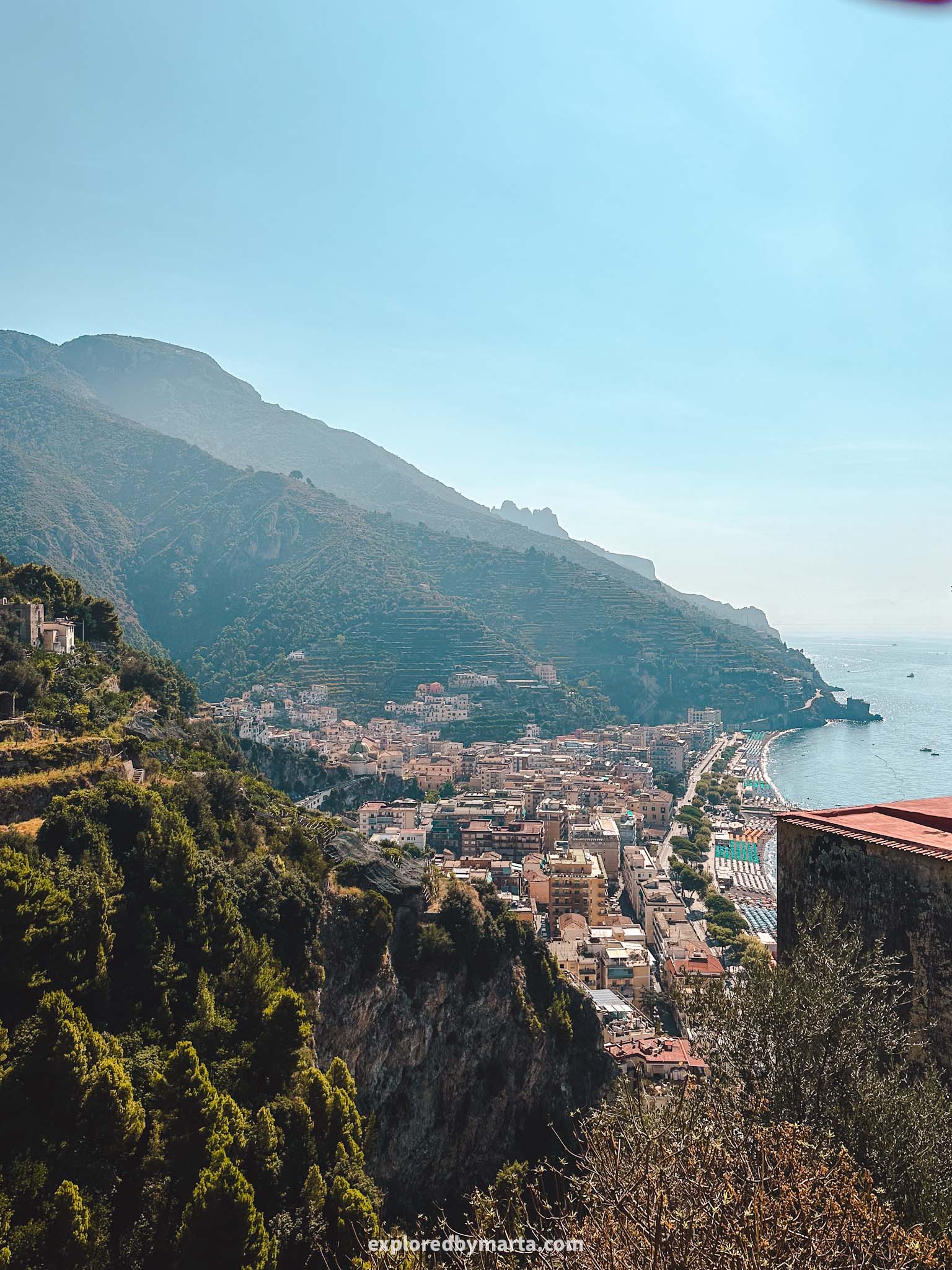
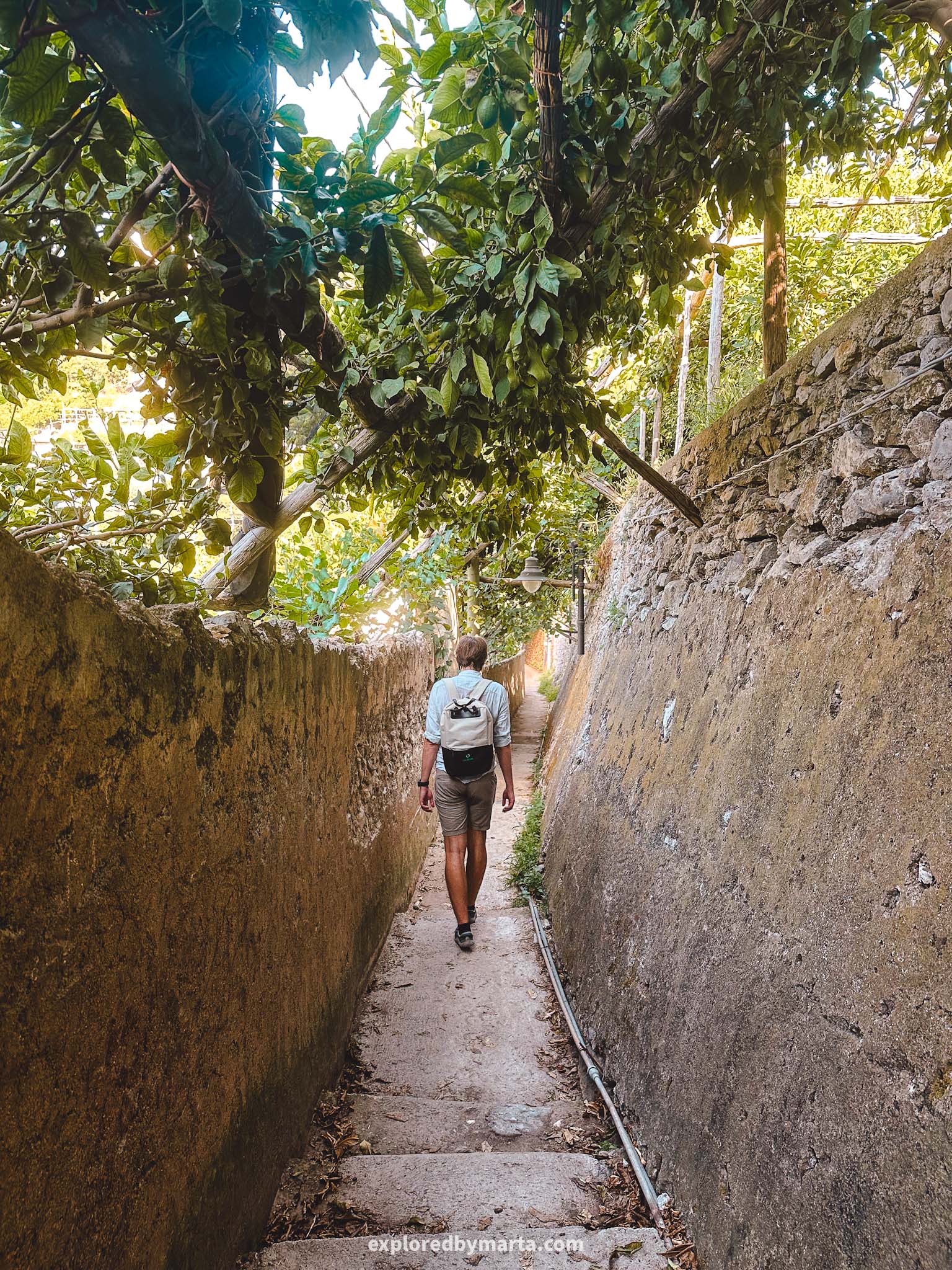
It’s about 2 kilometers/1.25 miles one way, so it’s very manageable, but yes, there are stairs involved – because of course there are, this is the Amalfi Coast 😅
Historically, this path was used to transport lemons and other goods between the two towns, and even today, people still use donkeys here sometimes. We actually saw them when we did the hike!
Along the way, you’ll walk through old lemon terraces where the famous sfusato amalfitano lemons are grown. The path is scenic the whole way, but there are two must-stop moments along it.
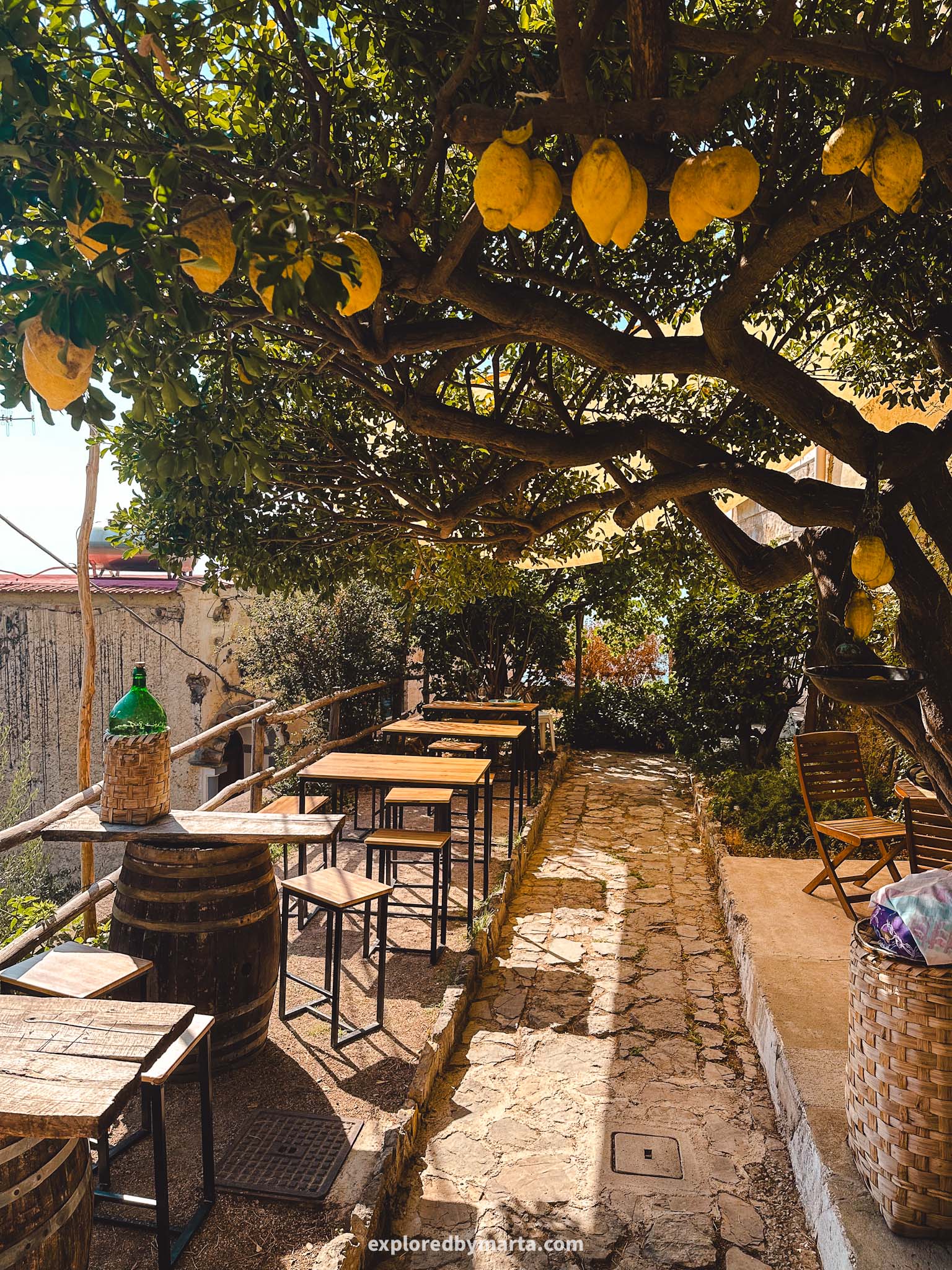
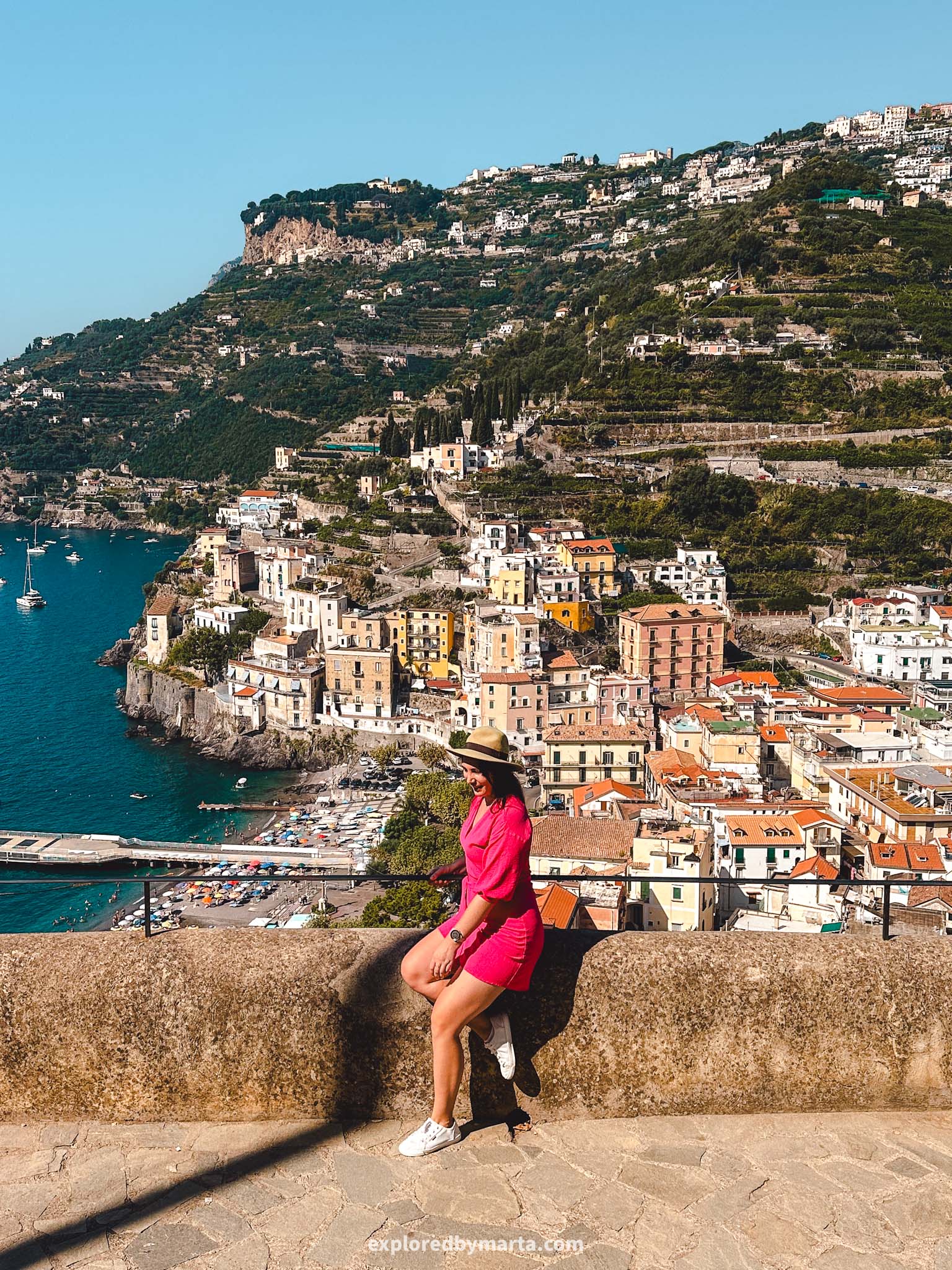
The first one is the little lemon farm around the midpoint, where you can stop for lemon granita or lemonade under the lemon trees. I mean… obviously stop, if they’re open.
The second one is Belvedere Mortella, a small lookout point with benches overlooking Minori. If you ask me, this is one of the prettiest views you’ll get on this whole walk.
Minori is tucked between the hills with the sea right in front, and from up here it all looks ridiculously photogenic. So yes, don’t just rush down to Minori once you see the town below – stop at Belvedere Mortella first.
It’s such a good little reward before the final descent.
6. Stop in Minori for the original delizia al limone

There is really only one correct thing to do in the small town of Minori – eat delizia al limone where it was invented. Yes, you might have eaten this dessert already, but it was made right here in Minori, so you have to try another one – the original!
Head to Pasticceria Sal De Riso, one of the most famous pastry shops on the Amalfi Coast, and order one there. This is not just a random pastry stop – Salvatore De Riso is one of Italy’s best-known pastry chefs and the creator of this famous lemon dessert.
So yes, this is the place.
And honestly, after walking through lemon groves and then sitting down in Minori for the original lemon dessert? The whole day just makes sense. 🤌
7. Walk back to Maiori along the sea
After your dessert stop, make your way back to Maiori.
You can walk back the same way along the Path of the Lemons (haha) or return by the coastal road if you want something easier after all those stairs (of course you want). Both options work, so just see how your legs are feeling at that point.
We chose to go back along the coastal road (the right choice) – it saves you some energy and gives you a completely different perspective of the coastline. I actually loved the seaside views just as much.
8. Have lunch and relax at Spiaggia di Maiori
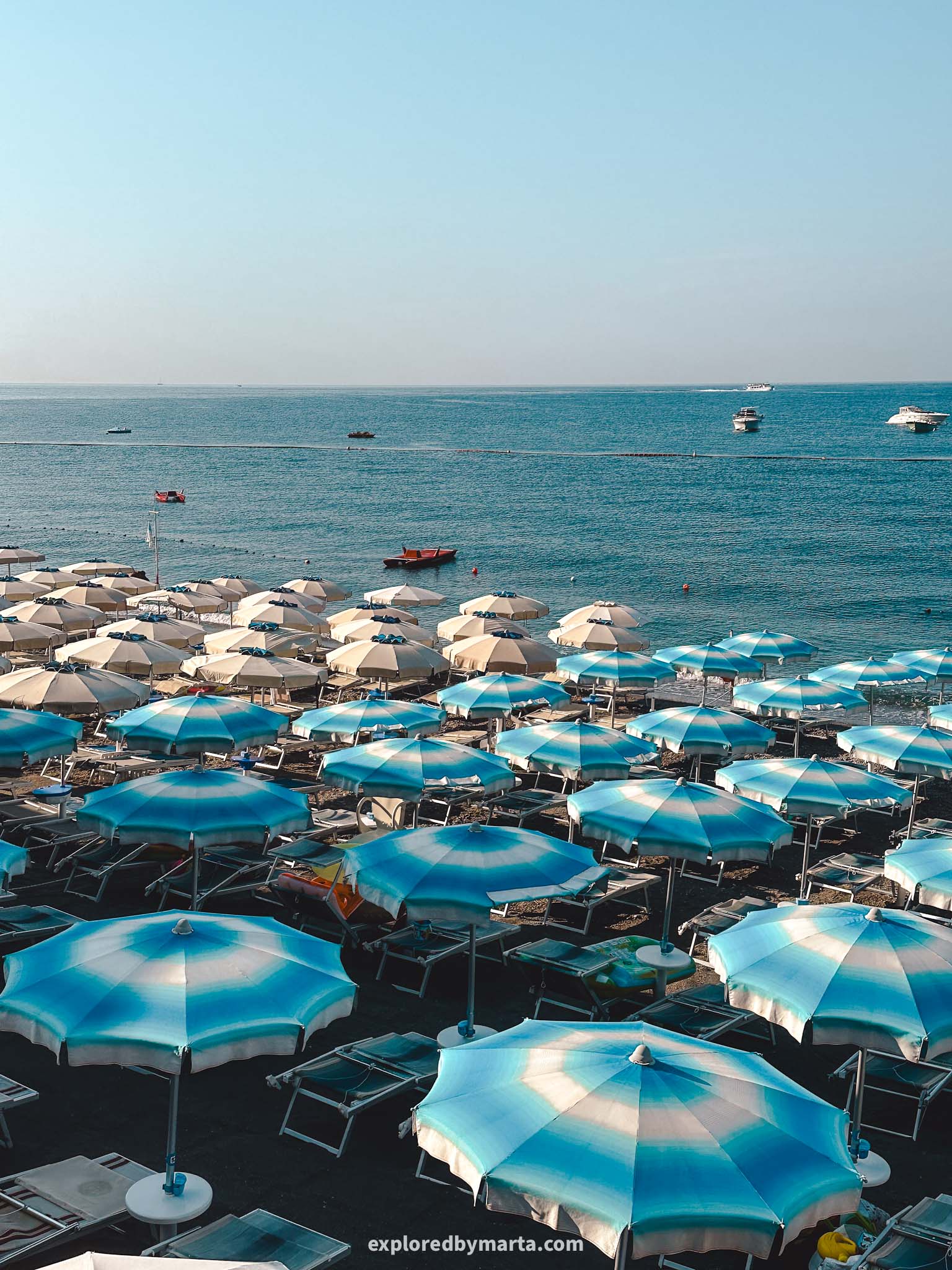
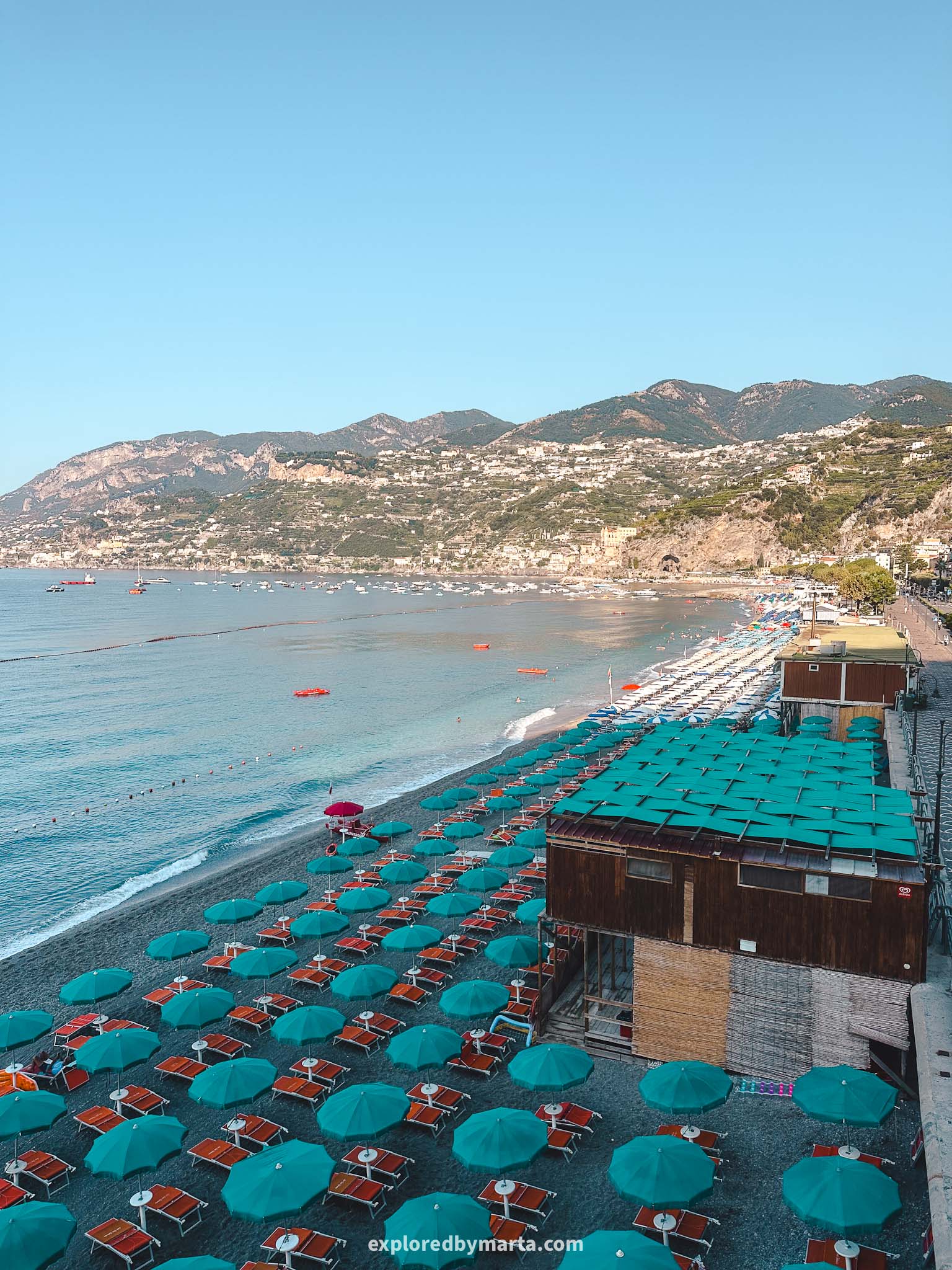
Once you’re back in Maiori, it’s time to slow down and relax – beach, food, whatever you feel like!
Maiori has the largest beach on the Amalfi Coast – it’s wider, more spacious, and just easier for a proper break without feeling squeezed into a tiny patch of sand.
There’s also a long promenade with benches, cafés, and beach clubs, so even if you don’t swim, it’s just a nice place to sit, stroll, and do a bit of nothing for once. And after Ravello and the lemon hike, a little bit of nothing sounds pretty perfect.
If you’re hungry, you’ve got some really good options here.

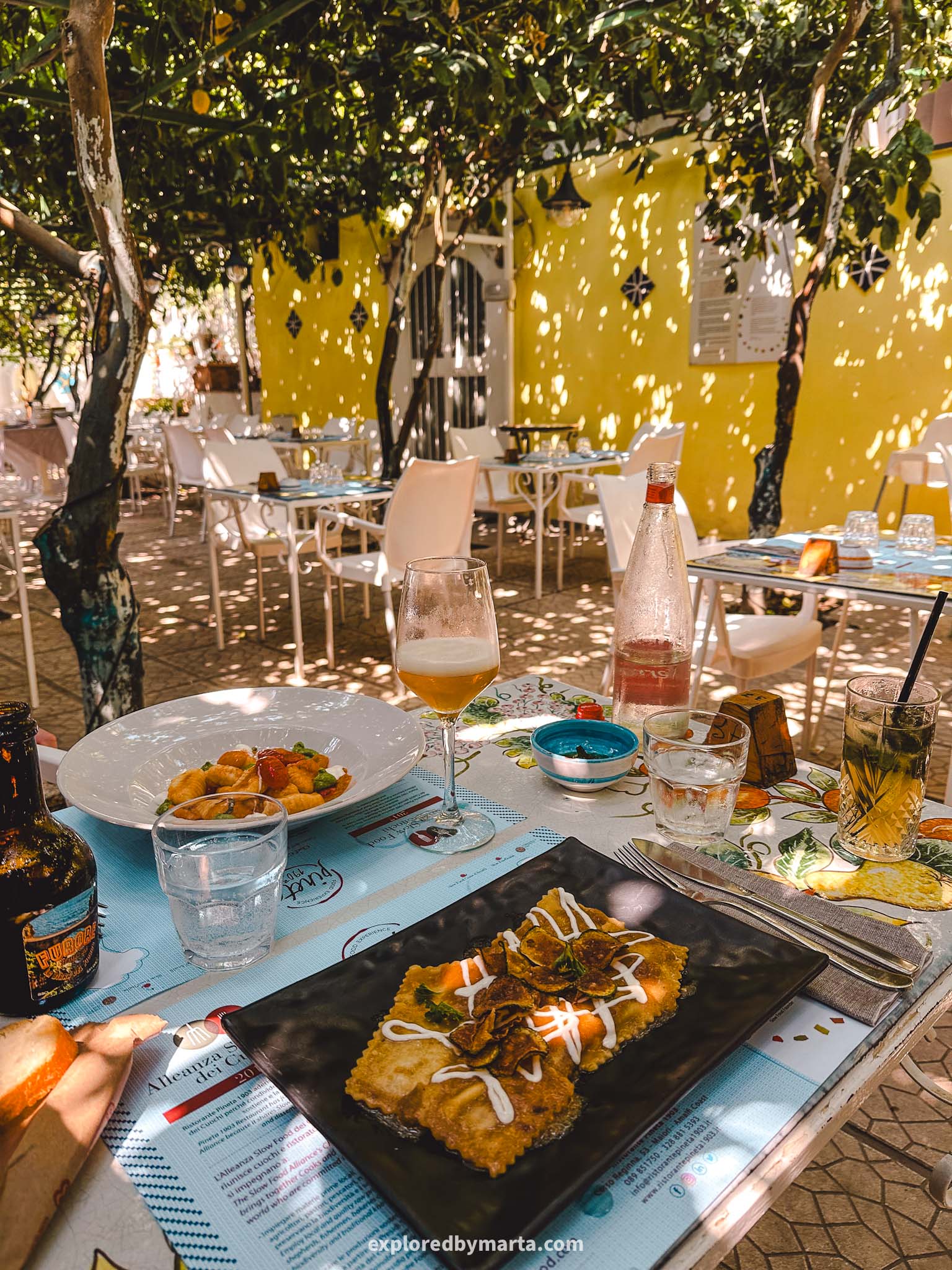
A really lovely one is Ristorante Pineta, a historic restaurant that has been around since 1903 and has a big lemon-tree courtyard. And by now, you already know I will always support the idea of eating under lemon trees if given the chance.
We actually went there twice! My tip – try the local ndunderi pasta, or go for a lemon pasta, which is a classic on the Amalfi Coast.
Another fancier option is Ristorante Torre Normanna, set inside a 13th-century watchtower overlooking the sea. This is one of the most scenic lunch spots on the Amalfi Coast and definitely more of a “let’s make this a moment” kind of place.
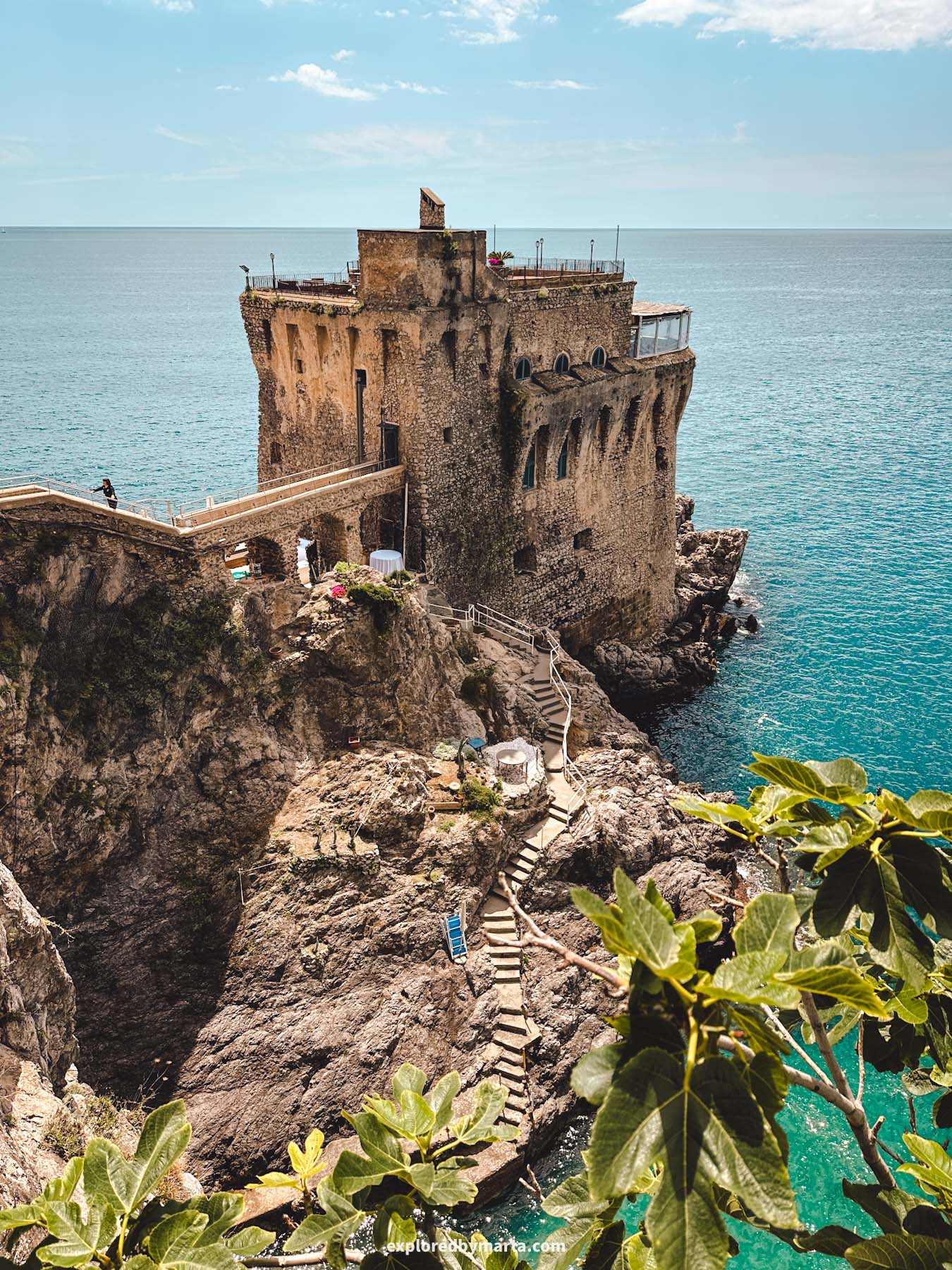
The views here are beautiful, and the whole setting feels very unique, but I would absolutely recommend making a reservation in advance and double-checking that they don’t have a private event going on. When we went, it was closed for a wedding 😅
They did offer us a table later in the day, but we were short on time…
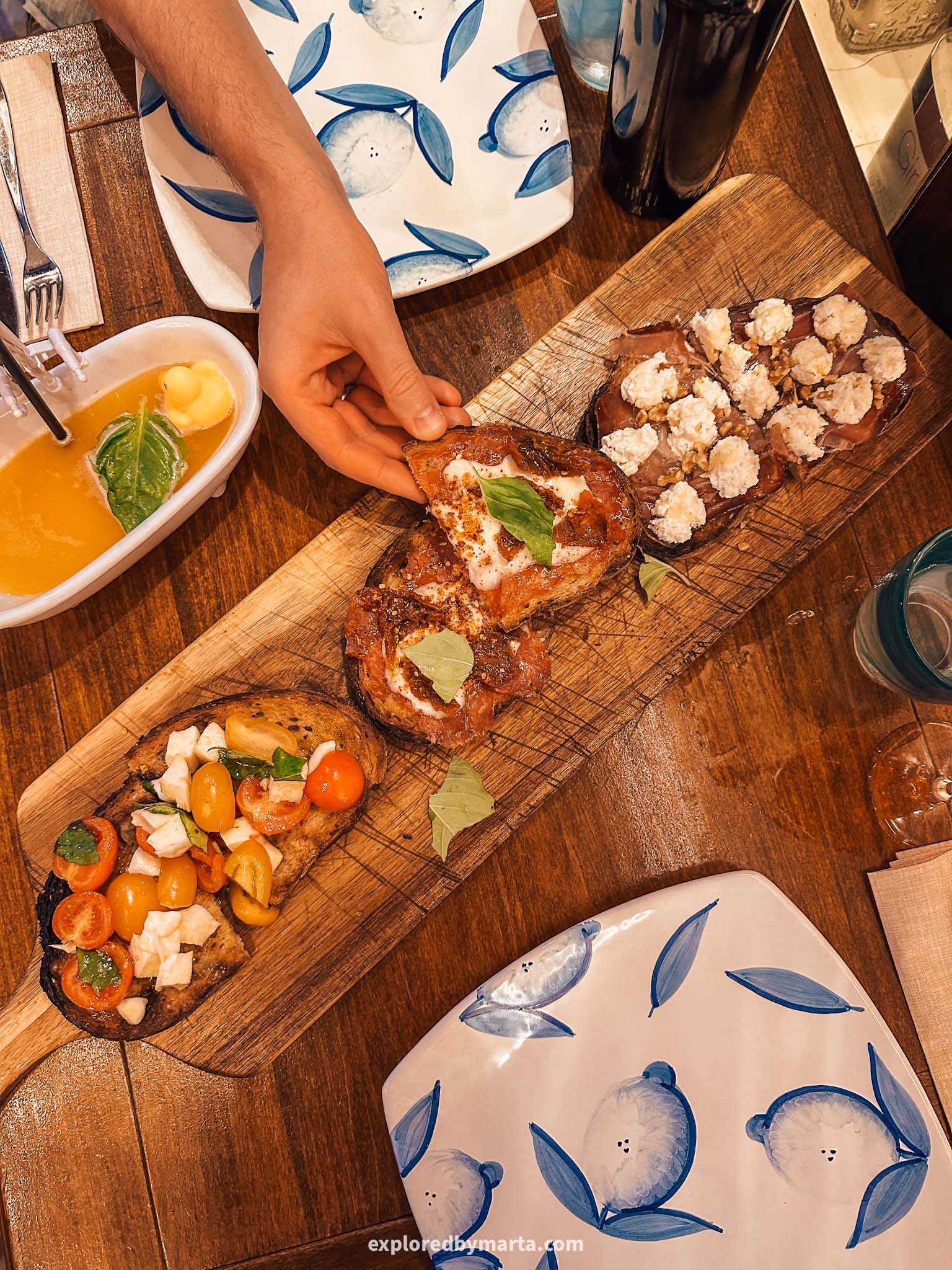
Another one of my favorites in Maiori is Casa Ferraiuolo. They’re known for their big bruschettas served on wooden boards, and it’s the kind of place that’s perfect for drinks and a shared late lunch or early dinner.
And that’s day 2 of your 3 days on the Amalfi Coast – breathtaking views in Ravello, lemon path, and a beach break in Maiori.
Day 3: Visit Positano, the iconic postcard town
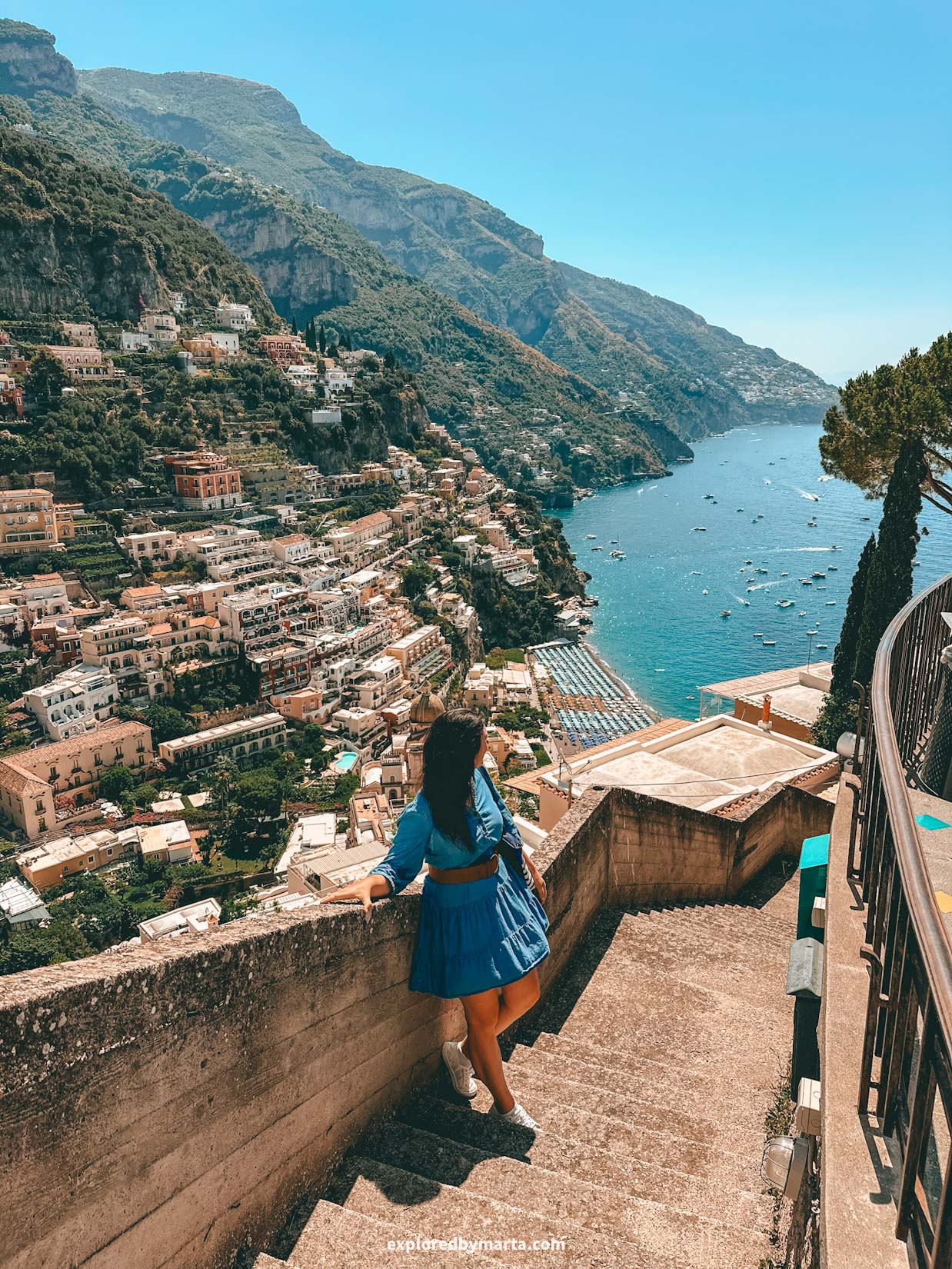
Let’s be honest – this is probably the day you’ve been waiting for.
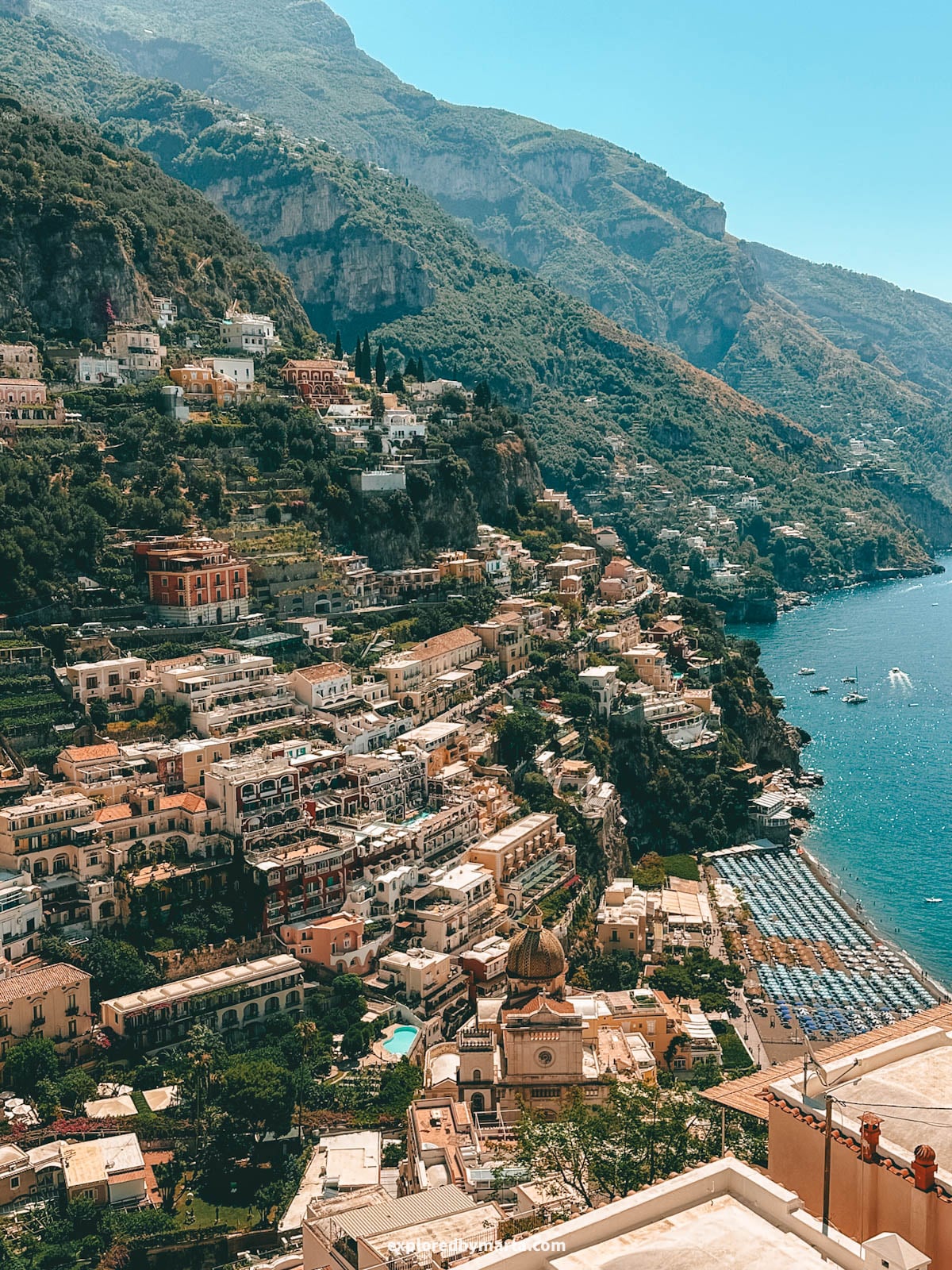
Positano is the postcard town of the Amalfi Coast. Those pastel houses stacked down the cliff, the beach, the sea, the tiled church dome… you’ve seen it before, and yes, it really does look like that in real life.
But Positano is also the busiest and trickiest town of the three, so this is another day where starting early really helps. I’d aim for around 9 to 10 AM again if you can.
And one important thing before we start – I would NOT recommend coming here by car. Parking in Positano is honestly a nightmare, very limited, and can go up to around 10 EUR per hour. Public transportation (bus or boat) is a much better and cheaper idea.
Yes, even if you do have a rental car.
1. Arrive in Positano – the route depends on how you get here
How your day starts in Positano actually depends on how you arrive, and it changes the whole flow a bit.
If you arrive by boat, you’ll start right by the beach. This is honestly the best first impression. You step off and immediately see Positano rising above you. From here, your day naturally starts at sea level and slowly works uphill.
If you arrive by bus, you’ll be dropped off higher up along the road. We got out at the Positano Sponda bus stop. That means you’ll start with the iconic cliff views first and then slowly make your way down toward the beach.
Both are good. They just give you a different first look at the town.
My opinion? Ferries are more expensive than buses, but this is the time I’d actually recommend arriving by ferry – those Positano sea views are just too good! You’ll arrive in style!
No need for a boat tour – views from the ferries are the same! 😃
2. Have breakfast with a view
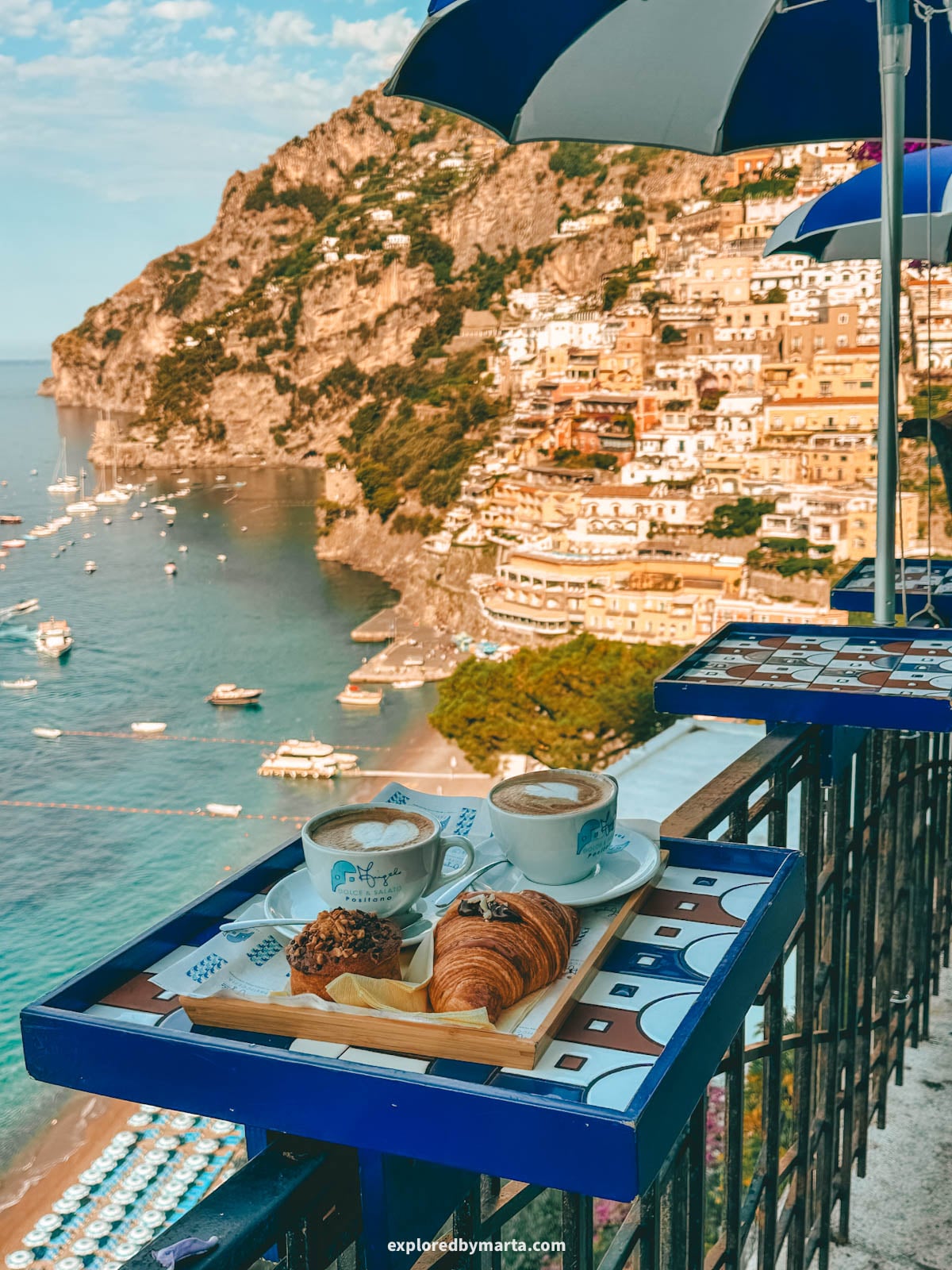

Before anything else, breakfast. Same rule as the last two days.
If you arrived uphill by bus, I’d go straight to Angelo Cafe – Dolce & Salato. They have simple roadside tables with one of the most iconic views over Positano, and honestly, it was one of my favorite meals we had there.
It’s not fancy, but that’s kind of the point. Coffee, pastry, that view… you know the drill by now.
If you arrived by boat, start lower down instead. Two really nice options are Hotel Palazzo Murat and La Zagara, both with beautiful terraces surrounded by greenery. It’s a calmer, more tucked-away start compared to the beachfront.
Either way, don’t rush this part. Positano is one of those places where breakfast with a view feels like an experience in itself. And, honestly, there’s not a lot you can do in Positano – the beach, the food, the views, shopping – that’s about it. So enjoy it!
3. Walk along Via Cristoforo Colombo, the best street for the iconic views
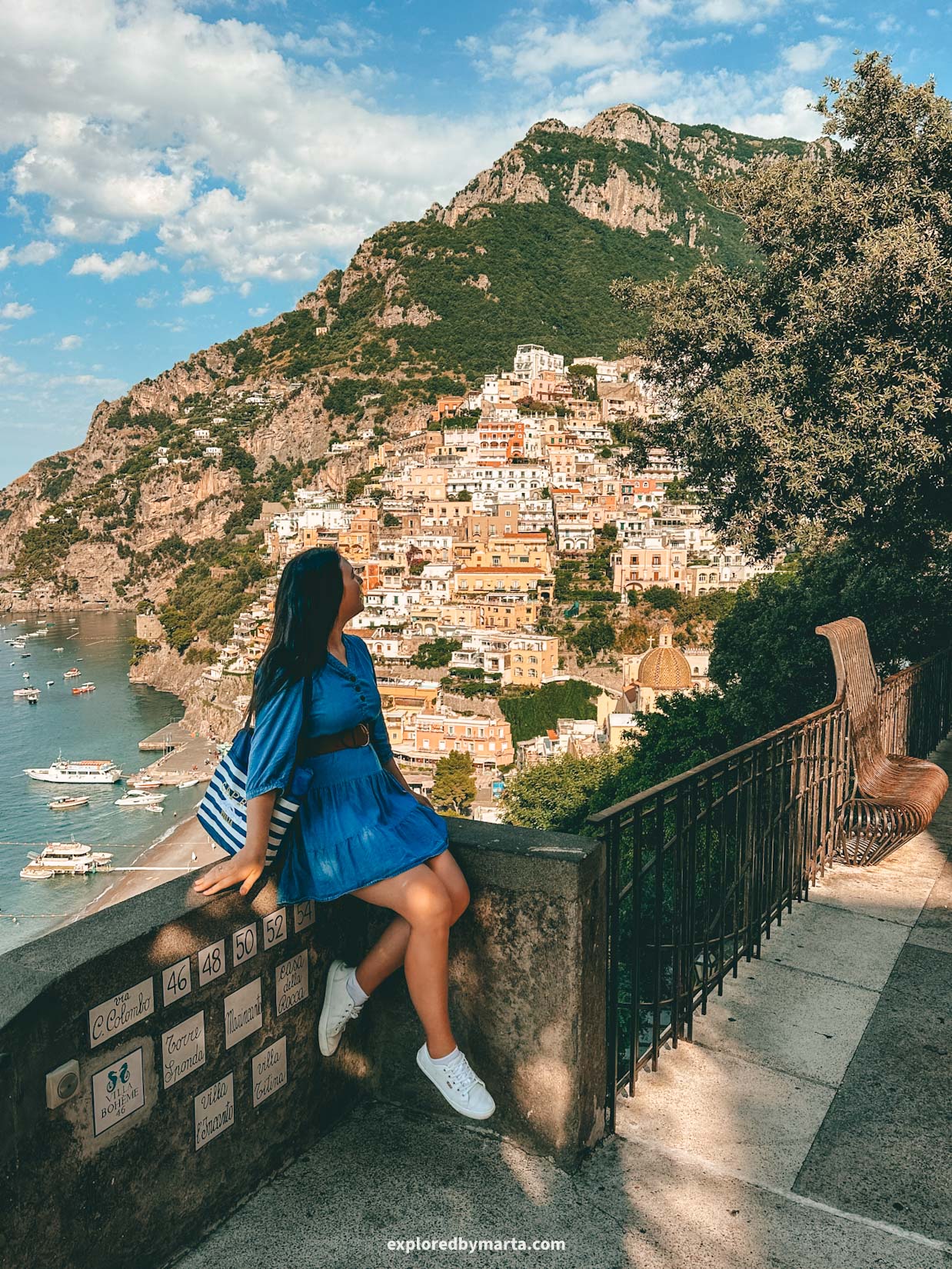
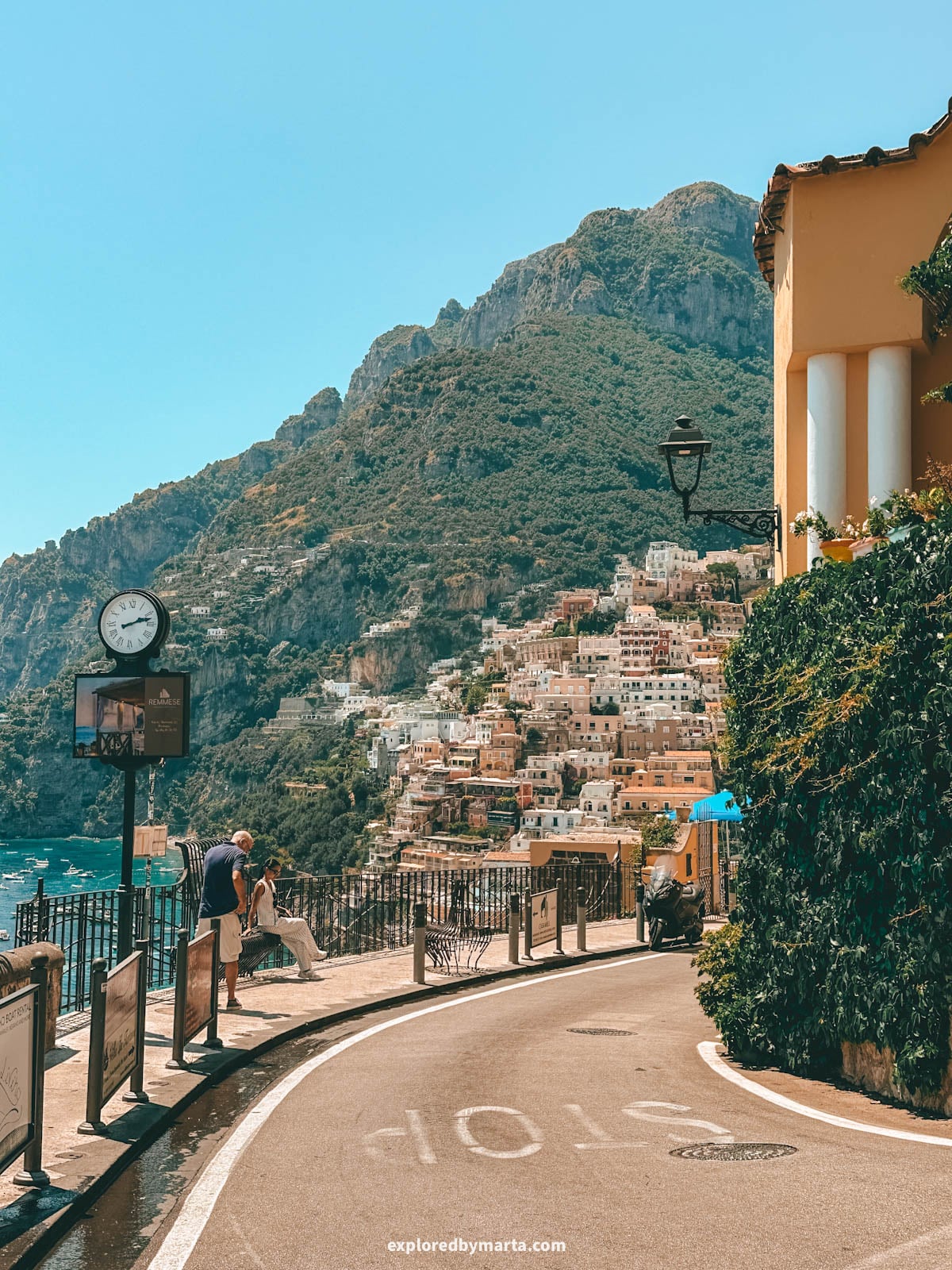
If there’s one street you should not skip in Positano, it’s Via Cristoforo Colombo.
This is where you get the classic Positano views – the stacked houses, the sea, the beach below, all in one frame. If you arrived by bus, you’ll already be near this area, so definitely start here. If you arrived by boat, just work your way up to it later.
This was one of my favorite parts of Positano, because the views just keep opening up in front of you. It’s one of those places where you stop every minute because every angle somehow looks better than the last one.
And honestly, this is the Positano people come for.
On this street, you will also find one of the most iconic Instagram spots on the Amalfi Coast (see photo above).
4. Stop by the Church of Santa Maria Assunta
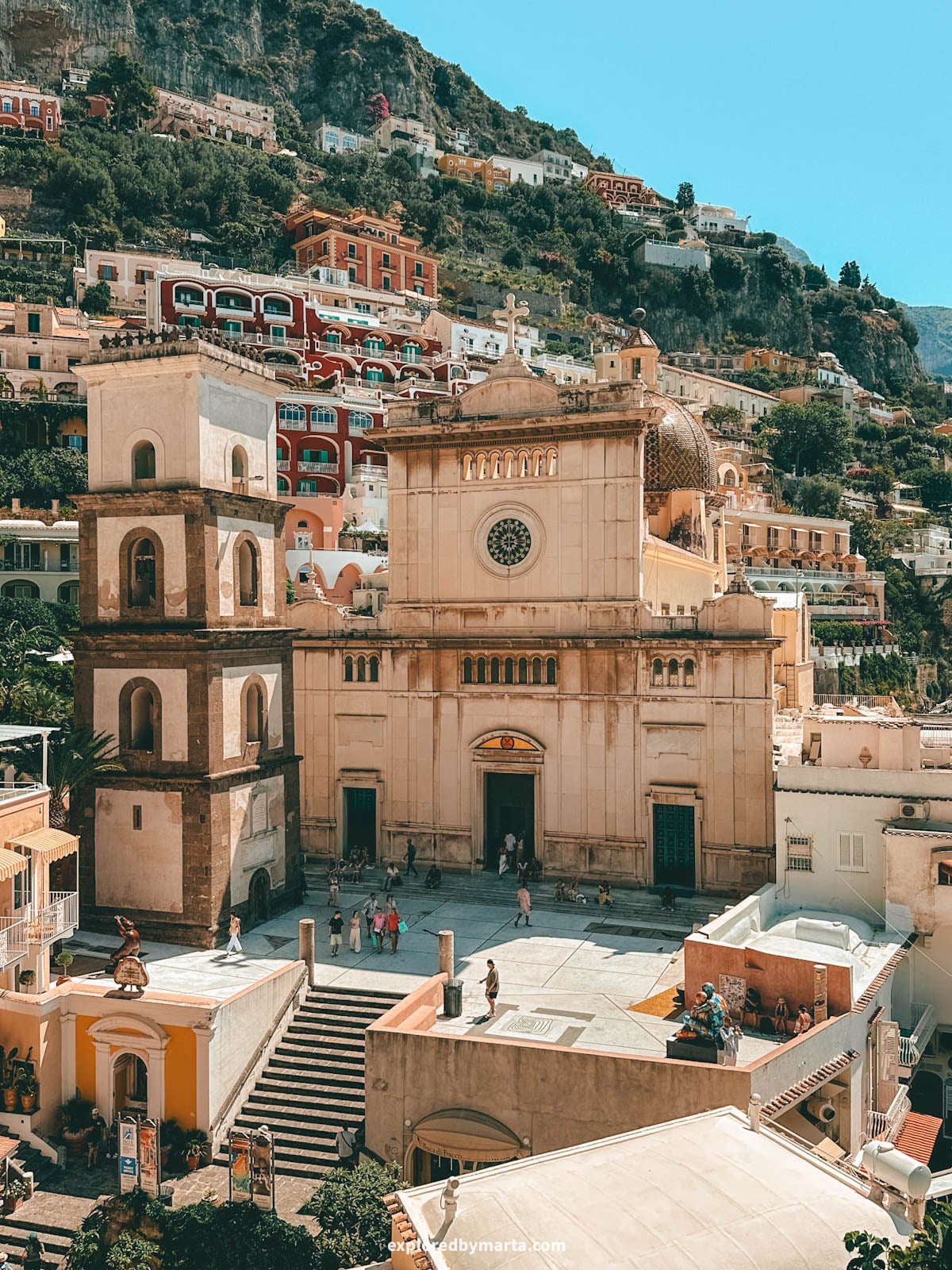
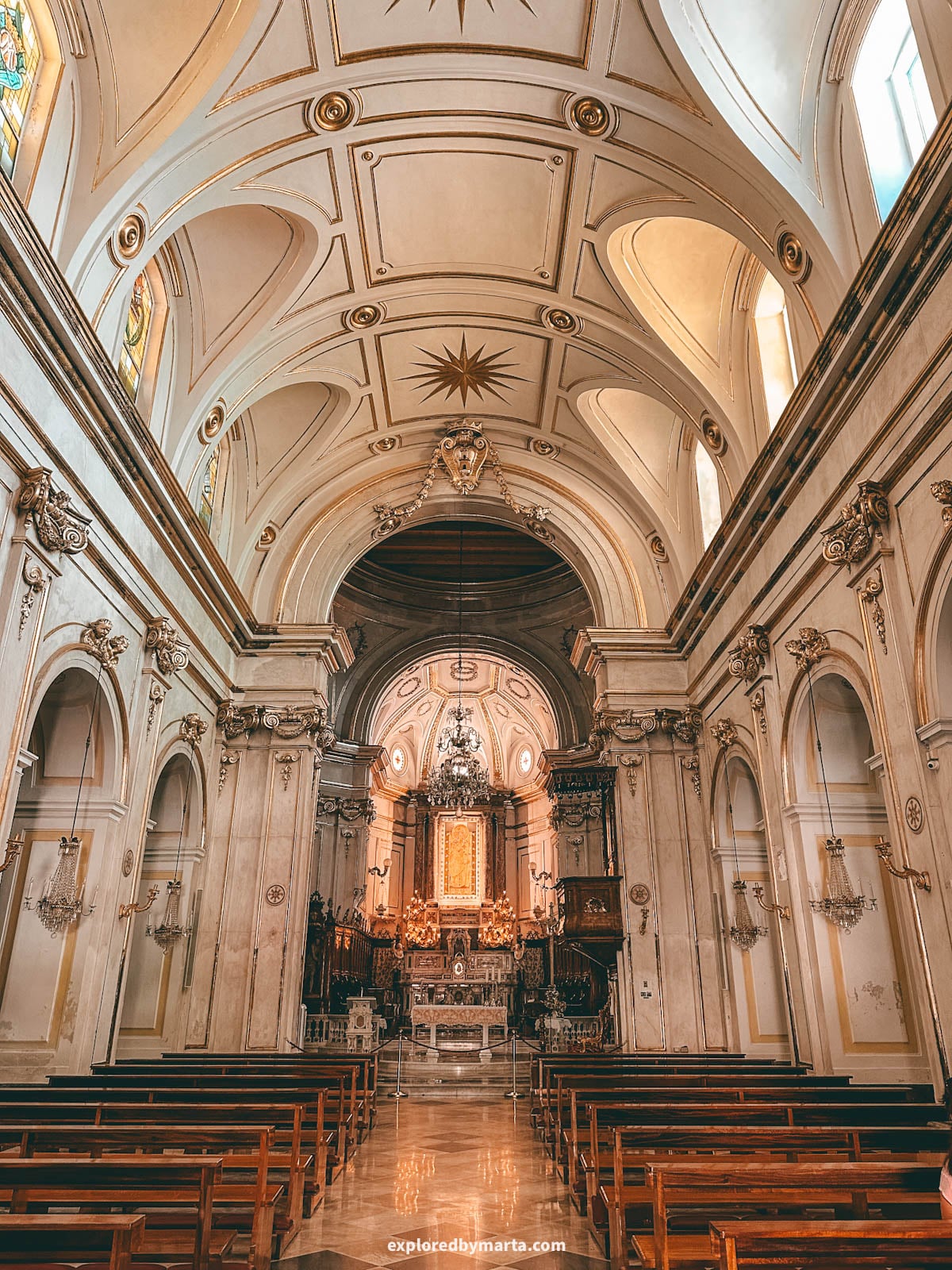
As you make your way through town, stop at the Church of Santa Maria Assunta.
This is Positano’s main church and one of the town’s most recognizable landmarks, especially because of that colorful tiled dome you’ll see in all the classic photos.
The square around it is one of the liveliest little corners in Positano, full of people passing through or sitting down for a second. It’s a quick stop, but it gives a bit of history and context to all the beauty around you.
If you happen to go inside, you’ll find the famous Byzantine icon of the Black Madonna, which, according to legend, was brought here by sailors.
5. Walk through the town and shop along Via dei Mulini
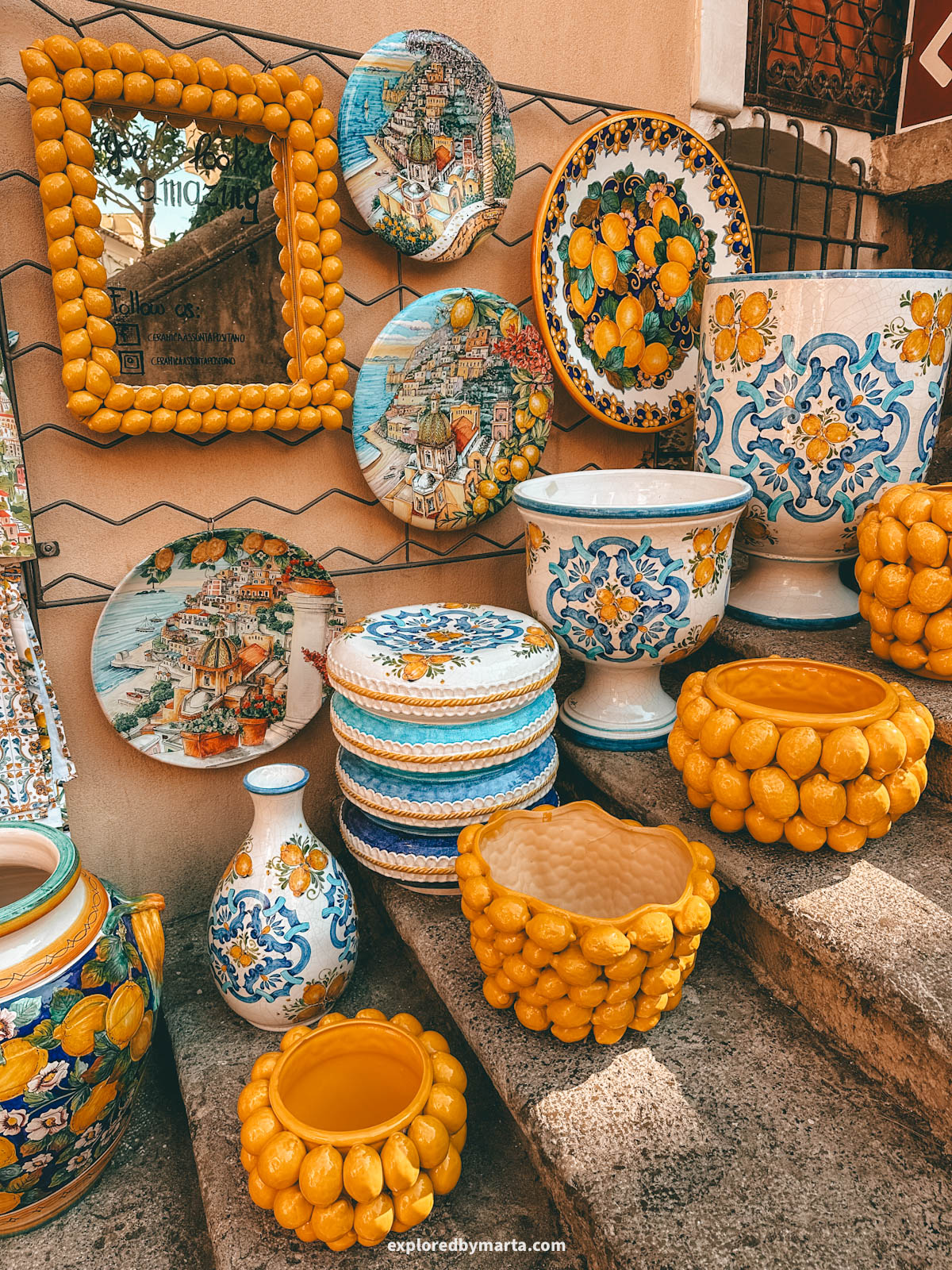
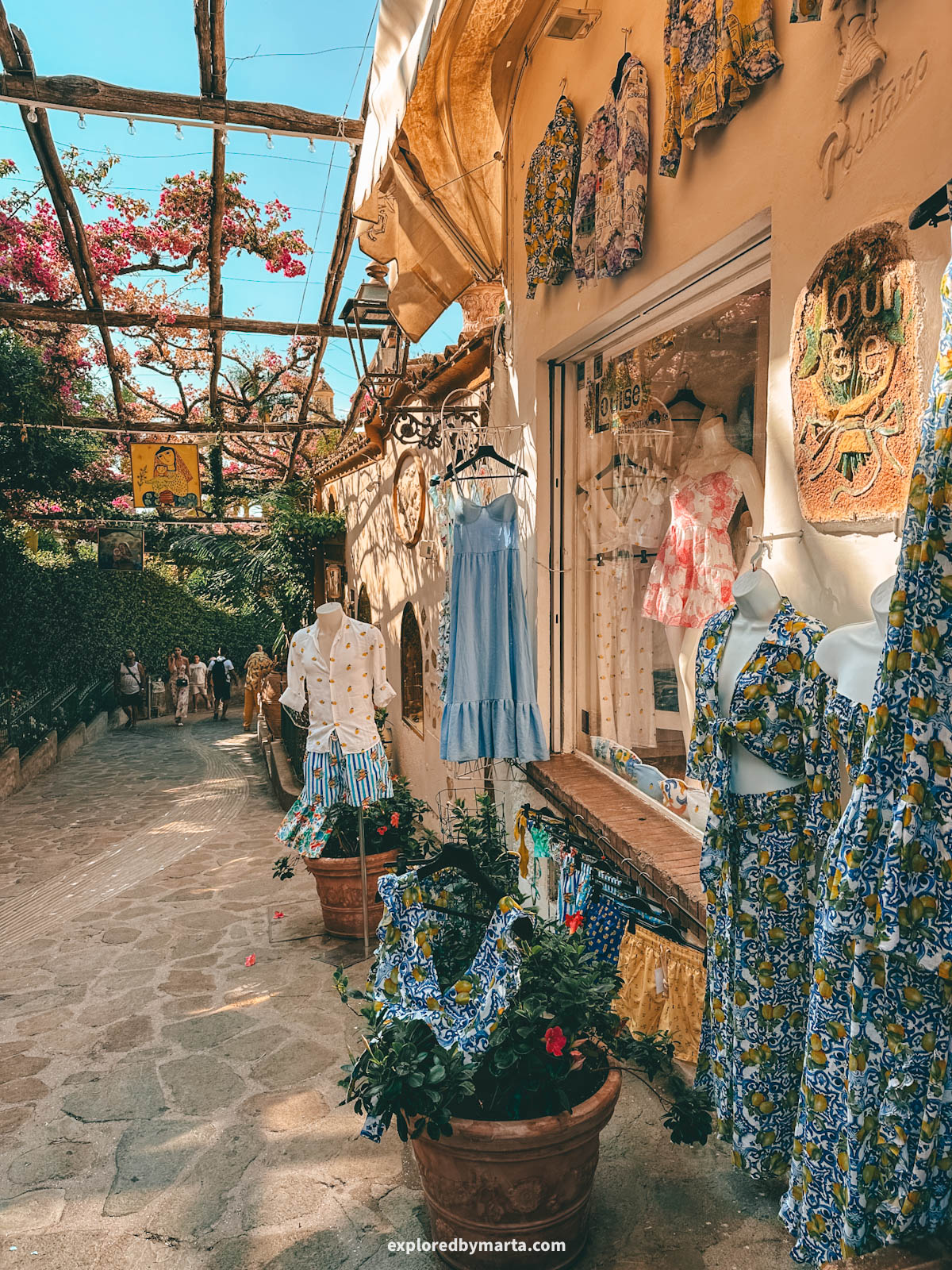
If you feel like shopping, head to Via dei Mulini, the main shopping street in Positano.
You’ll find linen clothes, sandals, ceramics, little boutiques, and all those Amalfi Coast-style pieces you’ve probably already seen a hundred times online. Positano is very good at making you want to buy things you did not plan to buy.
That said, it’s also one of the most expensive towns on the coast, so I’d treat this more as a “browse and maybe pick something special” kind of stop.
If you already bought ceramics or souvenirs in Amalfi, good. Your wallet will thank you 😅
6. Enjoy the iconic Spiaggia Grande
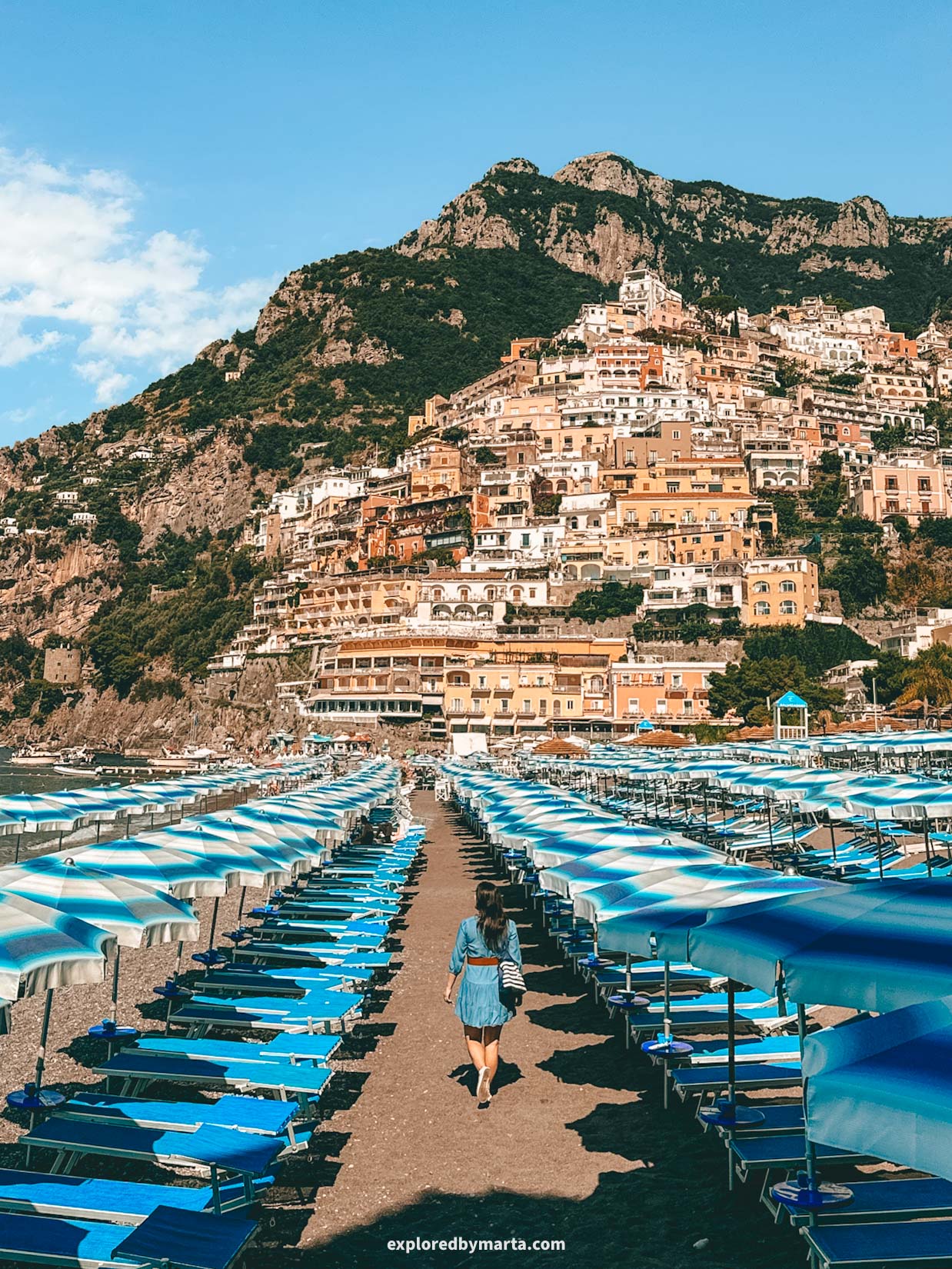
At some point, everything leads to the same place – Spiaggia Grande, Positano’s main beach.
This is the classic Positano scene – beach in front, colorful houses stacked behind, and mountains rising above. It’s busy, yes, but it’s also exactly what you came for.
You’ll also see the iconic dome of Santa Maria Assunta right by the beach and rows of umbrellas along the shore. It’s one of the most photographed spots on the Amalfi Coast, so this is definitely the moment for those classic Positano photos.
If you have time, grab a drink, sit by the water for a bit, or just take it all in before moving on. It really is one of those places worth slowing down for.
If you already had a beach moment in Maiori the day before, you don’t necessarily need to spend money on a beach setup here. But at the same time… this is Positano. If you feel like splurging a bit, this is kind of the place to do it.
7. Optional: walk over to Fornillo Beach
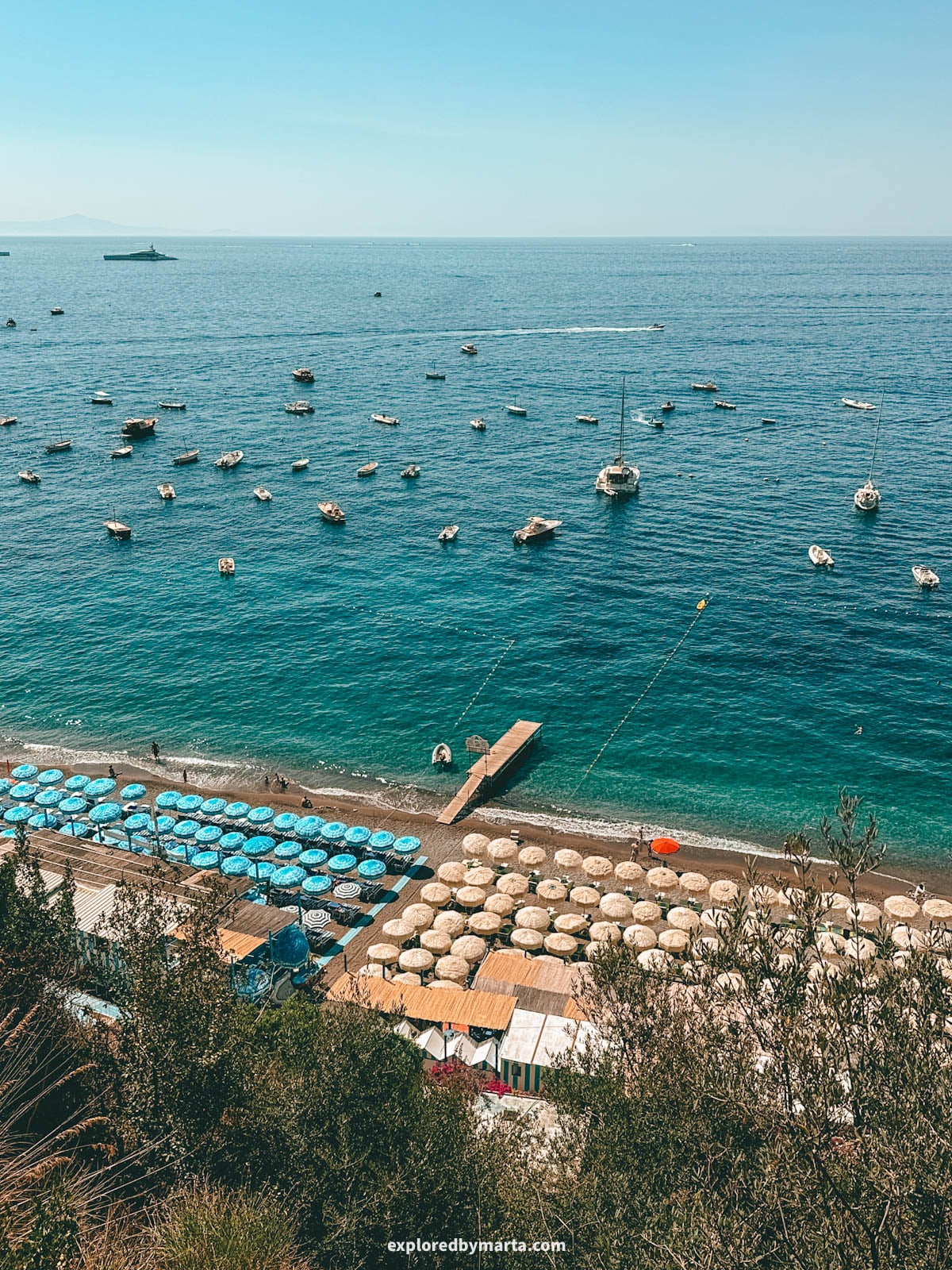
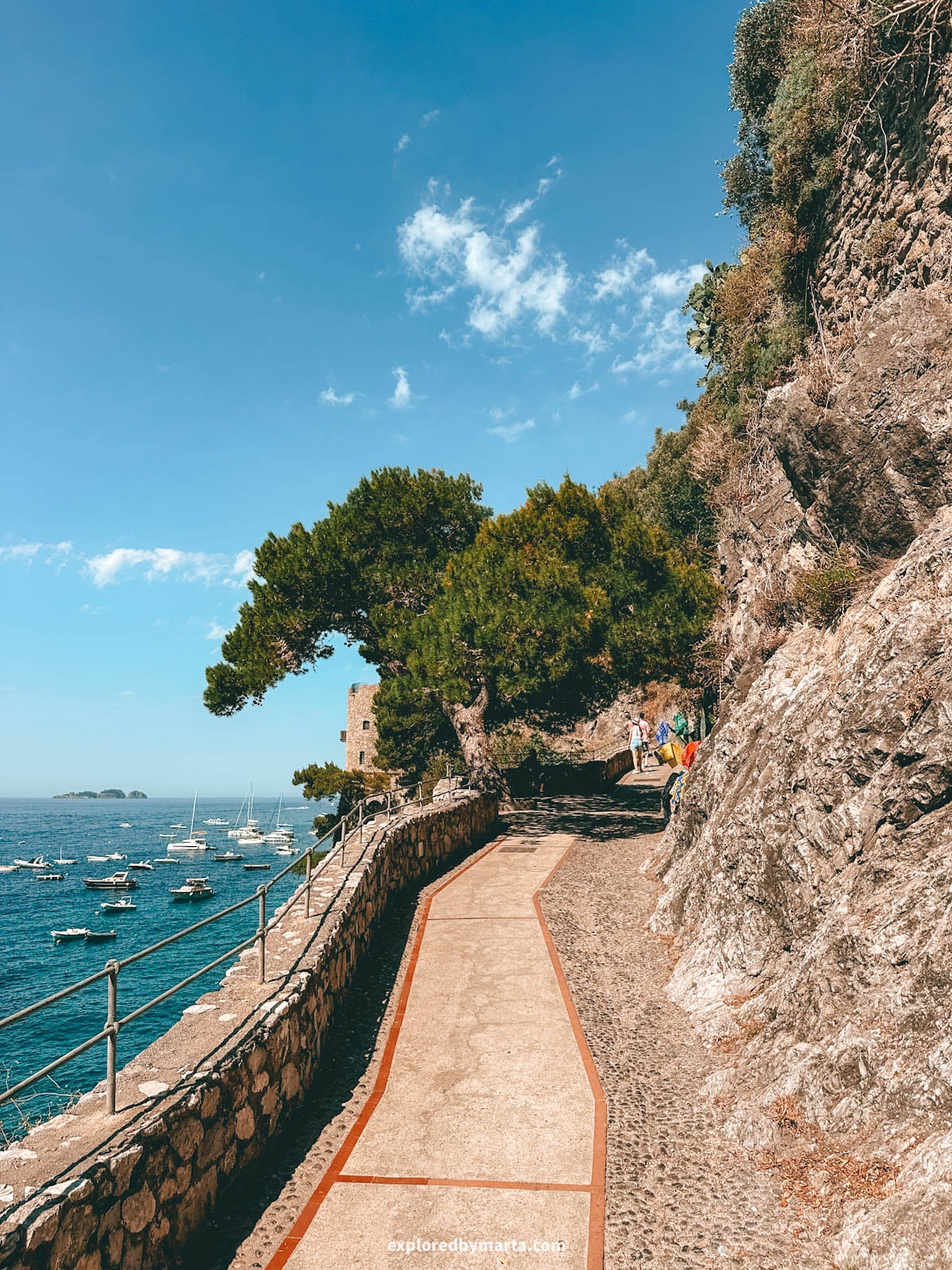
If you want a quieter moment, you can walk from Spiaggia Grande to Fornillo Beach.
Follow the coastal path, Via Positanesi d’America, on the right side of the beach if you’re facing the sea, and you’ll reach it in about 10 to 15 minutes. The walk itself is really nice, with a few viewpoints along the way.
Fornillo feels noticeably more relaxed than Spiaggia Grande. Fewer crowds, a bit more space, cheaper beach clubs, and less of that constant Positano buzz.
I’d say this is a great little escape if Positano starts to feel a bit too crowded – or if you just want to enjoy the seaside without all the chaos of the main beach.
8. Have lunch or dinner with a view
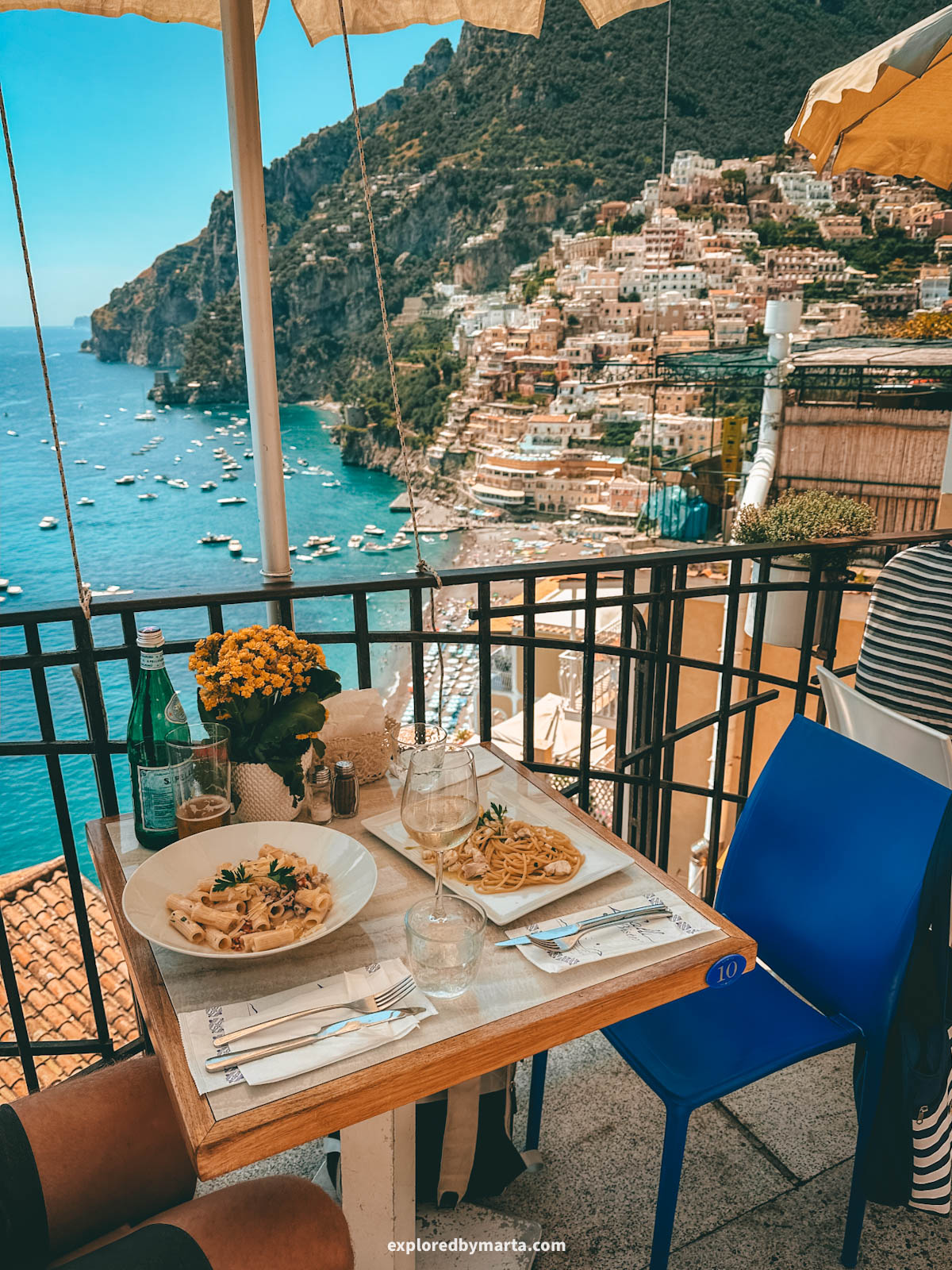
To finish the day, find a lunch or dinner restaurant with a view.
Positano is full of scenic restaurants, and this is one of those places where it’s actually worth choosing somewhere with a view.
Find a terrace overlooking the sea or the beach and just take your time – pasta, seafood, a drink… this is your “okay, this is why I came here” moment.
We ate at Li Galli Bistrot, a beautiful roadside place – nothing too polished, but the view is absolutely incredible. You’re sitting right above Positano with that classic layered view in front of you. Sometimes those simpler places really do end up being the best.
If you want something a bit more classic or more polished, you can also look at La Sponda at Le Sirenuse, Ristorante Don Giovanni, or Chez Black if you want to stay right by Spiaggia Grande.
And if you have the time, I’d really try to stay in Positano until sunset.
This is when the whole town starts to change. The light gets softer, the crowds slowly thin out, and those stacked houses begin to glow in that warm golden color. It’s honestly one of the prettiest moments of the day.
I think that’s the best way to end 3 days on the Amalfi Coast.
Tips and recommendations for visiting the Amalfi Coast
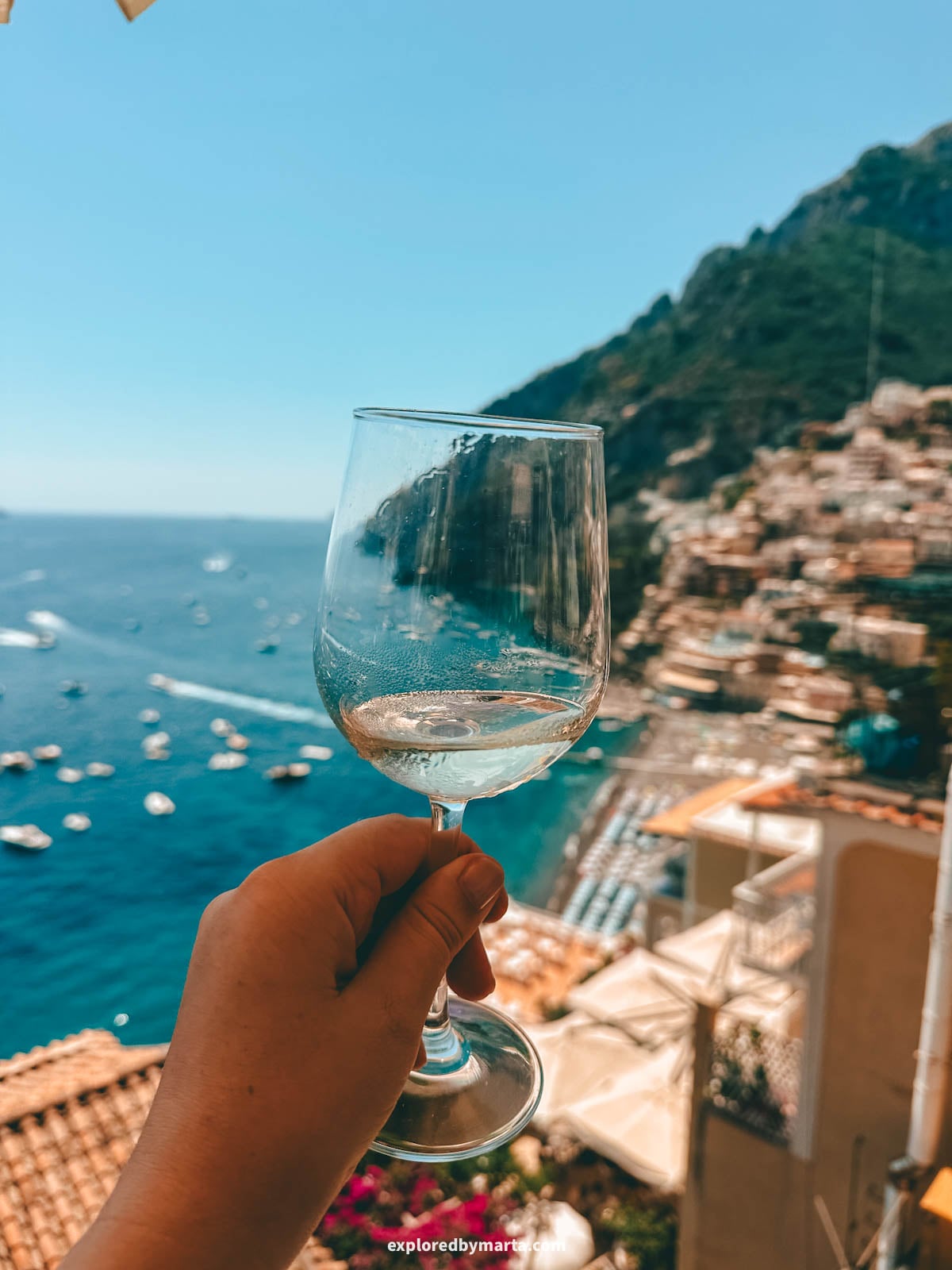
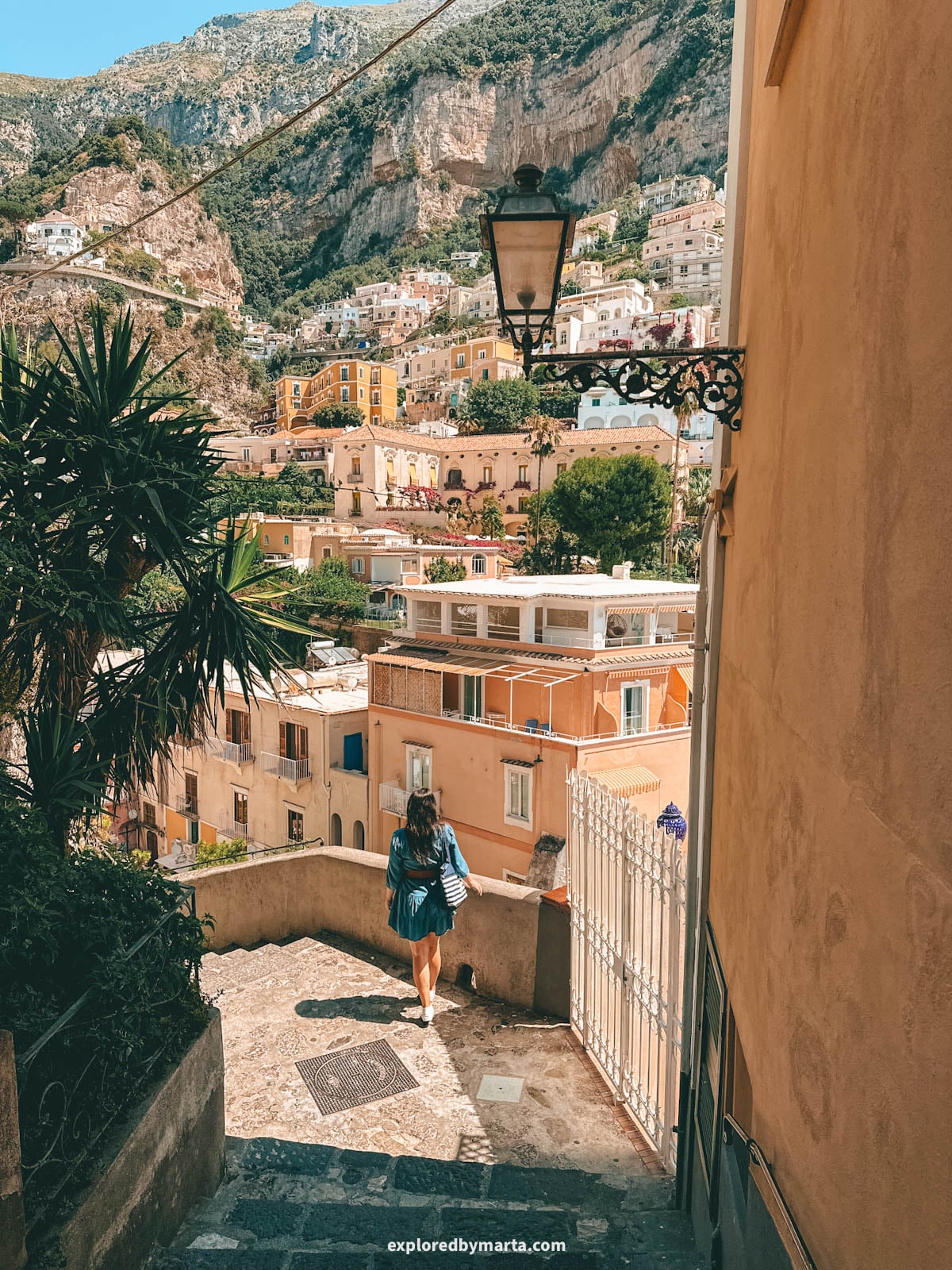
After spending quite a bit of time exploring the Amalfi Coast, there are a few things I’d definitely keep in mind when planning your trip. It can really make or break your experience.
Stay somewhere well-connected
This is important. If you want to explore the Amalfi Coast, it’s best to stay on the Amalfi Coast. Places like Amalfi or Maiori are great base options because they have better transport connections, which makes day-to-day travel much easier.
If you stay outside of the coastline, choose Sorrento or Salerno – they are the main gateways to the Amalfi Coast. However, travel times will be a bit longer.
My recommendation? Stay in Maiori.
Start your days early
This makes a huge difference. Places like Amalfi, Ravello, and especially Positano get very busy by late morning. Early mornings are quieter, cooler, and just a much better experience overall.
People always ask me how I manage to take photos without crowds. This is how.
Avoid driving, if possible
I know it sounds tempting, but honestly, I wouldn’t recommend it unless you’re very confident. Roads are narrow, traffic is intense, and parking is limited and expensive (Positano can go up to 10 EUR per hour).
At the same time, we explored almost everything by car. But we always arrived early in the morning, so we usually managed to find parking. We used the EasyPark app to pay for street parking.
One more thing to know – during high season, the Amalfi Coast has a “targa alterna” system, where cars are only allowed to drive the coastal road on certain days based on their license plate number.
So even if you rent a car, you might not be able to drive it every day (unless you visit during the off-season). Just another reason why I’d personally skip driving here and stick to buses, ferries, or taxis.
Another option is to rent a scooter – this rule doesn’t apply to them, and they are much easier to park.
Use buses, ferries, or taxis to get around
Getting around without a car is totally doable. Ferries are actually one of the nicest ways to travel here (plus the views are amazing), and public buses connect all the main towns and are a more affordable option.
Taxis are more expensive but offer more flexibility, especially if you’re short on time.
If I were you, I’d stay in one of the small towns on the Amalfi Coast (like Maiori), and get around everywhere by public buses. Except for day 3, when I would take a ferry to Positano, so that I can arrive there like a movie star, haha.
This way, you’d get a version of a boat trip along the Amalfi Coast – the views are the same from a ferry! Win-win!
Be prepared for a lot of stairs
This is the Amalfi Coast, after all. Towns are built vertically, so you’ll be walking up and down quite a bit. Comfortable shoes are a must. I wore my sneakers every day!
I’ve heard some people train for their European vacations. This might actually be a great idea. 😉
FAQ about visiting the Amalfi Coast in 3 days
Is 3 days enough for the Amalfi Coast?
Yes, 3 days is enough to see the highlights like Amalfi, Ravello, and Positano. If you want to explore all the main towns, 5 days would be even better.
Where should I stay for 3 days on the Amalfi Coast?
Amalfi or Maiori are great base options because they have better transport connections. If you stay outside the coast, Sorrento or Salerno are the most convenient, but have longer traveling times.
What is the best way to get around the Amalfi Coast?
Buses, ferries, and taxis are the easiest options. Driving is possible but can be stressful due to narrow roads, traffic, and limited and expensive parking.
Is it better to visit Positano or Amalfi?
Both are worth visiting. Positano is known for its iconic views, but it is more expensive, while Amalfi is more practical and better connected.
When is the best time to visit the Amalfi Coast?
Late spring (May, June) and early fall (September) are ideal. Summer has the best weather but also the biggest crowds.
Read more about traveling on the Amalfi Coast

And that’s what I’d do if I had 3 days on the Amalfi Coast.
It’s a mix of the must-see places like Amalfi, Ravello, and Positano, but also those little moments in between – pastries in quiet squares, random viewpoints, lemon trees everywhere, and way too much good food.
I’ve packed this 3-day Amalfi Coast itinerary with lots of options, but you can always skip or change something and leave space for those small, unplanned moments – because those are usually the ones you remember the most.
Take your time, start your days early, and enjoy the journey!
More Amalfi Coast travel inspiration:
- 20 bucket list things to do on the Amalfi Coast, Italy
- 20 most iconic Instagram spots on the Amalfi Coast, Italy
- 30 best places to visit on the Amalfi Coast, Italy
- Guide to 10 must-visit villages on the Amalfi Coast, Italy
- 19 unique hidden gems on the Amalfi Coast, Italy
- 21 traditional must-try foods on the Amalfi Coast, Italy
- 10 beautiful hikes on the Amalfi Coast, Italy (& nearby!)
Town travel guides:
- Sorrento: Guide to Sorrento: 25 best things to do in Sorrento, Italy
- Amalfi: 21 best things to do in Amalfi Town on Italy’s Amalfi Coast
- Praiano: Guide to Praiano: 15 things to do in Praiano, Amalfi Coast
- Ravello: Romantic Ravello: 10 ultimate things to do in Ravello, Italy
- Atrani: 15 things to do in Atrani, the jewel of Italy’s Amalfi Coast
- Maiori: Majestic Maiori: 12 top things to do in Maiori, Italy
- Minori: Mesmerizing Minori: 10 best things to do in Minori, Italy
- Cetara: 13 best things to do in Cetara on Italy’s Amalfi Coast
- Vietri sul Mare: 12 top things to do in Vietri sul Mare, Italy’s Amalfi Coast
- Salerno: 15 best things to do in Salerno, gateway to the Amalfi Coast
PIN FOR LATER!