

Charming Pollença: 10 things to do in Pollença, Mallorca
This post may contain affiliate links. If you use these links to make a purchase or booking, I may earn a small commission at no extra cost to you! Thank you for your support!
Pollença is one of the most charming towns in northern Mallorca, sitting just inland from the coast, between the Serra de Tramuntana mountains and Pollença Bay.
Honey-colored stone houses, narrow cobbled streets, a lively main square, and the famous 365 Calvari Steps – this is one of those Mallorcan towns where you can spend a slow half day and feel like you really got to know the place.
We’ve been to Mallorca about five times over the years, and visited Pollença a couple of times. I love that it has that perfect mix of history, atmosphere, and just enough things to do without feeling overwhelming.
It’s also one of the most popular day trips from Palma de Mallorca! In this guide, I’m sharing the best things to do in Pollença with photos, tips, and locations!
A few things to know about Pollença
Before we get into the list, here are a few things that are good to know about Pollença, especially if it’s your first time visiting.
Pollença and Port de Pollença are not the same place. This trips up a lot of first-time visitors. Pollença is the historic inland town with the Calvari Steps and the cobbled old town. Port de Pollença, or Port de Pollensa, is the coastal town about 6 km (3.7 miles) away.
Pollença is known as the “city of artists.” Turns out, in the early 20th century, a group of artists settled here, inspired by the light and the surrounding mountains. The artistic community has stayed strong ever since, and you’ll see galleries and craft shops all around the old town.
Pollença has a famous music festival! I later learned that Pollença hosts one of the most respected classical music festivals in Spain – the Festival de Pollença – running every summer since 1962. The concerts take place inside the cloister of the Sant Domingo convent!
Pollença is hugely popular with cyclists. Mallorca is one of Europe’s top road cycling destinations, and Pollença sits right at the foot of some of the most popular routes into the Tramuntana mountains. You’ll see cycling groups everywhere! It’s part of the atmosphere here.
So, what are the best things to do in Pollença?
1. Climb the famous 365 Calvari Steps
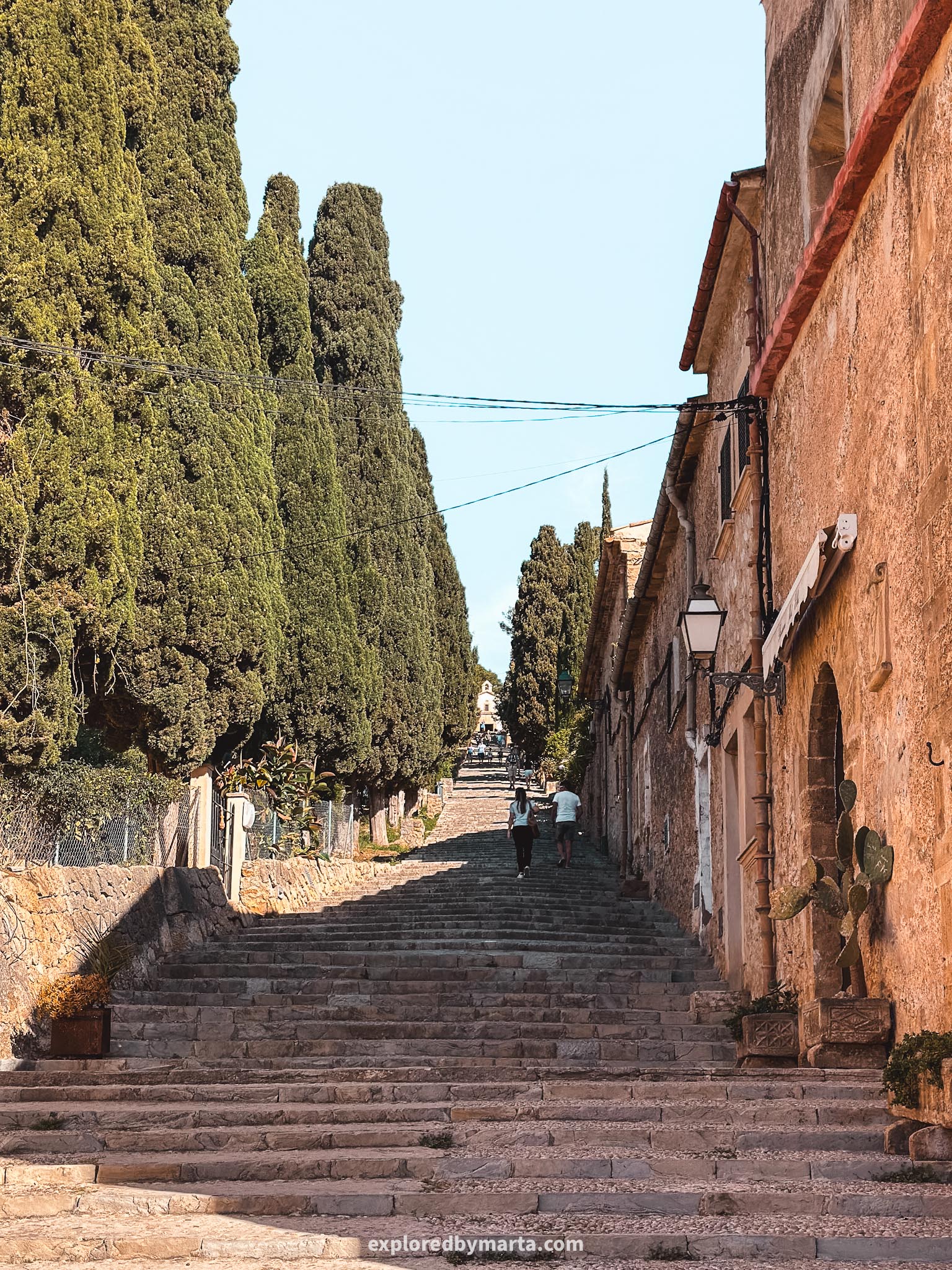

Climbing the 365 Calvari Steps, or Escala del Calvari, is the most iconic thing to do in Pollença.
The stone stairway has – you guessed it – 365 steps, symbolically representing each day of the year, and it leads from the heart of the old town up to a small 18th-century chapel on top of the hill.
Don’t let the number scare you off. The climb isn’t difficult – the steps are small and fairly flat, and most people in normal shape can do it without much trouble.
My honest tip? Stop often and turn around. With every few steps, the panorama over Pollença changes – you can see more rooftops, more church towers, more of the mountains.
So I basically climbed a bit, turned around, checked out the view, climbed a bit more, turned around again. It’s like the view rewards you the whole way up, not just at the top.


If you’re climbing in the middle of a summer day, it’s going to be a bit harder because of the heat. The good news is there’s a small café at the top where you can get a cold drink, and the small chapel itself is open, shaded, and a nice place to cool down for a few minutes.
And here’s a tip most people don’t do: don’t walk back down the same way. Walk over to the Mirador del Calvari viewpoint (next stop on this list), and then take the road down.
We did this and got a completely different set of views on the way down – this time facing toward the sea, Port de Pollença, and the Formentor peninsula. Maybe I even liked these open views better than the view from the stairs..? Hmm. I think so, yes.
Historically, the Calvari Steps were created as a pilgrimage route, but today they’re the most famous landmark of the town and one of the must-do things to do in Pollença.
Location: Calvari Steps
2. See Pollença from above at Mirador del Calvari
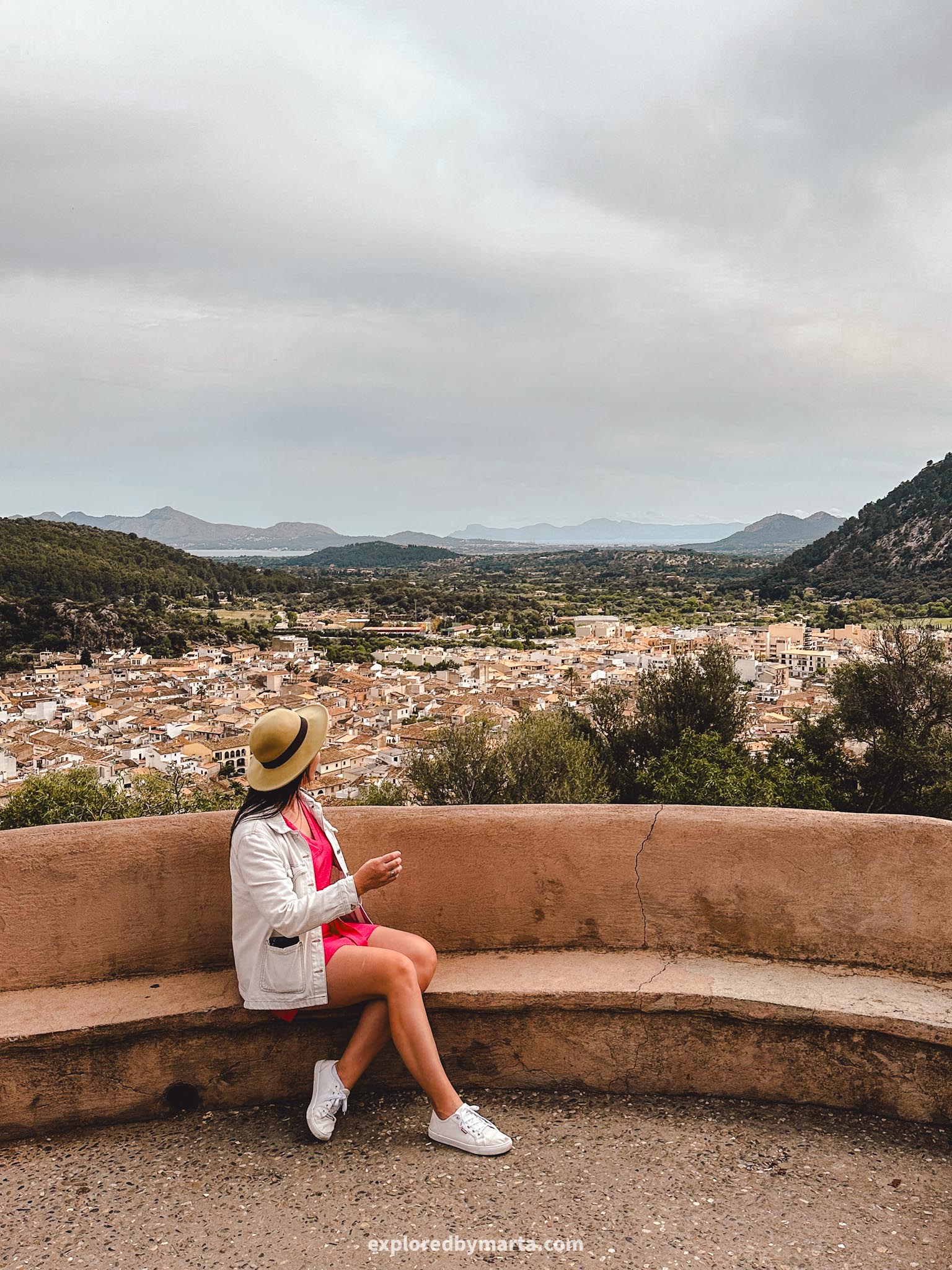
Once you reach the top of the Calvari Steps, the chapel is the obvious focal point, but, for me, the actual best view isn’t from there. It’s from Mirador del Calvari, a small viewing platform just a few steps away.
So don’t just climb back down, but walk down the road to this viewpoint instead.
While the view from the top of Calvari Steps is a bit limited, this viewpoint is where you get the spectacular panorama over Pollença, the surrounding countryside, and the entire Bay of Pollença – you can clearly see how Pollença sits in a valley between mountains!


You can also see a slice of Port de Pollença in the distance, and to the left, the long backbone of the Formentor peninsula stretching toward Cap de Formentor, the northernmost point of Mallorca, where you can see some of the best views in all of Mallorca.
A bit to the right of the town, you’ll spot a small pine-covered hill with a 14th-century sanctuary on top. That’s Puig de Pollença, also known as Puig de Maria, and climbing it is one of the most underrated things to do in Pollença – I’ve got it as the last stop on this list.
Location: Mirador del Calvari
3. Cross the ancient Roman Bridge of Pollença

If you really decide to walk down the road, you might as well do a small detour and visit the Roman Bridge of Pollença!
The Roman Bridge of Pollença, or Pont Romà, is a historic landmark on the edge of the old town. The bridge is believed to date back to Roman times, possibly around the 1st century AD, which makes it roughly 2,000 years old. Wild!!
The double-arched stone bridge crosses the Sant Jordi River, which was completely dry when we visited – apparently it usually is, except after heavy rainfall.
Visiting the bridge is a quick but worthwhile stop, especially if you’re into Roman history. It’s also right next to one of the parking lots where many travelers leave their cars, so maybe you’ll pass it anyway.
Location: Roman Bridge of Pollença
4. Try tapas and sangria at Plaça Major de Pollença

Sitting at a terrace on Plaça Major de Pollença with tapas and a drink is one of those quintessential Spanish experiences I never get tired of.
Plaça Major is the main square of Pollença, lined with cafés, restaurants, and bakery terraces, and dominated by the honey-colored façade of Santa Maria de Pollença Church.
We chose a spot at one of the restaurants with a clear view of the church and ordered a glass of tinto de verano (a lighter, more refreshing alternative to sangria) along with our usual tapas combo – patatas bravas and croquettes.
We order these basically every time we eat tapas anywhere in Spain, and they have yet to disappoint us. Close runners-up are grilled cheese and padrón peppers.


This time in Pollença, we also tried something more local – pa amb oli. It’s the Mallorcan version of the classic Spanish bread-and-tomato tapa, made with the dense local pa pagès bread, rubbed with tomato, olive oil, and a pinch of salt.
Anything with sobrasada (the local soft, spreadable cured sausage) is also a great regional choice – check out my full guide to traditional foods in Mallorca if you want to know what else to try.
What I love about eating at the main square is that there’s always something happening. Architecture to admire, kids playing, locals going about their day, other people slowly working through their lunch.
It’s the most Spanish thing you can do – sit down, order something, watch the town live around you.
One thing that surprised me is how popular Pollença is with cyclists. The square fills up with cycling groups in the morning, and you can hear them clack-clack-clacking across the cobblestones in their cycling shoes.
Many restaurants on the square even have bike racks set up because they get so many cycling customers. It’s part of Pollença’s character.
If you want a few more specific restaurants to consider beyond just picking whatever terrace looks nice, here are some well-rated places in Pollença:
- La Fonda de l’Aigua – elegant and well-reviewed for a slightly slower, sit-down meal
- Can 1907 Restaurant – in Plaça Major with a terrace on the square, Italian-Mallorcan, homemade pizzas and pasta
- Q11 Restaurant – also on Plaça Major, Italian-Mediterranean fusion, seasonal menu
- Restaurant Celler El Molí – traditional Mallorcan in a converted old mill
Fun fact! The famous English writer Agatha Christie spent time in nearby Port de Pollença and wrote her story Problem at Pollensa Bay while there. So if you’re a fan, you’ve technically followed her footsteps.
Location: Plaça Major de Pollença
5. Step inside Santa Maria de Pollença Church

While we were sitting on the terrace at Plaça Major having our tapas, the church bells were ringing every 15 minutes, which was very much the church saying “hello, please come look at me.”
So I gathered the church was inviting us in. 😅
To be honest, that was one of the best decisions of the day. Santa Maria de Pollença Church, also known as Església de Nostra Senyora dels Àngels, looks pretty modest from the outside.
Honey-colored stone, simple façade, nothing that suggests “wait until you see what’s inside.”


But then you step in, and the painted ceiling is one of the most beautiful church interiors I’ve seen in all of Mallorca. The frescoes covering the walls and the ceiling, the rose window above the entrance, the gold details – it’s so much more than the outside suggests.
I later learned that the church was originally founded by the Knights Templar in the 13th century, although it’s been rebuilt and expanded many times since then.
Entrance is free, but you can drop some money in one of their donation boxes. We visited on a Saturday morning shortly after it opened, and it was almost empty. Highly recommend popping in even if you “don’t usually do churches” – you really don’t want to miss the ceiling.
Location: Santa Maria de Pollença Church
6. Find the best ice cream in Pollença

After lunch, I did some quick research on my phone for the best ice cream in Pollença, and the answer was: Can Noble Gelats Artesans.
So obviously we had to go. 10/10 – exactly what you want after walking around a sun-soaked Mallorcan town in the middle of summer. I had to take photos quickly, because they were already melting away! 😅
The little shop is hidden away in one of the side streets just off the main square, and they make their ice cream in-house using local ingredients.
They have all the classics like strawberry and pistachio, but the more unique flavors are what stand out – rosemary honey, fig, almond. Sooo good. Honestly, this should be a non-negotiable stop in Pollença, especially if you visit in summer.
Location: Can Noble Gelats Artesans
7. Shop the streets at Pollença Sunday Market

If you happen to visit Pollença on a Sunday, you’ll get to experience the famous Pollença Sunday Market, one of the biggest and liveliest weekly markets on the island.
The whole heart of the old town fills up with stalls selling everything from fresh produce to handmade crafts. Obviously, we planned to come back to Pollença on Sunday for this!
Weekly markets are a big part of Mallorcan culture – every town has its own day, and locals genuinely shop at them, not just tourists.
If your trip lines up with Pollença’s Sunday market, it’s absolutely worth planning around. The market runs roughly from 8:00 AM to 1:30 PM, so go early to avoid the heat and the crowds.


You’ll find fresh fruits, vegetables, local cheeses, preserves, olive oil, sobrasada, handmade crafts, textiles, leather goods, and souvenirs. You don’t even need to buy a lot – just walking around checking out the stalls is so much fun, too!
We picked up caramelized almonds for my husband (a Mallorcan classic), a basket of fresh strawberries, and a couple of locally made dresses for me. It ended up being one of my favorite shopping moments of the trip.
If you’re looking for authentic Mallorcan souvenirs, this is one of the best places on the island to get them. Market hotspots in Pollenca are: Plaça Major, Plaça de Ca les Monnares, Via Pollentia, and Costa i Llobera Street. But, to be fair, it’s all over the town!
Location: Plaça Major
8. Visit the Pollença Museum inside a medieval convent


I’ll be honest – I’m not really a museum person. But the Museum of Pollença (Museu de Pollença) is housed inside the Convent de Sant Domingo, a former Dominican convent founded in the 16th century, and I love a beautiful old cloister, so this was a must for me.
And it was beautiful. The museum has multiple floors filled with art, a gorgeous cloister courtyard, and a church-turned-exhibition-hall with rotating temporary shows.
Besides, the entry to the museum is free!


There’s also a permanent collection covering archaeological artifacts from the area, alongside both local and international art.
Even as someone who’s not particularly into art, I found it interesting, and the beautiful inner courtyard alone is worth the visit for photos. I’d plan around 30 minutes for the whole visit, unless you’re super interested in art and want to explore everything.
If you have less than 30 minutes, at least peek inside the church-turned-exhibition-hall – it’s part of the same complex and, to me, was one of the most striking places we saw during the museum visit!
Location: Museum of Pollença
9. Find the Rooster Fountain, the symbol of Pollença

Did you know that Pollença has its own symbol, and it’s a rooster? Yes, a rooster. And the town has a dedicated Rooster Fountain (Font del Gall) hidden away on a small square called Plaça l’Almoina.
I learned that according to a legend, during medieval times, a rooster crowed loud enough to warn the people of Pollença about pirate attacks, giving them time to prepare and defend themselves.
Ever since, the rooster has been the symbol of the town, and you’ll notice it on flags, signs, and town decorations as you walk around.
The fountain itself is small and pretty easy to miss if you don’t know it’s there (or that it is a symbol of the town!). Locals say touching the rooster brings good luck and protection. It’s a quick stop, free, and a nice little hidden corner of the town.
Location: Font de la Plaça l’Almoina
10. Hike to the summit of Puig de Pollença (Puig de Maria)

This last one is for anyone who likes a short, rewarding hike. We came back to Pollença another time specifically to hike up Puig de Pollença, also known as Puig de Maria – the small pine-covered hill with a 14th-century sanctuary on top that I mentioned earlier.
And honestly, it’s one of my favorite short hikes in all of Mallorca.
The trail starts at the beginning of Cami d’es Puig road, where there are a few parking spots if you’re driving. The first part is a paved road, then it turns into a typical Mallorcan stone-laid path that climbs up to the top.
The path is easy to follow but pretty steep, and the stone-laid sections are hmmm, a bit challenging to walk on – they’re not technical, but they’re rough underfoot.


Definitely not suitable for cycling, and not the kind of path I’d do in flip-flops. Comfortable walking shoes will save you! We hiked all the way up and back down in about 1 hour total, so it’s not a long commitment.
And the view from the top is huuuuge – you can see well above the level of the Calvari Steps (see that white long line in the photo? That would be the steps!), with panoramic views over Pollença, the bay, and the surrounding mountains.
The hilltop sanctuary itself is a 14th-century Gothic stone structure that still functions as a site of pilgrimage. The best part for me was how quiet it was. Compared to the steady stream of people on the Calvari Steps, Puig de Pollença felt almost empty!
There were a few other hikers but nothing like the crowds in the town. It really is one of those places few people find, and the payoff is 1000% worth the climb. Perfect for a quick, rewarding workout if you want to add a bit of nature to your Pollença day.
Location: Puig de Pollença – Cami d’es Puig road
FAQ about visiting Pollença
Is Pollença worth visiting?
Yes, Pollença is absolutely worth visiting. It’s one of the most charming historic towns in northern Mallorca, with a beautiful old town, the iconic 365 Calvari Steps, a lively main square, and easy access to the Tramuntana mountains and Pollença Bay. It also makes for one of the most popular day trips from Palma de Mallorca. Half a day is enough to see the main sights.
How many days do you need in Pollença?
Half a day is enough to see the main things to do in Pollença – climbing the Calvari Steps, exploring the old town, visiting the church, and having tapas on the main square. If you want to add the Puig de Pollença hike or visit the Sunday market, plan for a full day. Some travelers also stay in or near Pollença for several days and use it as a base for exploring northern Mallorca, including Port de Pollença, Cap de Formentor, and Alcúdia.
What is the difference between Pollença and Port de Pollença?
Pollença is the historic inland town with the cobbled old town, the Calvari Steps, and the main square. Port de Pollença (also written as Port de Pollensa) is the coastal town about 6 km (3.7 miles) away, with the beach, marina, and most of the resort hotels. They are two separate places, both worth visiting, but if you want the historic Pollença experience, the inland town is the one you want.
How do you get to Pollença from Palma?
The easiest way to get from Palma to Pollença is by car – the drive takes about 50 minutes via the Ma-13 motorway. Buses also run between Palma and Pollença daily, but the journey is longer and less flexible. There is no train service to Pollença.
Is the Calvari Steps climb difficult?
No, the 365 Calvari Steps climb isn’t difficult. The steps are small and fairly flat, and most people in normal shape can do the climb without much trouble. It takes about 15 minutes to climb at a relaxed pace. The main challenge is the heat if you climb in the middle of a summer day.
When is the best time to visit Pollença?
The best time to visit Pollença is in spring (May to June) or autumn (September to October), when the weather is mild and there are fewer crowds. July and August are hot and busy, although the town comes alive with the famous Pollença Music Festival during this time. Winter is quieter but some restaurants and shops may have shorter opening hours.
Where do you park a car in Pollença?
The best spot is Carrer de Cecili Metel – there’s street parking along the road plus several large parking lots right next to it. From there, it’s a 5-minute walk to the main square. On the other side of town, Parking Pont Romà next to the old Roman Bridge is another but smaller option. Remember that Sundays are market days, and you should try to arrive early as spots fill up fast.
Read more about traveling in Mallorca
Pollença ended up being one of our favorite stops in all of northern Mallorca, and it’s the mix that does it – the history, the laid-back atmosphere, and how walkable everything is.
You can cover the main sights in half a day. The 365 Calvari Steps, the old town streets, the main square, the museum. None of it felt rushed.
But if you can, time your visit for a Sunday so you catch the market. And come early in the day or outside peak summer, when the streets are quieter and parking is far easier.
It also pairs really well with the rest of the north. Port de Pollença for the beach, Alcúdia for the old walls, or the drive up to Formentor Peninsula and Mirador Es Colomer if you have a car.
If you’re planning more of your Mallorca trip, here are some of my other Mallorca guides to help you plan:
More Mallorca travel inspiration:
- Mallorca bucket list: 23 best things to do in Mallorca, Spain
- 21 best places to visit in Mallorca, Spain
- 11 unique hidden gems in Mallorca, Spain
- 20 most iconic Instagram spots in Mallorca, Spain
- 12 most beautiful villages in Mallorca, Spain
- 13 best viewpoints in Mallorca, Spain
Guides to nearby towns:
- 10 top things to do in Alcúdia Old Town, Mallorca
- 13 best things to do in Valldemossa, Mallorca
- 13 ultimate best things to do in Sóller, Mallorca
- Enchanting Deià: 10 things to do in Deià, Mallorca
- Idyllic Fornalutx: 9 things to do in Fornalutx, Mallorca
More to explore in Mallorca:
- 13 things to do in Serra de Tramuntana mountains, Mallorca
- 16 most popular day trips from Palma de Mallorca, Spain
- 10 delicious traditional foods in Mallorca, Spain
- 6 most beautiful beaches in Mallorca, Spain
PIN FOR LATER!


